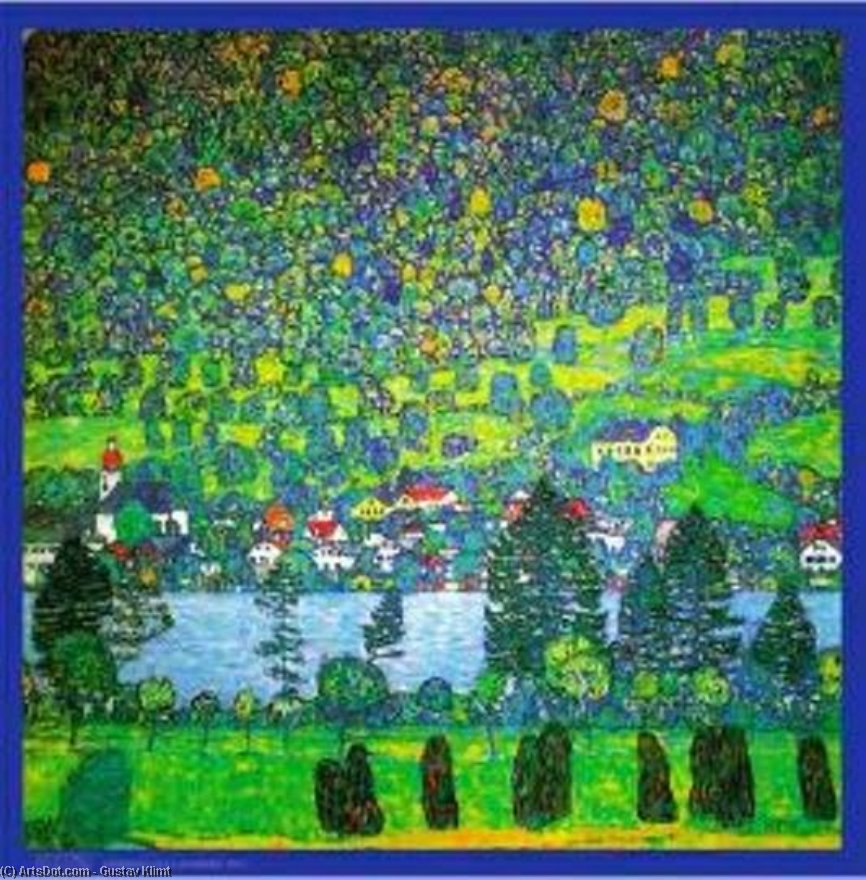
A Glimpse of Paradise: Gustav Klimt’s *Unterach Sulattersee*
Gustav Klimt's Unterach Sulattersee is not merely a landscape; it’s an evocation of a dreamlike state, a shimmering vision of Austrian countryside filtered through the lens of Art Nouveau and Symbolism. Painted sometime around 1916, this work captures the serene beauty of Unterach am See (Sulattersee), but transcends simple representation to become a testament to Klimt's unique decorative style. It’s a painting that invites contemplation, offering a respite from the everyday world into a realm of stylized harmony and tranquil beauty.
The Allure of Attersee: A Retreat and an Inspiration
The Lake Attersee region held a particular fascination for Klimt, becoming a frequent escape from the bustling city of Vienna. He first discovered its captivating shores in 1900, and returned almost every summer until 1916, finding solace and artistic rejuvenation amidst its turquoise waters and lush surroundings. Unlike his earlier, often grand-scale commissions, these landscapes were intensely personal explorations – paintings created for Klimt’s own satisfaction, free from the constraints of public expectation. This freedom allowed him to experiment with form and color in ways that pushed the boundaries of traditional landscape painting. Unterach Sulattersee exemplifies this shift; it's a distillation of his observations, not a literal depiction, but rather an emotional response rendered in vibrant hues and intricate patterns.
A Symphony of Color and Texture
Klimt’s technique in Unterach Sulattersee is instantly recognizable. He abandons traditional brushwork for a mosaic-like application of paint, building up layers of color in short, curved strokes that create a rich, tactile surface. The palette is dominated by greens and blues reflecting the lake and foliage, punctuated by touches of yellow, orange, and even hints of gold – a signature element often associated with Klimt’s “golden phase.” The use of metallic pigments isn't merely decorative; it imbues the scene with an ethereal quality, suggesting a radiant inner light. Lines are largely absent in the conventional sense, replaced by these dynamic patterns that define forms and create a unique visual rhythm. Trees become clusters of dots, foliage transforms into ornamental motifs, and the entire landscape seems to vibrate with life.
Beyond Representation: Symbolism and Emotional Resonance
While seemingly straightforward as a landscape, Unterach Sulattersee operates on a deeper symbolic level. Klimt wasn’t interested in photographic realism; he sought to capture the *essence* of a place, its emotional impact rather than its precise appearance. The stylized rendering of nature suggests an idealized vision, a harmonious world untouched by the anxieties of modern life. The absence of human figures further enhances this sense of tranquility and timelessness. It’s as if Klimt is presenting us with a pristine Eden, a sanctuary where beauty reigns supreme. This painting isn't just about what Klimt *saw* at Lake Attersee; it’s about what he *felt* – a profound connection to nature and a yearning for peace and harmony.