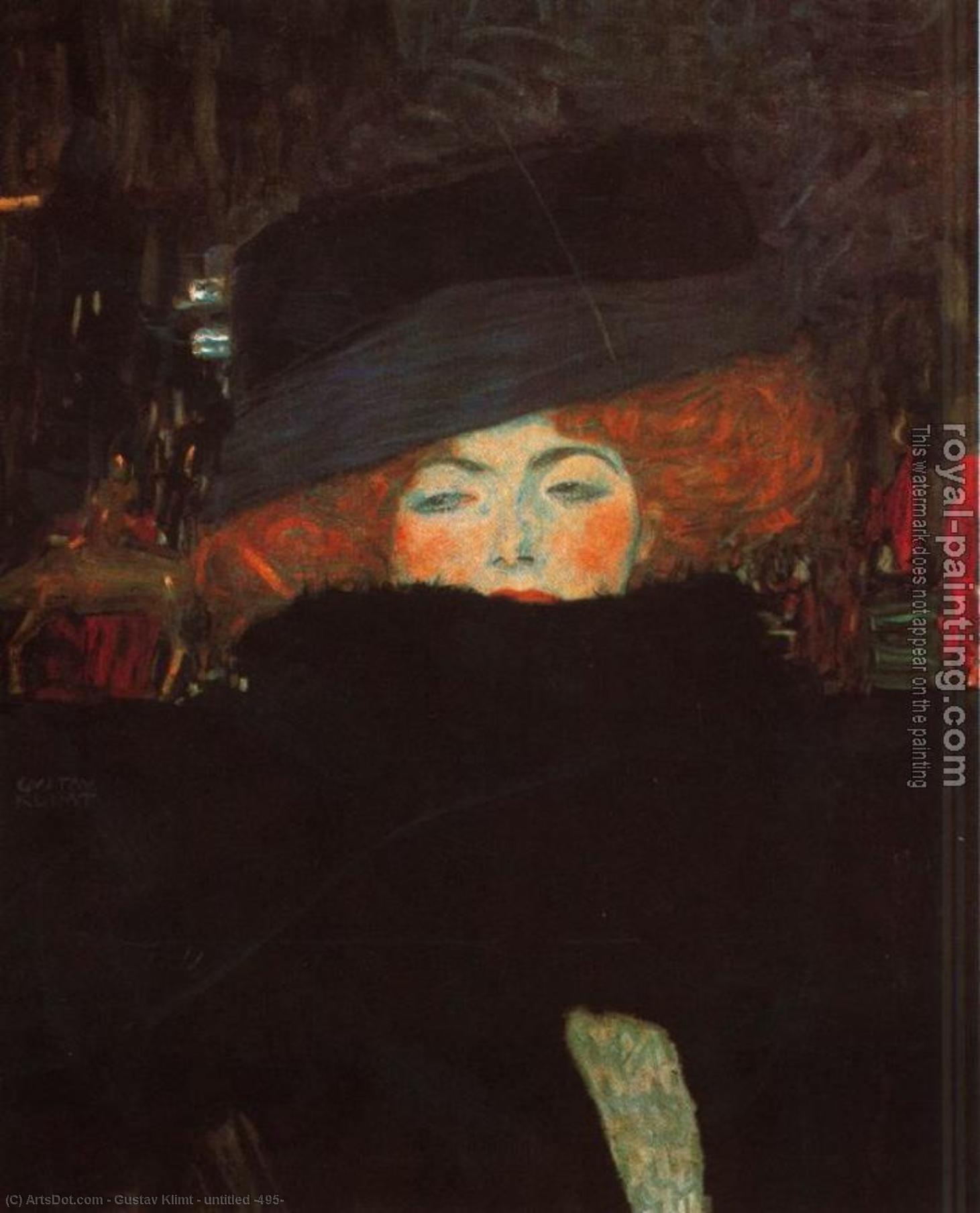
The Enigmatic Figure: An Introduction to Klimt's "Untitled (495)"
Gustav Klimt’s “Untitled (495),” a captivating portrait from the early 20th century, transcends mere representation; it’s an immersion into the opulent and often unsettling world of Viennese Symbolism. Born in Baumgarten, Austria, in 1862, Klimt was already a figure of considerable renown by the time this painting emerged – a master navigating the complex currents of artistic innovation and societal expectation. This particular work, dating from an unknown period within his prolific career, embodies many of the hallmarks that would define his ‘Golden Phase,’ yet retains a haunting ambiguity that continues to draw viewers in. The image presents a woman, her features partially obscured by a dramatic black hat adorned with vibrant red hair – a striking combination immediately arresting the eye. Her gaze is direct, almost challenging, as she raises her hand to her face, creating an immediate sense of intimacy and vulnerability. Beyond this central figure, a subtle backdrop hints at a gathering, figures receding into the distance, suggesting a private moment captured within a larger social scene – a detail that adds layers of intrigue to the composition.
A Symphony of Style: Art Nouveau’s Golden Embrace
Klimt's artistic language in “Untitled (495)” is deeply rooted in the principles of Art Nouveau, but he transcends simple imitation. The painting showcases a masterful manipulation of decorative elements, echoing the flowing lines and organic forms characteristic of the style. However, Klimt elevates these motifs through his distinctive use of gold leaf – a technique he would become synonymous with – transforming the canvas into a shimmering tapestry. This isn’t merely ornamentation; it's integral to the painting’s emotional impact. The gold acts as a visual metaphor for wealth, spirituality, and perhaps even decadence, reflecting the anxieties and aspirations of Vienna at the turn of the century. The brushwork itself is deliberately loose and expressive, contributing to the overall sense of movement and dynamism within the scene. Notice how Klimt employs short, broken strokes to define the woman’s hat and hair, contrasting them with smoother, more blended areas in the background – a technique that creates depth and visual interest.
Symbolism and Sensuality: Decoding the Portrait
The symbolism embedded within “Untitled (495)” is rich and open to interpretation. The woman’s pose—hand raised to her face—suggests introspection, perhaps even a touch of melancholy or hidden emotion. Her attire, though not explicitly detailed, hints at an aristocratic background – the quality of the fabrics and the overall composition evoke a sense of refined elegance. The red hair is particularly significant; in Klimt’s work, red often represents passion, vitality, and sometimes danger. The blurred figures in the background could symbolize the fleeting nature of social interactions or perhaps represent the woman's isolation within a larger world. Furthermore, the painting’s overall mood—a blend of beauty, mystery, and subtle unease—reflects the broader themes explored by Klimt: the tension between sexuality and morality, tradition and modernity, and the individual’s place in society. The work is not simply a portrait; it's an exploration of the human psyche.
A Legacy of Gold: Klimt’s Enduring Influence
“Untitled (495)” stands as a pivotal piece within Gustav Klimt’s oeuvre, representing a crucial transition in his artistic style. It foreshadows the lavish ornamentation and sensual themes that would define his most celebrated works, such as *The Kiss*. Klimt's innovative use of gold leaf revolutionized painting, influencing generations of artists and solidifying his place as one of the most important figures in modern art. Today, reproductions of this captivating portrait offer a window into the artistic genius of Gustav Klimt, allowing viewers to experience firsthand the power and beauty of Viennese Symbolism. ArtsDot offers meticulously crafted hand-painted reproductions that faithfully capture the original’s luminosity and emotional depth – bringing this iconic image to life in your home or studio.