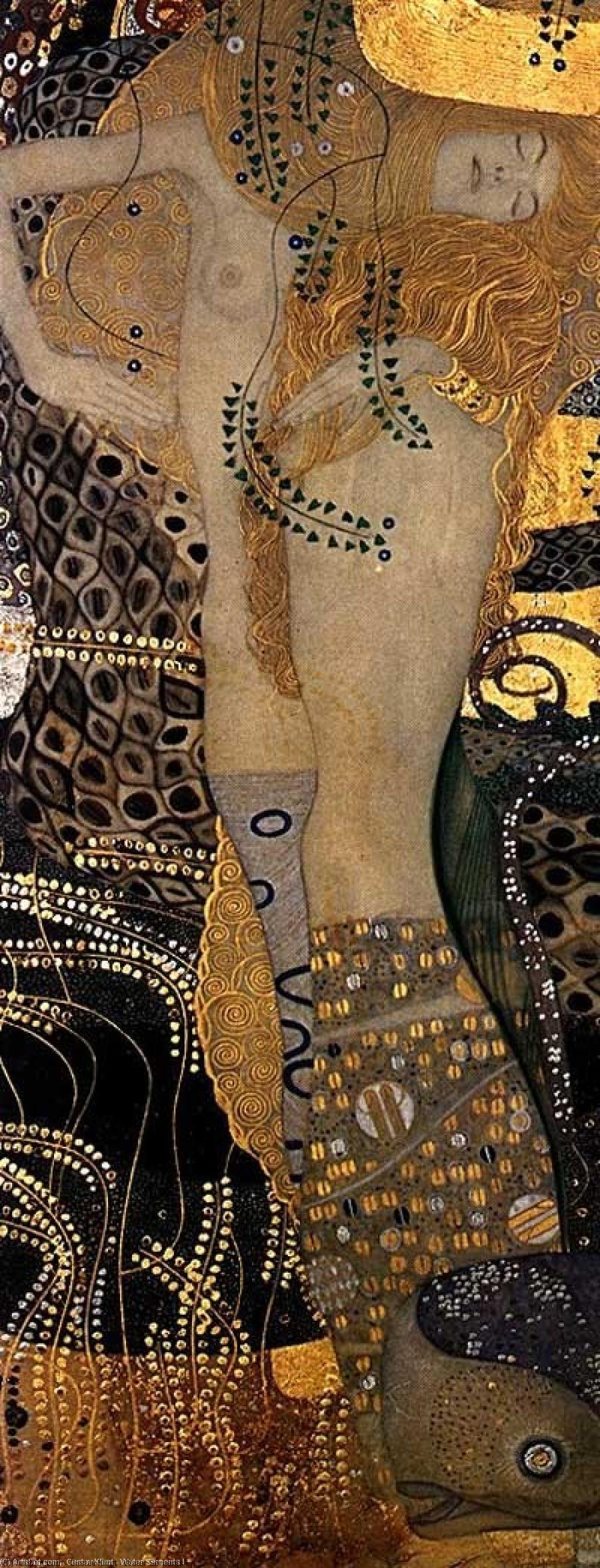
Gustav Klimt’s mesmerizing ‘Water Serpents I,’ a Symbolist masterpiece from 1904-1907, captivates with its opulent gold leaf and intertwined serpents—a testament to Art Nouveau's sensual beauty. Explore this iconic artwork at ArtsDot.com.
A Dance of Serpents and Gold: Exploring Gustav Klimt’s Water Serpents I
Gustav Klimt, born July 14, 1862, in Baumgarten near Vienna, emerged from a family marked by both artistic inclination and financial hardship. His father, Ernst Klimt, was a gold engraver—a profession that instilled in young Gustav an enduring fascination with the shimmering allure of gold leaf and the meticulous precision required to achieve its breathtaking beauty. Frequent relocations within Vienna shaped his formative years, fostering a keen observational eye and cultivating a sensitivity to human emotion – qualities that would become cornerstones of Klimt’s artistic vision. Already demonstrating exceptional drawing skills as a child, he pursued formal training at the Vienna Kunstgewerbeschule under Ferdinand Laufberger, gaining a foundational understanding of architectural painting alongside exposure to the dominant academic styles of his time.
- Style: Klimt's Water Serpents I exemplifies Art Nouveau’s opulent aesthetic, characterized by flowing lines, organic motifs, and decorative embellishments. It rejects rigid formalism in favor of sensual curves and intricate patterns—a deliberate departure from the austere conventions of earlier artistic movements.
- Technique: Employing oil paint on canvas, Klimt utilized a layering technique known as cloisonné enamel, incorporating gold leaf to create luminous surfaces and heighten textural richness. This painstaking process resulted in an image that radiates warmth and depth—a testament to Klimt’s mastery of artistic craft.
Historical Context: Vienna Secession and Artistic Rebellion
Created between 1904 and 1907, Water Serpents I arose from the crucible of Vienna Secession – a movement spearheaded by Klimt himself and fellow artists who challenged the conservative artistic establishment. Rejecting academic traditions, Secession championed individualism and experimentation, advocating for a bold new vision of art that prioritized emotional expression over mere imitation. This rebellious spirit permeated Klimt’s oeuvre, informing his exploration of themes related to mythology, sexuality, and spirituality.
Symbolism Unveiled: Serpents, Femininity, and Eternal Cycles
The painting's symbolism is rich and multilayered. The intertwined serpents represent duality—life and death, masculine and feminine—a recurring motif in Klimt’s work reflecting his interest in Jungian psychology. Surrounding a central female figure draped in flowing robes, the serpents symbolize fertility and regeneration, mirroring the cyclical nature of existence. The pervasive gold leaf serves as a visual metaphor for divinity and immortality, elevating the artwork beyond mere representation into a realm of spiritual contemplation.
Emotional Resonance: Capturing Beauty’s Fragility
Water Serpents I transcends its formal elements to evoke profound emotional resonance. Klimt's masterful manipulation of color—primarily browns, blacks, and shimmering gold—creates an atmosphere of mystery and enchantment. The painting invites viewers into a contemplative space where beauty is juxtaposed with vulnerability, prompting reflection on themes of desire, transformation, and the enduring power of artistic vision. It remains a captivating testament to Klimt’s genius and a cornerstone of Symbolist art.