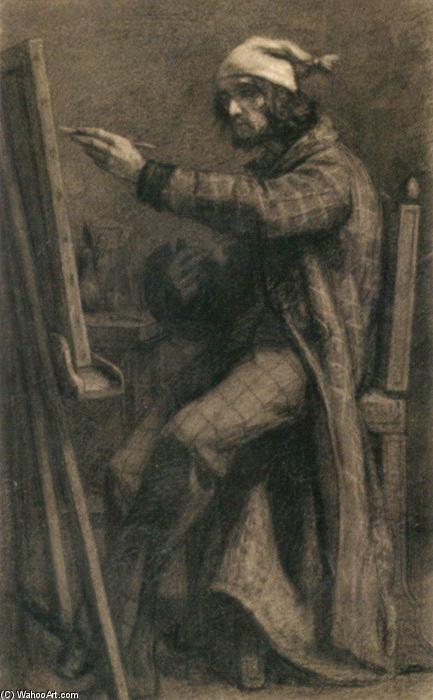
A Window into Artistic Labor: The Soul of Realism
In the mid-19th century, the Parisian art world was often a stage for the ethereal and the idealized, where Romanticism draped the canvas in soft light and heroic myth. Yet, standing defiantly against this tide of embellishment is Gustave Courbet’s "Artist at His Easel." Completed in 1847, this monumental work serves as much more than a simple portrait of a craftsman; it is a profound manifesto of the Realist movement. Through this canvas, Courbet invites us into the intimate, unvarnished sanctuary of the studio, stripping away the gilded illusions of his era to reveal the raw, tactile essence of creative labor. To gaze upon this piece is to witness the birth of a new way of seeing—one that finds dignity not in the divine, but in the tangible reality of the everyday.
The painting captures a moment of intense, solitary focus. The artist sits centrally, his presence grounding the composition with a heavy, physical weight. There is no theatrical drama here, only the quiet, rhythmic pulse of work. Courbet’s mastery lies in his ability to elevate the mundane; he renders the worn texture of a chair, the subtle sheen on a drinking cup, and the precise placement of brushes and pencils with an almost obsessive observational accuracy. This meticulous technique does not merely serve to show skill, but to reinforce his philosophical commitment: that art should mirror life without attempting to sanitize or romanticize it. For the collector or designer, this piece offers a sense of grounded permanence and intellectual depth.
Composition, Symbolism, and the Weight of Truth
The structural brilliance of "Artist at His Easel" lies in its deliberate use of space and shadow. The composition is anchored by the seated figure, flanked by chairs that create a sense of depth and perspective within the studio walls. This arrangement does more than organize the visual field; it symbolizes the artist's isolation and his intense connection to his craft. The muted backdrop acts as a stage for the interplay of light and shadow, drawing the eye toward the tools of the trade—the very instruments of his rebellion. Every element, from the heavy fabric of a garment to the way light catches a tool, is imbued with a sense of truth.
For those looking to integrate such a masterpiece into a curated space, the emotional impact of Courbet’s work is unparalleled. It brings an atmosphere of contemplative strength and authenticity to any room. Unlike decorative art that seeks only to please the eye, this painting demands engagement. It speaks of the grit, the sweat, and the profound dignity found in honest toil. Whether placed in a modern gallery-style living room or a classic study, a high-quality reproduction of this work serves as a powerful conversation piece, reminding all who view it of the beauty found in the unadorned truth of our existence.