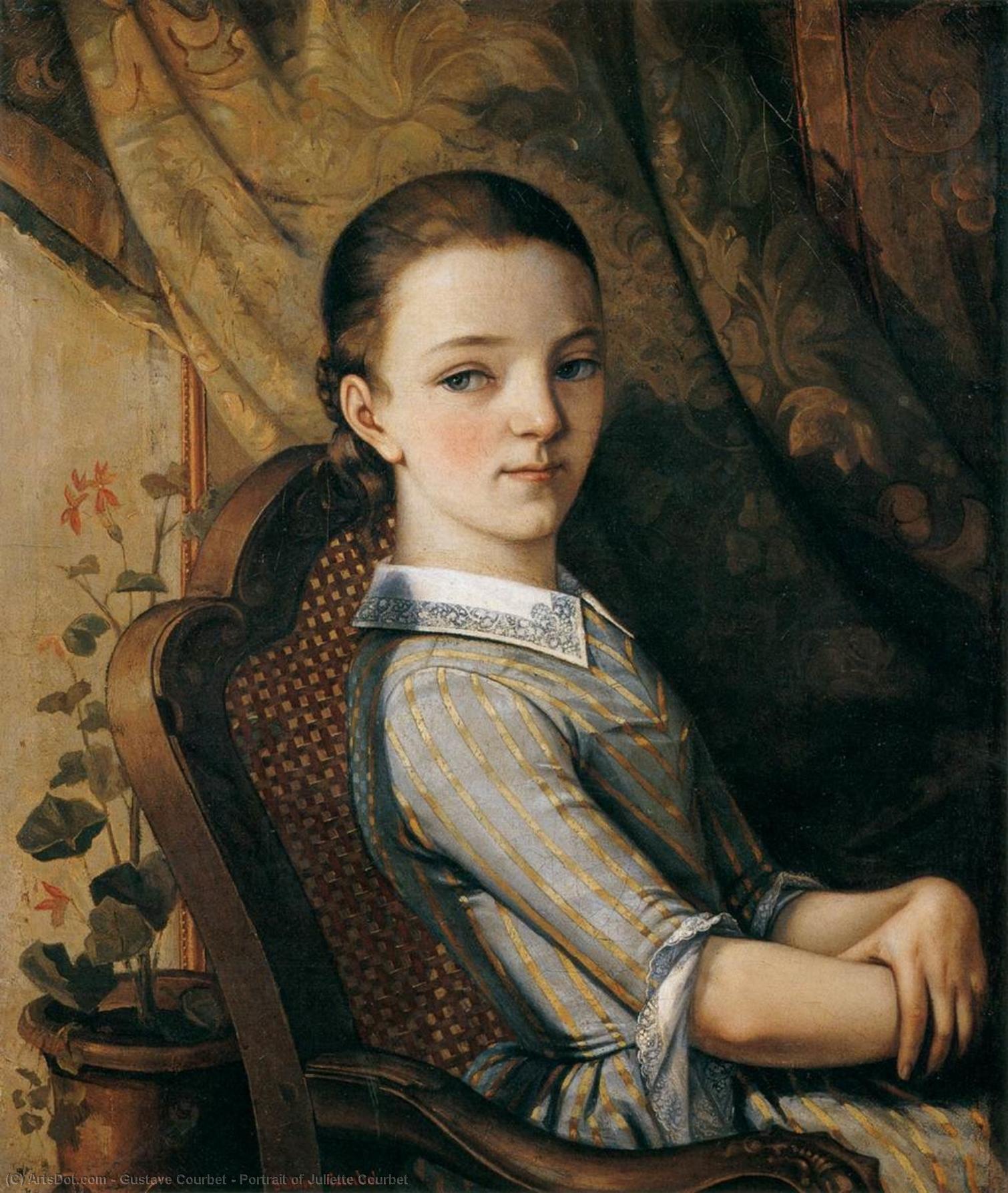
Portrait of Juliette Courbet
Gustave Courbet, a pioneering figure in the Realism movement, left an indelible mark on 19th-century French painting. His works, characterized by their unflinching portrayal of everyday life and rejection of traditional academic conventions, continue to captivate art enthusiasts worldwide. One such masterpiece is 'Portrait of Juliette Courbet,' a testament to his skill in capturing the essence of his subjects.
Artistic Context
Painted in 1844, ‘Portrait of Juliette Courbet’ showcases Courbet's early mastery of Realism. The subject, Juliette Courbet, is depicted with elegance and poise, her hands folded on her lap as she gazes directly at the viewer. The painting exudes a sense of harmony and balance, with the inclusion of a vase, another chair, and potted plants adding depth to the composition. These elements weren’t merely decorative; they served as anchors for Courbet's gaze, mirroring his intention to portray a scene of domestic tranquility—a deliberate contrast to the grand narratives favored by Romantic artists. The Salon of 1844 was dominated by idealized landscapes and mythological subjects, making Courbet’s decision to depict a simple interior with ordinary objects all the more revolutionary.
Artistic Style
Courbet's adherence to Realism is evident in his meticulous attention to detail and his commitment to depicting only what he could see. This approach set him apart from his contemporaries and influenced later movements such as Impressionism and Cubism. The 'Portrait of Juliette Courbet’ exemplifies this style, presenting a candid and unromanticized portrayal of the subject. He employed a technique known as *plein air*, or “open air,” though in this case it was executed indoors—a conscious choice to capture natural light and texture without resorting to artificial pigments. The subtle gradations of color achieved through layering thin glazes contribute to the painting’s luminous quality, reflecting Courbet's fascination with scientific observation.
Historical Significance
Gustave Courbet's contributions to French painting are monumental. His paintings challenged traditional norms by focusing on ordinary people and everyday scenes, often on a grand scale traditionally reserved for paintings of religious or historical subjects. This bold approach earned him recognition and paved the way for future generations of artists. He was a vocal critic of academic art institutions and championed artistic freedom—a stance that resonated with burgeoning intellectual currents of his time. The painting’s rejection by the Salon jury underscored the tensions between established artistic conventions and Courbet's uncompromising vision.
Relevance Today
The 'Portrait of Juliette Courbet’ remains a significant work in the history of art. It is housed at the Musée du Petit Palais in Paris, France, a museum renowned for its diverse collection of artworks. For those interested in exploring more of Courbet’s works and other masterpieces from various periods and styles, ArtsDot.com offers an extensive selection of handmade oil painting reproductions. Consider commissioning a faithful reproduction to bring this iconic image into your home—a tangible connection to the artistic spirit of the Belle Époque.
Gustave Courbet: Portrait of Juliette Courbet -
Gustave Courbet: Firemen Running to a Fire -
Gustave Courbet: Self-Portrait with Black Dog
Wikipedia: Gustave Courbet