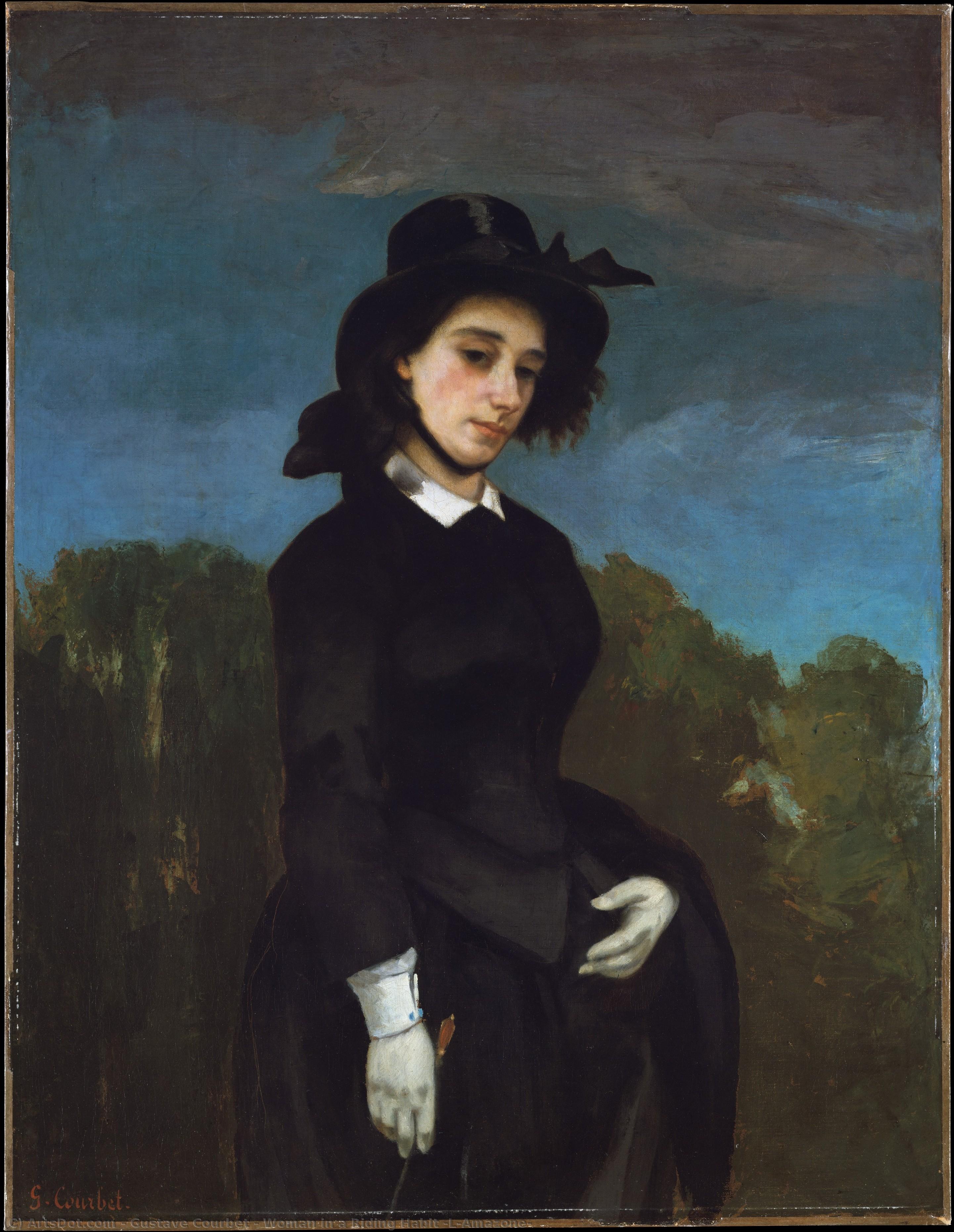
A Defiant Gaze: The Spirit of L'Amazone
In the grand tapestry of nineteenth-century French art, few images capture the tension between societal expectation and individual autonomy as poignantly as Gustave Courbet’s Woman in a Riding Habit (L'Amazone). Painted in 1856, this masterpiece is far more than a mere portrait; it is a profound statement of modern femininity. The subject, identified as the spirited Louise Colet, sits atop her horse with an air of quiet contemplation that belies the scandalous nature of her activity. At a time when women’s roles were strictly circumscribed by domesticity and decorum, the act of riding astride was viewed as a radical departure from tradition. Courbet captures this moment of subtle rebellion, presenting a figure who does not seek attention through grand gestures, but rather commands it through an unmistakable presence of inner strength and independence.
The emotional resonance of the painting lies in its ability to evoke both intimacy and distance. As the viewer encounters her downward gaze, there is a sense of being invited into a private, pensive moment, yet her posture remains resolute, almost defiant. For collectors and lovers of fine art, this piece offers a window into the soul of the Realist movement—a period where the grit and truth of life were prioritized over the polished illusions of Romanticism. It is an artwork that breathes with the vitality of a woman claiming her space in a world designed to limit her.
The Mastery of Realism and Texture
Technically, L'Amazone serves as a definitive exhibition of Courbet’s mastery over the medium of oil on canvas. Eschewing the ethereal, soft-focus techniques favored by his contemporaries, Courbet employed a robust and tactile approach to painting. He possessed an uncanny ability to render the physical world with such precision that one can almost feel the weight of the heavy black fabric of the riding habit and the smooth, muscular tension of the horse beneath it. His brushwork is deliberate and grounded, emphasizing the textures of nature—the lushness of the grass and the subtle play of light across the scene—to create a sense of absolute presence.
This commitment to Realism means that every detail serves the truth of the subject. There is no unnecessary embellishment; instead, Courbet uses light and shadow to sculpt form and depth. For an interior designer, this makes the piece an extraordinary focal point for a room. The painting’s rich, earthy palette and its balanced composition allow it to integrate seamlessly into both classical and contemporary settings. Whether placed in a sunlit library or a sophisticated modern study, a high-quality reproduction of this work brings with it a sense of historical weight and an undeniable aesthetic gravity.
A Legacy of Empowerment for the Modern Collector
To possess a reproduction of L'Amazone is to hold a piece of art history that continues to evolve in meaning. What was once viewed as a scandalous depiction of a woman breaking social taboos has become an enduring symbol of female empowerment. The painting’s historical context—rooted in the social upheavals of mid-19th century France—lends it a layer of intellectual depth that appeals to the discerning collector. It is a conversation starter, a work that invites scrutiny and reflection on the progress of human rights and the changing landscape of gender roles.
For those seeking to curate a collection that inspires strength and sophistication, Courbet’s work offers unparalleled value. The painting does not merely decorate a wall; it enriches the atmosphere of a home with its narrative complexity and artistic integrity. It stands as a testament to the power of art to challenge the status quo, making it an essential acquisition for anyone who appreciates art that is as intellectually stimulating as it is visually breathtaking.