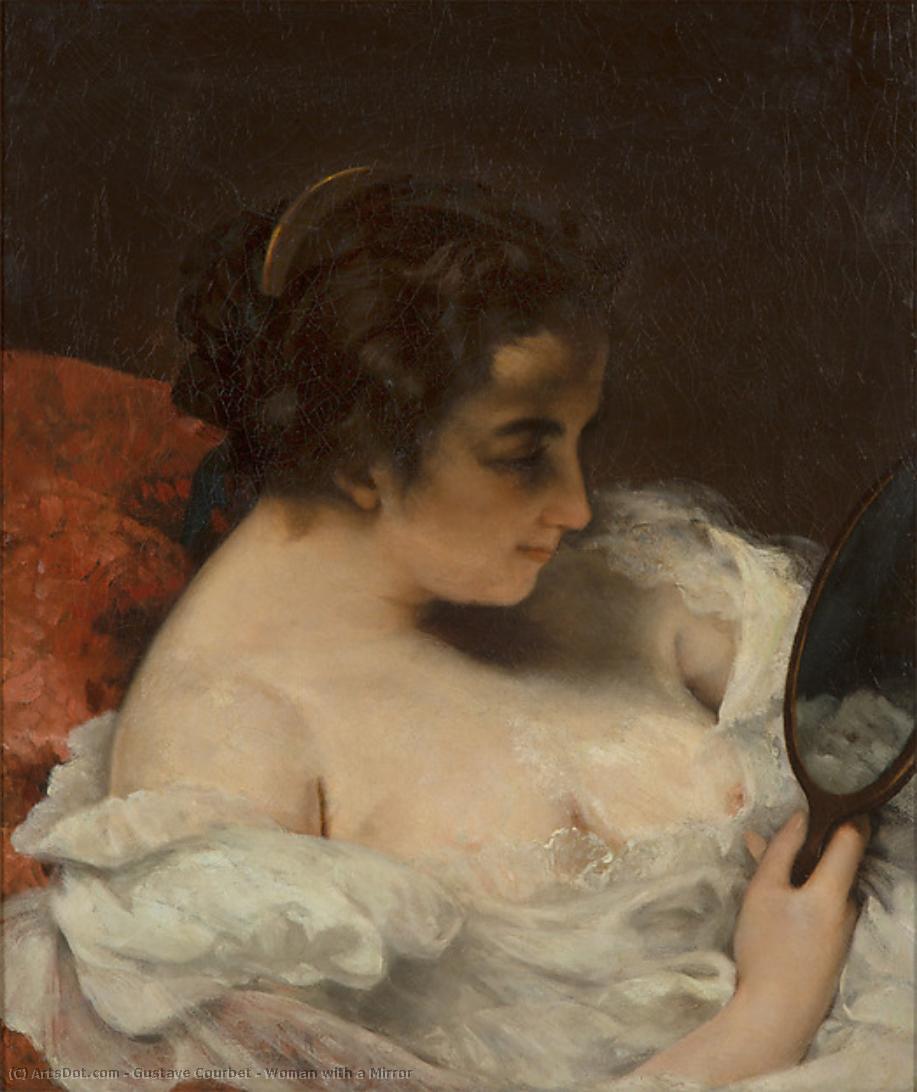
A Moment of Introspection: Courbet’s “Woman with a Mirror”
Gustave Courbet's "Woman with a Mirror," painted in 1860, is more than just a portrait; it’s a quietly revolutionary exploration of self-perception and the burgeoning anxieties of modern life. This intimate scene, rendered in a palette of earthy tones and subtle color shifts, captures a woman seated before a mirror, lost in contemplation. The painting immediately draws us into her private world, inviting us to consider not just what we see – a bourgeois woman dressed elegantly but with an air of vulnerability – but also the unspoken thoughts swirling within her gaze.
Courbet’s decision to depict this seemingly simple act—a woman examining her reflection—was profoundly significant for its time. Prior to this, self-portraiture was largely confined to religious iconography or aristocratic vanity. Courbet's work challenged this convention, elevating the ordinary subject of everyday life and imbuing it with a new level of psychological depth. The critic Théophile Thoré recognized this shift immediately, noting the “rare subtlety” of the color palette and suggesting a connection to the masters of the Italian Renaissance, particularly Correggio – a deliberate nod to the classical tradition while simultaneously rejecting its idealized forms.
The Language of Color and Form
Courbet’s technique is characterized by his meticulous observation and commitment to portraying reality without embellishment. He employed a *alla prima* approach—working directly onto the canvas with minimal underpainting—to achieve a remarkable sense of immediacy and texture. The brushstrokes are visible, lending a tactile quality to the fabric of her dress and the smooth surface of the mirror. The muted colors – ochres, browns, and subtle greens – create an atmosphere of quiet intimacy, while the careful modeling of light and shadow emphasizes the contours of the woman’s face and body. The mirror itself isn't rendered with photographic precision; instead, it reflects a slightly distorted version of reality, hinting at the subjective nature of perception.
- Color Palette: Earthy tones dominate, creating a sense of groundedness and realism.
- Brushwork: Visible, textured brushstrokes contribute to the painting’s immediacy.
- Light & Shadow: Carefully rendered to create volume and depth.
A Glimpse into 19th-Century Society
“Woman with a Mirror” is deeply rooted in the social and intellectual climate of mid-19th century France. The painting reflects the growing interest in psychology and introspection that characterized the era, fueled by figures like Jean-Jacques Rousseau and later, Sigmund Freud. The woman’s contemplative posture suggests a moment of self-reflection – perhaps questioning her place in society, grappling with personal desires, or simply contemplating the passage of time. The presence of the partially obscured figure in the background adds another layer of intrigue, hinting at a domestic scene and suggesting that this act of self-examination is taking place within a larger social context.
Furthermore, Courbet’s decision to depict a bourgeois woman engaging in such a private activity was itself a statement. It challenged the prevailing artistic conventions that typically focused on heroic subjects or grand historical events, shifting the focus to the everyday experiences of ordinary people. This marked a significant departure from the Romantic ideals of beauty and heroism, paving the way for Realism – Courbet’s own movement – which sought to depict the world as it truly was, without idealization.
Symbolic Resonance and Emotional Impact
The mirror serves as more than just a reflective surface; it functions as a potent symbol of self-awareness and the complexities of identity. It represents not only the woman’s physical appearance but also her inner thoughts and emotions. The act of looking into the mirror is an inherently vulnerable one, forcing us to confront our own imperfections and anxieties. “Woman with a Mirror” resonates with viewers on a deeply emotional level, prompting contemplation about the nature of self-perception and the search for meaning in a rapidly changing world. It’s a painting that invites us to pause, observe, and consider the quiet power of introspection.