A Reverie of Myth and Mortality: Exploring Gustave Moreau’s “A Dead Poet Being Carried by a Centaur”
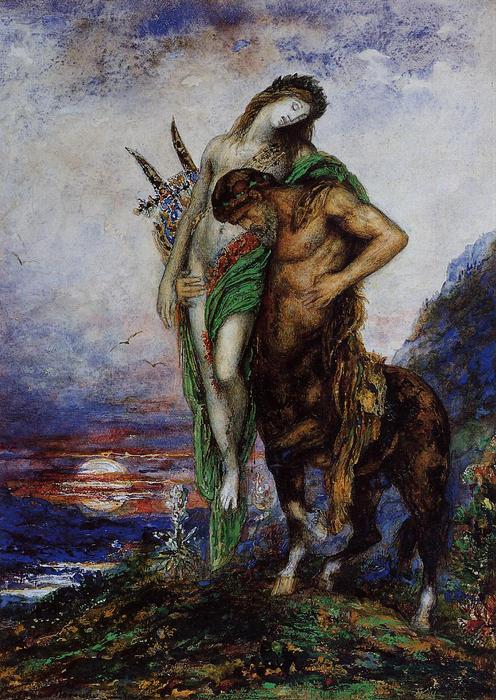
Moreau's "A Dead Poet Being Carried By A Centaur" isn’t merely a painting; it’s an immersion into the subconscious, a meticulously crafted tapestry woven from threads of mythology and profound contemplation. Painted around 1890, this monumental canvas embodies the core tenets of Symbolism—a movement that rejected literal representation in favor of conveying emotion and spiritual truth through suggestive imagery and evocative color palettes. It stands apart from its contemporaries like Monet or Renoir, prioritizing psychological depth over optical accuracy.
- Subject Matter & Narrative: The composition depicts a haunting tableau: a woman cradling the lifeless body of a poet on the back of a centaur—a creature blending human and animal characteristics—atop a horse. This narrative draws heavily upon classical mythology, specifically Euripides’ tragedy “Medea,” where Medea abandons her son to pursue vengeance against Jason. Moreau skillfully adapts this dramatic tale into an allegorical exploration of grief, loss, and the inescapable cycle of life and death.
- Style & Technique: Moreau's style is instantly recognizable for its opulent ornamentation and dreamlike atmosphere. He employed a technique known as cloisonné enamel—a painstaking process involving layering thin sheets of metal with enamel pigment—resulting in surfaces that shimmer with iridescent hues and possess an almost sculptural quality. This meticulous craftsmanship contributes significantly to the painting’s ethereal luminescence, enhancing its symbolic resonance.
Historical Context: The Rise of Symbolism
The Symbolist movement arose as a reaction against the materialism and scientific rationalism that dominated late 19th-century Europe. Artists like Moreau felt increasingly disillusioned with Impressionism’s focus on capturing fleeting sensations, arguing instead for art's capacity to access deeper realms of consciousness. Influenced by thinkers such as Nietzsche and Freud, Symbolists sought to express inner psychological states—desires, fears, anxieties—through symbolic imagery rather than direct depiction. The painting reflects this intellectual ferment, mirroring the broader preoccupation with mortality and the subconscious during a period marked by societal upheaval.
- Symbolism Unleashed: Moreau’s masterful use of symbolism elevates “A Dead Poet Being Carried By A Centaur” beyond mere visual spectacle. The woman represents mourning, while the centaur embodies primal instinct and the duality of human nature. The swords symbolize conflict—perhaps representing the poet's struggle against death itself or the broader battle between reason and emotion. Even the bird soaring above symbolizes hope amidst despair, offering a glimmer of transcendence.
- Color Palette & Texture: Moreau’s color palette is deliberately muted yet intensely expressive, dominated by shades of crimson, gold, and indigo—colors traditionally associated with passion, royalty, and spirituality. The cloisonné enamel technique creates a textured surface that reinforces the painting's dreamlike quality, inviting viewers to linger on its intricate details.
Emotional Impact & Legacy
“A Dead Poet Being Carried By A Centaur” continues to captivate audiences today with its haunting beauty and profound psychological complexity. Moreau’s ability to distill complex emotions into a single image speaks to the enduring fascination with themes of grief, mortality, and the human condition. It serves as a poignant reminder that art can transcend literal representation, accessing realms of feeling and thought that lie beneath the surface of everyday experience. Its influence extends beyond Symbolism itself, inspiring artists across genres who strive to convey similar levels of emotional depth and symbolic richness—a testament to Moreau’s enduring artistic vision.