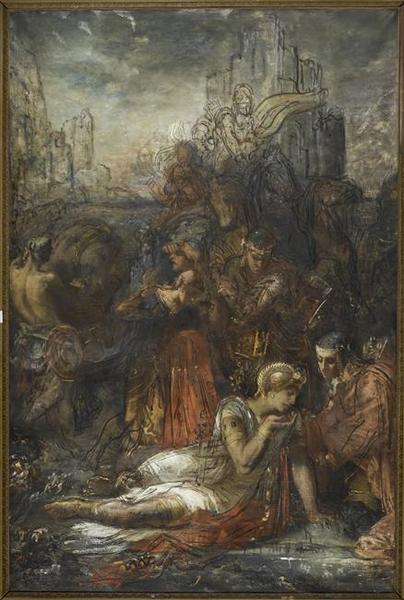
Darius, Fuyant après la Bataille d'Arbelles, s’arrête, épuisé de Fatigue, pour Boire dans une Mare – A Vision of Exhaustion and Symbolism
Gustave Moreau’s “Darius, fuyant après la bataille d’Arbelles, s’arrête, épuisé de fatigue, pour boire dans une mare” (Darius, fleeing after the Battle of Arbella, stops, exhausted from fatigue, to drink in a pond) is not merely a depiction of a historical event; it's a profound meditation on human vulnerability, spiritual exhaustion, and the enduring power of myth. Painted during the height of Symbolism’s influence in late 19th-century Paris, this large oil on canvas transcends a simple narrative scene, immersing the viewer in a world of potent symbolism and emotional resonance. Moreau, deeply influenced by the Romantic tradition and the esoteric currents of his time, sought to evoke not what he *saw*, but what he *felt* – a desire for transcendence that is powerfully conveyed through his masterful manipulation of color, form, and subject matter.
Subject and Composition: A Moment of Profound Distress
The painting centers around Darius, the Persian king, depicted in a state of utter collapse following the decisive Battle of Arbella (490 BC). Moreau doesn’t present a heroic victory; instead, he captures a moment of raw vulnerability. Darius is shown seated amidst a group of figures – likely his soldiers and attendants – all surrounding him with an almost devotional intensity. The composition itself is deliberately unsettling. The figures are arranged in a chaotic yet carefully constructed manner, mirroring the disarray of battle and the psychological turmoil experienced by Darius. The inclusion of two horses adds to the sense of instability and urgency, further emphasizing the scene’s dramatic tension.
Technique and Style: The Language of Symbolism
Moreau's technique is characterized by a meticulous attention to detail combined with an almost dreamlike quality. He employs rich, saturated colors – deep reds, blues, and golds – that contribute significantly to the painting’s emotional impact. His brushwork is often dense and layered, creating a sense of texture and depth. The figures are rendered with a classical grace, reminiscent of Renaissance masters, yet imbued with a distinctly Symbolist sensibility. Notice the almost sculpted quality of Darius's form, emphasizing his physical exhaustion and vulnerability. Moreau’s use of light is particularly effective, casting dramatic shadows that heighten the scene’s sense of mystery and foreboding.
Symbolism and Historical Context
The painting draws heavily on classical mythology and historical accounts to convey deeper symbolic meanings. Darius represents not just a military leader but also the burden of leadership, the consequences of conflict, and the inevitability of mortality. The act of drinking from a muddy pond – a symbol of purification and renewal – is presented as a desperate attempt to find solace in the face of overwhelming defeat. Moreau’s choice to depict this moment of exhaustion rather than a triumphant victory speaks volumes about his artistic concerns. It reflects the Symbolist movement's rejection of purely representational art, favoring instead works that explored subjective experience and universal themes. The painting aligns with the broader Symbolist interest in exploring psychological states and spiritual realities through evocative imagery.
Emotional Impact and Artistic Legacy
"Darius, fuyant après la bataille d’Arbelles…" is a profoundly moving work that continues to resonate with viewers today. Moreau's ability to capture the essence of human suffering and vulnerability elevates this historical scene into something far greater than a mere illustration. It invites contemplation on themes of power, loss, and the enduring struggle for meaning in a chaotic world. As a key figure in the Symbolist movement, Moreau’s influence can be seen in the works of many subsequent artists, cementing his place as one of the most important and evocative painters of the 19th century.