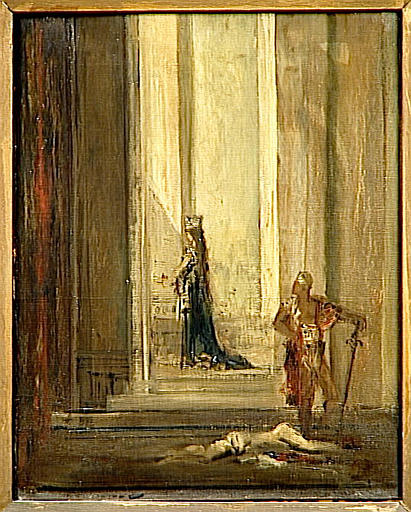
A Descent Into Darkness: The Haunting Vision of Gustave Moreau
In the twilight of the nineteenth century, as the world outside accelerated through industrial progress and scientific discovery, Gustave Moreau retreated into the labyrinthine corridors of the human psyche. His masterpiece, Décollation de Jean Baptiste, stands as a profound testament to this inward journey. Painted circa 1895, this work is far more than a mere depiction of a biblical execution; it is an excavation of the subconscious, a confrontation with mortality rendered in an exquisitely unsettling monochrome. The scene captures the gruesome moment of Saint John the Baptist’s decapitation, yet Moreau deliberately eschews the visceral gore of realism in favor of a much deeper, more ambiguous visual language. He invites the viewer not to witness a crime, but to contemplate the heavy silence that follows the end of life.
The atmosphere of the painting is thick with a dreamlike distortion that anticipates the Surrealist movement by decades. Moving away from the naturalistic light and fleeting moments celebrated by his Impressionist contemporaries, Moreau employs a technique of meticulous detail layered with fantastical, almost ghostly, ambiguity. Through the masterful use of oil on canvas and painstaking glazing, he achieves an astonishing depth and luminosity that seems to glow from within the shadows. His brushstrokes are controlled and deliberate, creating textures that suggest both the solidity of flesh and the fluidity of a fading memory. By avoiding sharp, clinical outlines and favoring soft, hazy edges, Moreau ensures that the boundaries between the physical world and the spiritual realm remain perpetually blurred.
Symbolism and the Weight of History
To understand this work is to understand the heart of the Symbolist movement. Emerging during the Belle Époque, Symbolism was a reactionary force against the materialism of the age, seeking refuge in mythology, folklore, and religious iconography to express profound spiritual anxieties. In Décollation de Jean Baptiste, every shadow serves as a vessel for meaning. The monochrome palette strips away the distractions of color, forcing the eye to focus on the raw emotional weight of the composition. The stark contrast between light and dark mirrors the eternal struggle between earthly desire and divine judgment, a central theme in Moreau’s oeuvre.
For the discerning collector or interior designer, this piece offers an unparalleled opportunity to introduce a sense of intellectual depth and dramatic tension into a space. It is a work that demands attention and rewards slow, meditative observation. The painting does not merely decorate a wall; it anchors a room with its gravity and mystery. Whether placed in a quiet study or a grand gallery, Moreau’s vision provides a focal point of profound emotional resonance, making it an exquisite choice for those who seek art that speaks to the complexities of the human condition and the enduring power of the unseen.