A Visionary Echo of Myth and Faith
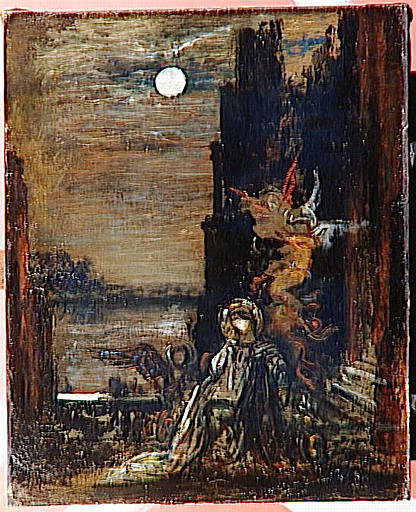
In the twilight of the nineteenth century, as the bustling streets of Paris vibrated with the energy of modernity, Gustave Moreau was busy weaving a different kind of reality—one composed of dreams, shadows, and the eternal. His masterpiece, Etude pour sainte Cécile, painted circa 1890, serves as a profound testament to the Symbolist movement's obsession with the psychological and the unseen. Unlike the Impressionists, who sought to capture the fleeting dance of light upon a surface, Moreau turned his gaze inward. This work is not merely a portrait of a saint; it is an attempt to distill the very essence of spiritual transcendence into visual form. To gaze upon this piece is to step away from the objective world and enter a realm where emotion takes precedence over observation, capturing not what the eye sees, but what the soul feels.
The composition itself is a haunting tapestry of the celestial and the terrestrial. At its heart stands Saint Cecilia, her form rendered with a quiet, monumental grace. She is surrounded by a swirling assembly of figures—angels and demons that seem to emerge from the very ether, blurring the lines between the divine and the macabre. The presence of birds and the subtle suggestion of a boat in the periphery add layers of narrative mystery, inviting the viewer to reconstruct a mythic landscape. This arrangement creates a sense of profound movement within a frozen moment, a characteristic much sought after by collectors who desire art that offers depth and continuous discovery.
The Alchemy of Colorlessness and Technique
One of the most striking features of this study is its deliberate departure from the vibrant, saturated palettes of contemporary trends. Moreau employs an almost monochromatic approach, utilizing sophisticated shades of grey punctuated only by the faintest whispers of ochre. This choice was far from accidental; it was a calculated symbolic act designed to strip away worldly distractions and focus the viewer's attention on the purity of form and light. The technique is nothing short of alchemical, reminiscent of the meticulous precision found in mezzotint engravings. By layering tonal gradations with painstaking care, Moreau achieves an astonishing level of textural richness and a luminous quality that seems to glow from within the canvas itself.
For the discerning interior designer or art enthusiast, this mastery of light and shadow offers unparalleled versatility. The artwork possesses a "haunting luminosity" that can anchor a room, providing a focal point that is both sophisticated and intellectually stimulating. The interplay of dark recesses and soft highlights creates a dramatic tension that breathes life into any space, making it an ideal centerpiece for collections focused on classical elegance or avant-garde mystery.
A Legacy of Symbolism and Spiritual Depth
To understand Etude pour sainte Cécile, one must understand the intellectual ferment of Moreau’s era. Influenced by the rising tides of Nietzschean philosophy and the sweeping, operatic grandeur of Wagner, Moreau sought to transform biblical narratives into vehicles for esoteric truth. He drew heavily from medieval mysticism and the intricate imagery of Dante, creating a visual language that speaks to the subconscious. This painting is an invitation to contemplate the mysteries of faith and the complexities of the human psyche, making it much more than a decorative object; it is a window into the infinite.
Owning a high-quality reproduction of such a significant work allows one to bring this atmosphere of quiet contemplation into the modern home. Whether placed in a library, a study, or a grand salon, the piece acts as a portal to another time and state of mind. It offers a sense of permanence and intellectual weight, appealing to those who seek art that does not merely decorate a wall but enriches the very spirit of the environment.