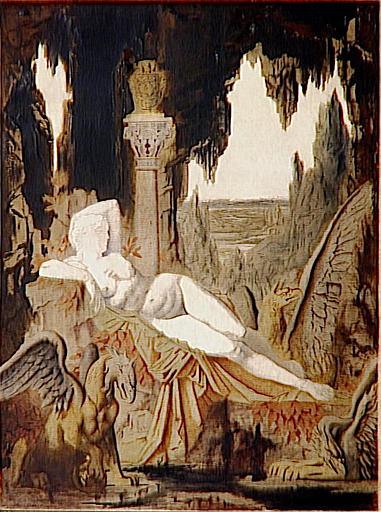
A Vision of Mythic Grace: Gustave Moreau’s *Fée aux Griffons*
Gustave Moreau's Fée aux Griffons (Fairies with Griffins) is not merely a depiction of a fantastical scene; it’s an immersion into the richly layered world of Symbolist art, a realm where dreams and mythology intertwine to evoke profound emotional responses. Painted in 1880, this captivating work exemplifies Moreau's unique approach – one that deliberately eschewed the naturalism favored by his contemporaries, opting instead for a meticulously constructed tableau brimming with allegorical significance. The painting’s power resides not just in its visual beauty but also in its ability to transport the viewer into a space of heightened imagination and spiritual contemplation.
- Subject Matter: The central figure, a woman reclining amidst a fantastical setting, immediately establishes a connection with classical mythology. Her outstretched wings, adorned with griffins – mythical creatures combining the body of a lion with the head and wings of an eagle – elevate her to a position of divine or semi-divine status.
- Style & Technique: Moreau’s style is characterized by its opulent detail, rich color palette, and meticulous rendering. He employs a technique reminiscent of Byzantine mosaics and Renaissance frescoes, creating a sense of luminous depth and otherworldly beauty. The brushwork is often obscured, contributing to the painting's hazy, dreamlike atmosphere.
The Symbolist Movement & Moreau’s Vision
Moreau was a pivotal figure in the Symbolist movement, which arose as a reaction against the perceived materialism and superficiality of Realism and Impressionism. Symbolists sought to express subjective emotions, spiritual truths, and mythological themes through highly stylized imagery. Moreau's work is deeply rooted in this tradition, drawing inspiration from sources such as medieval legends, classical mythology, and esoteric philosophies. He was particularly interested in exploring the darker aspects of human psychology and the mysteries of the unconscious mind. The painting’s composition deliberately evokes a sense of timelessness, suggesting an eternal struggle between beauty and darkness, innocence and corruption.
- Historical Context: Created during a period of significant social and intellectual change in France – marked by advancements in science, industrialization, and the rise of new philosophical ideas – Moreau’s art reflects a desire to find meaning and solace in the face of these rapid transformations.
- Influence of Byzantine Art: Moreau's fascination with Byzantine iconography is evident in the painting's flattened perspective, stylized figures, and use of gold leaf, creating an effect of shimmering grandeur.
Decoding the Symbolism
Beyond its immediate visual appeal, Fée aux Griffons is laden with symbolic meaning. The griffins themselves represent power, guardianship, and divine authority – qualities associated with both protection and judgment. The woman’s reclining pose suggests vulnerability and perhaps a state of transition or transformation. The presence of the birds further amplifies this sense of ethereal beauty and spiritual connection. The vase, a recurring motif in Moreau's work, symbolizes fertility, abundance, and the cyclical nature of life and death. The overall effect is one of profound mystery and suggestive ambiguity – inviting viewers to interpret the scene through their own emotional and intellectual lens.
Emotional Impact & Artistic Value
Moreau’s *Fée aux Griffons* possesses a captivating allure, drawing the viewer into its dreamlike world. The painting's rich textures, luminous colors, and evocative symbolism create an intensely immersive experience. It is a testament to Moreau’s mastery of technique and his profound understanding of the human psyche. A hand-painted reproduction offers a unique opportunity to own a piece of this artistic legacy, bringing a touch of timeless beauty and symbolic depth into any interior space. This artwork represents not just a visual object but a portal to a world of mythic grace and enduring fascination.