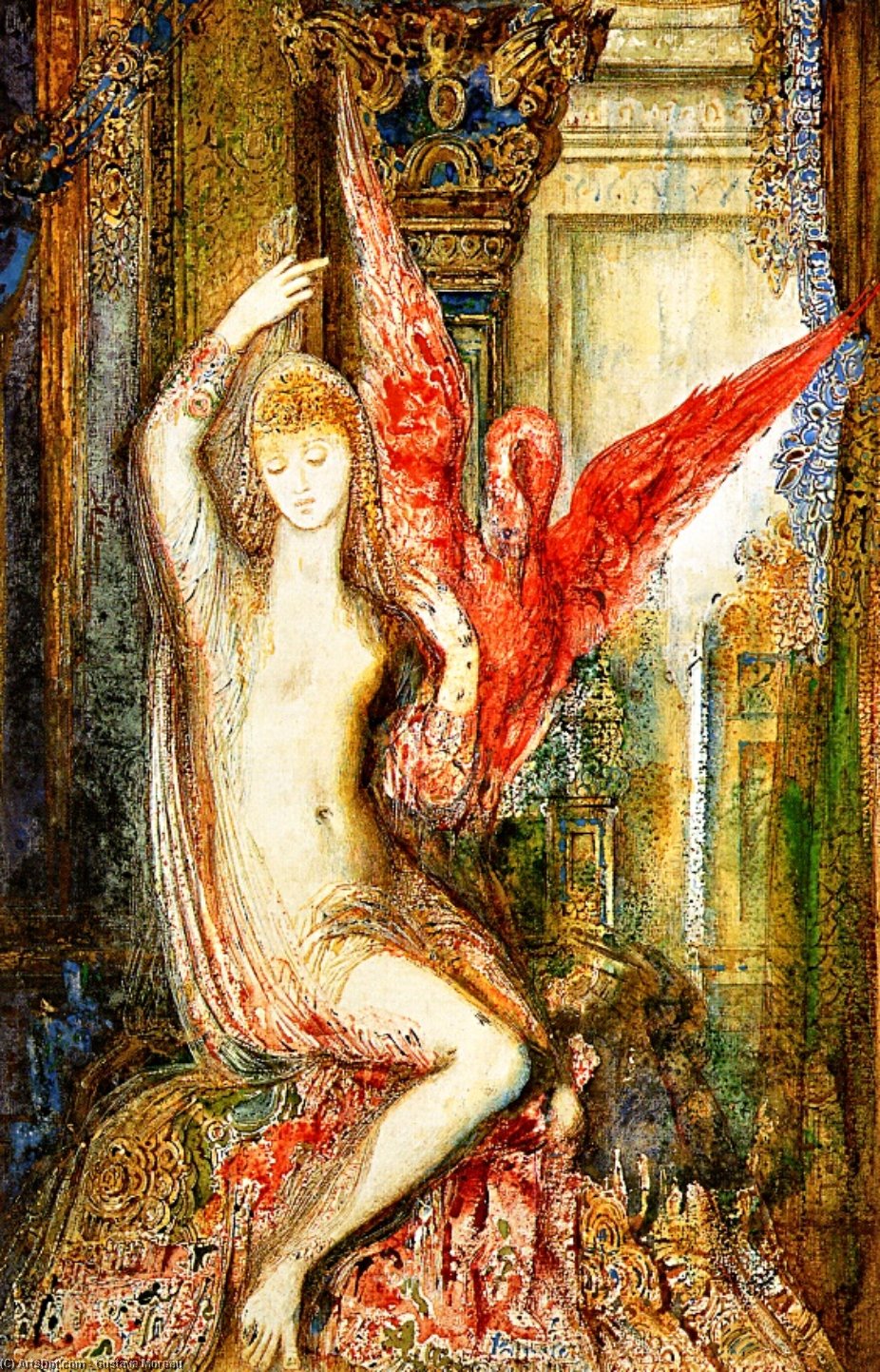
A Dream Weaver's Vision: Exploring Gustave Moreau’s Femme à Libis Rose
Gustave Moreau (1826-1898) stands as a singular figure in the annals of Symbolist painting, an artist who deliberately rejected the prevailing Realism and Impressionism of his era to delve into realms beyond mere observation. Rather than capturing fleeting moments or objective reality—a pursuit championed by contemporaries—Moreau sought to unlock the hidden narratives residing within myth, religion, and the human psyche through a meticulously crafted visual language steeped in personal symbolism.
“Femme à Libis Rose,” painted around 1895, exemplifies this distinctive approach. It’s not merely a portrait; it's an invitation into Moreau’s dreamscape—a world populated by archetypal figures and laden with evocative imagery designed to stir the imagination.
Style and Technique: Symbolist Aesthetics
Moreau’s style is undeniably rooted in Symbolism, a movement that prioritized emotion and intuition over factual representation. Unlike Impressionists who aimed to capture light and color as perceived by the eye, Moreau employed techniques reminiscent of Byzantine icon painting—layered glazing, muted palettes dominated by earthy tones—to create an atmosphere of solemn grandeur and spiritual contemplation. The meticulous detail with which he rendered textures and surfaces contributes to this sense of timelessness.
Mythological Resonance: Semele and Jupiter
The artwork draws heavily upon mythological themes, specifically the tale of Semele and Jupiter—a story recounted in Greek mythology about Zeus’s attempt to seduce Semele, his mortal wife, with a dazzling display of divine splendor. Moreau skillfully incorporates elements of this narrative into the composition: The woman seated on a chair is positioned as if awaiting a celestial visitation, mirroring Semele's anticipation of Zeus’s arrival.
Symbolism Unveiled: Birds and Fertility
The presence of birds—particularly the pink ibis—is rife with symbolic significance. In Egyptian mythology, the ibis was associated with resurrection and rebirth, representing divine protection and spiritual renewal. Moreau’s careful placement of these birds—one near Semele's face and another in the upper right corner—underscores the painting’s preoccupation with themes of fertility, transformation, and immortality. The repetition of bird imagery reinforces this overarching message.
Emotional Impact: A Portrait of Contemplation
"Femme à Libis Rose" transcends a simple depiction of a woman; it's an exploration of inner states—a portrait not just of appearance but of spirit. Moreau’s masterful use of color and texture evokes a profound sense of melancholy and serenity, inviting the viewer to contemplate the mysteries of existence and the enduring power of myth.
This artwork is available as a high-quality reproduction on ArtsDot.com – explore stunning prints and canvases for your home!