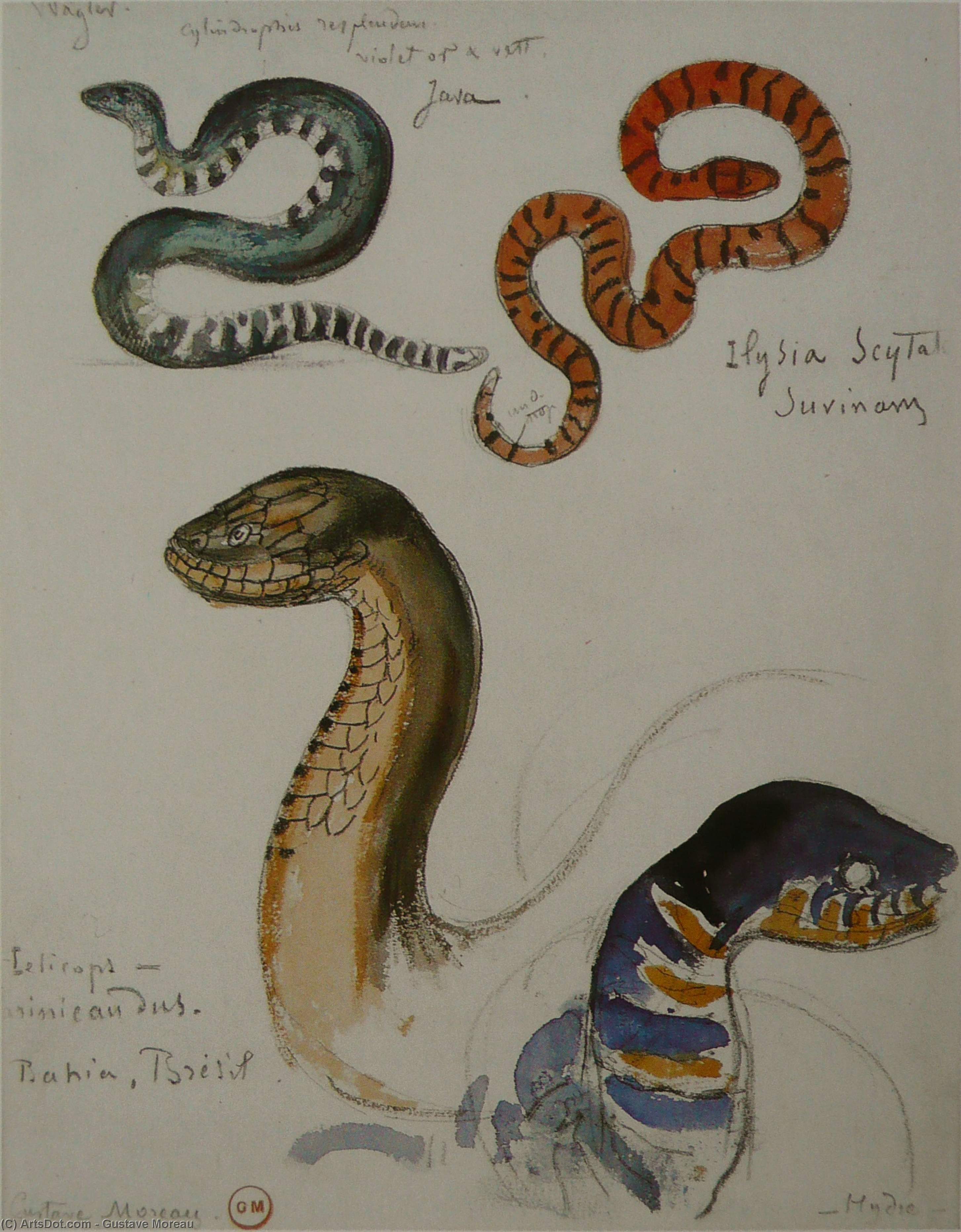
Moreau’s mesmerizing 'Four Studies of Snakes,' a Symbolist masterpiece from 1898 Paris, unveils intricate colored serpents imbued with mystical symbolism—green, red, blue, and black—capturing the artist's profound exploration of myth and emotion. Explore this evocative artwork and bring its timeless beauty into your home.
A Tapestry of Mythic Serpents: Exploring Gustave Moreau’s “Four Studies of Snakes”
Moreau's "Four Studies of Snakes" isn’t merely a depiction of reptiles; it’s an immersion into the fertile soil of Symbolist imagination. Painted sometime around 1890, this enigmatic artwork encapsulates the core tenets of the movement—a deliberate rejection of naturalistic representation in favor of psychological and spiritual exploration. Moreau, deeply influenced by Nietzschean philosophy and Wagnerian opera, sought to transcend the limitations of observable reality, believing that art could access realms beyond sensory perception.
- Subject Matter & Composition: The painting presents four snakes—one vibrant green, one fiery red, one serene blue, and one brooding black—each meticulously rendered against a stark white background. Their placement isn’t random; they intertwine subtly, creating an interconnected visual narrative that speaks to themes of duality and transformation. This deliberate arrangement underscores Moreau's fascination with mythological serpents as symbols of primal forces and hidden knowledge.
- Style & Technique: Moreau employed a technique characterized by meticulous detail and layering—a hallmark of Symbolist painting. He utilized tempera on canvas, applying thin washes of color to build up complex textures and patterns. The resulting surface possesses an almost velvety quality, inviting the viewer’s eye to linger upon minute variations in hue and tone. This painstaking approach reflects Moreau's desire to capture not just what he saw but what he *felt*, channeling his inner vision onto the canvas.
Historical Context: The Symbolist Rebellion
Emerging in Paris during the Belle Époque, Symbolism arose as a reaction against the dominant artistic trends of Impressionism and Naturalism. Artists like Moreau rejected the pursuit of objective observation, arguing that art should strive to evoke emotion and convey spiritual truths. They drew inspiration from sources outside the realm of empirical science—literature, mythology, folklore, and psychoanalysis—creating artworks that prioritized subjective experience over factual accuracy.
Symbolism Unleashed: Decoding the Snake Motif
The snake motif itself carries profound symbolic weight across cultures and throughout history. In Judeo-Christian tradition, it represents temptation, evil, and death; however, Moreau reimagines this archetype as a conduit for regeneration and enlightenment. The colors chosen—green symbolizing rebirth, red representing passion and vitality, blue embodying serenity and contemplation, and black signifying darkness and introspection—further amplify the painting’s symbolic resonance.
Emotional Impact & Artistic Legacy
"Four Studies of Snakes" transcends mere visual beauty; it invites contemplation. Moreau's masterful manipulation of color and texture compels viewers to confront their own inner landscapes, prompting questions about mortality, spirituality, and the transformative power of imagination. It remains a testament to Symbolist ambition—to capture not just what is seen but what is felt—and continues to inspire artists and collectors alike with its haunting elegance and intellectual depth.