A Visionary Encounter Between Virtue and Vice
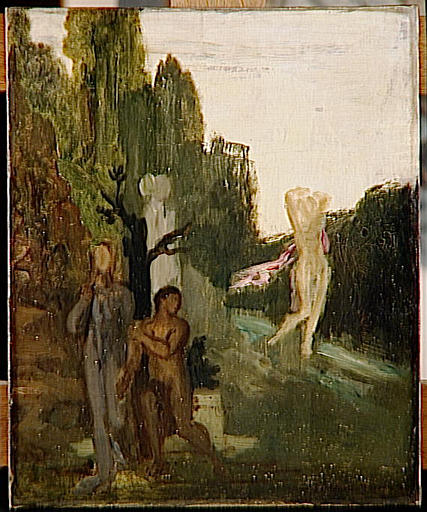
In the profound depths of Gustave Moreau’s Hercule entre le vice et la vertu, we encounter far more than a mere retelling of Greek mythology; we are invited into an immersive experience of the human soul. Painted around 1890, this monumental canvas serves as a cornerstone of the Symbolist movement, a period when artists sought to reject the literalism of the physical world in favor of capturing psychological states and spiritual truths. The painting captures the legendary hero Hercules caught in a celestial struggle between two female figures—one embodying the seductive pull of temptation and the other representing the noble path of righteousness. It is a visual metaphor for the eternal, internal conflict that resides within every individual, a timeless battle to overcome base desires and ascend toward higher aspirations.
The atmosphere of the work is nothing short of hypnotic, possessing a dreamlike quality that blurs the line between reality and hallucination. Moreau achieved this through a meticulous application of technique, utilizing tempera on canvas to create a surface that feels velvety and rich. By layering pigments with extraordinary precision, he produced luminous colors that seem to shimmer with an inner, supernatural light. This painstaking process allows the viewer to lose themselves in a landscape of intricate patterns and textures. Furthermore, Moreau’s masterful use of chiaroscuro—the dramatic interplay between deep shadows and brilliant highlights—sculpts the figures with an emotional intensity that heightens the drama of the encounter, making the scene feel as though it is unfolding within a sacred, nocturnal dream.
The Symbolist Rebellion and Historical Resonance
To understand the impact of this masterpiece, one must consider the era of its creation. Emerging during the Belle Époque in Paris, Moreau’s work represented a decisive rebellion against the dominant artistic trends of the day. While the Impressionists were preoccupied with capturing the fleeting, sensory impressions of light and atmosphere, Moreau and his Symbolist contemporaries turned their gaze inward. They sought to explore the subconscious, drawing inspiration from the esoteric, the mythological, and the biblical. In Hercule entre le vice et la vertu, we see this rejection of empirical observation; the artist does not aim to document a historical event, but rather to conjure an allegory that speaks to the universal human condition.
For the discerning collector or interior designer, this piece offers a profound sense of intellectual and aesthetic depth. It is an artwork that demands contemplation, providing a focal point that is both visually opulent and philosophically stimulating. The presence of subtle elements—the delicate silhouette of a bird, the ancient structure of a tree, and the enigmatic figures surrounding the hero—adds layers of narrative complexity that reward repeated viewing. Whether placed in a grand gallery or a curated private study, this reproduction brings with it the prestige of the 19th-century French avant-garde, offering an unparalleled opportunity to possess a fragment of the dreamlike world envisioned by one of history's most significant masters.