A Divine Encounter in the Realm of Dreams
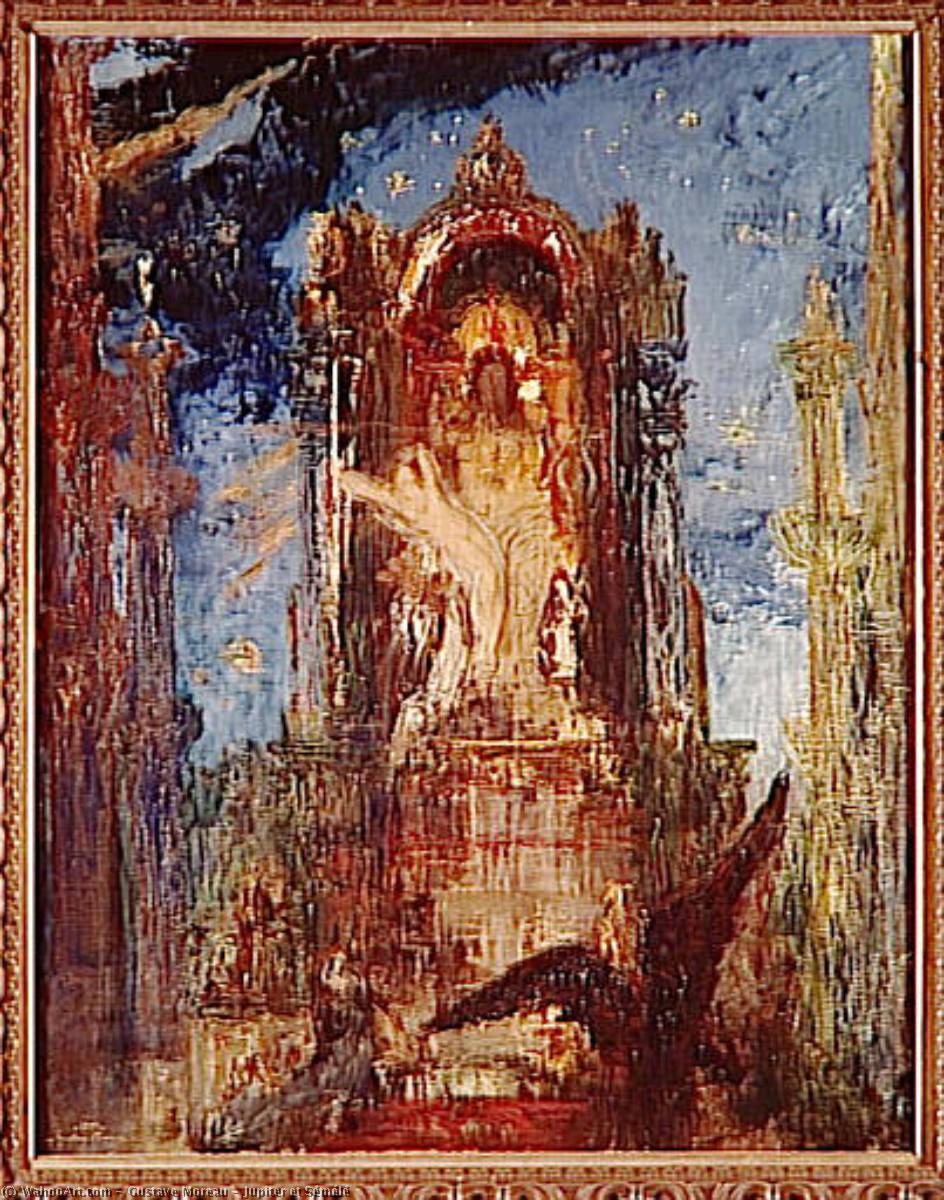
In the heart of Gustave Moreau’s Jupiter et Sémélé, we find ourselves suspended between the mortal and the divine, caught in a moment of breathtaking cosmic tension. This masterpiece serves as a profound window into the Symbolist movement, where the boundaries of reality dissolve into the ethereal. The painting captures the climactic instant from Greek mythology when Jupiter, the king of the gods, reveals his terrifyingly magnificent true form to the mortal Semele. It is not merely a depiction of a myth, but an evocation of an overwhelming spiritual experience—one that promises both enlightenment and destruction. As the viewer gazes upon this monumental scene, they are drawn into a world where architecture and atmosphere merge to create a sense of sacred awe.
The composition is anchored by a structure that feels simultaneously like an ancient temple and a soaring cathedral, its verticality pulling the eye upward toward a turbulent, swirling sky. Moreau masterfully uses this architectural grandeur to symbolize the intersection of earthly constraints and celestial aspirations. Within this space, the air seems thick with the weight of destiny. The lighting is theatrical and directional, casting deep, dramatic shadows that dance against the ornate details of the building, highlighting the central figures in a way that feels almost hallucinatory. For the collector or interior designer, this piece offers a commanding presence, bringing a sense of historical depth and intellectual mystery to any curated space.
The Mastery of Symbolist Technique
To look closely at Jupiter et Sémélé is to witness Moreau’s unparalleled command over the oil medium. Eschewing the flat clarity of Realism, Moreau embraced a rich, tactile technique characterized by heavy impasto. The paint is applied with a deliberate thickness, creating a surface that catches the light and breathes with life. His brushstrokes are loose and expressive, contributing to an atmosphere of instability and movement that mirrors the chaotic energy of the divine revelation. This textured approach allows for a complex layering of color, where luminous highlights struggle against murky, atmospheric depths, creating a sense of profound emotional intensity.
The symbolism embedded within the technique is as vital as the subject matter itself. The swirling clouds and distorted forms are not mere background elements; they are visual manifestations of the psychological state—the confusion, the fear, and the ecstasy of Semele’s encounter with the infinite. Moreau’s ability to blend fine academic training with a visionary, almost modern sensibility makes this work a cornerstone of late 19th-century art. It is a painting that does not just tell a story; it vibrates with the energy of an unfolding tragedy, making it an irresistible choice for those who seek art that provokes deep contemplation and emotional resonance.
A Timeless Legacy for the Discerning Collector
As a pivotal figure who paved the way for early Modernism, Gustave Moreau’s influence can be felt in the works of legends like Henri Matisse. Jupiter et Sémélé stands as a testament to his ability to clothe profound mysteries in opulent, visual splendor. For those looking to adorn a home or gallery with a high-quality reproduction, this artwork offers more than just decoration; it provides an invitation to explore the hidden realms of the human psyche. The painting’s ability to evoke feelings of mystery, apprehension, and sublime beauty ensures that it remains a captivating centerpiece, capable of inspiring conversation and providing a window into the eternal dance between the human spirit and the divine.