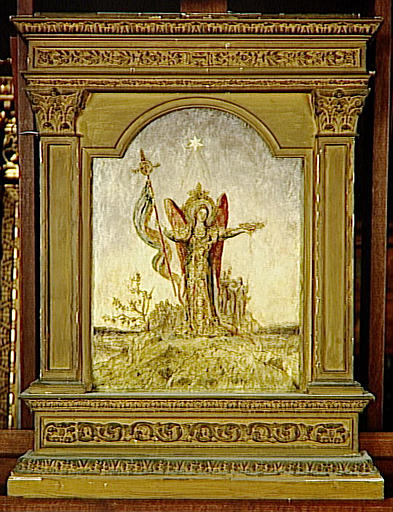
A Vision of Faith and Mystery: Exploring Gustave Moreau’s *L'Eglise triomphante*
Gustave Moreau’s L'Eglise triomphante (The Triumphant Church) is a captivating enigma, a work that immediately draws the viewer into its richly layered symbolism and haunting beauty. Painted in the late 19th century, during the height of Symbolism – a movement profoundly influenced by Romanticism and a desire to explore the subconscious – this piece exemplifies Moreau’s unique approach: a deliberate rejection of naturalistic representation in favor of evocative imagery rooted in mythology, religion, and personal emotion. The painting's power lies not just in its subject matter—a woman holding aloft a cross—but in the carefully constructed atmosphere of solemnity and contemplation that permeates every detail.
Subject and Composition: A Central Figure
At the heart of L’Eglise triomphante stands a solitary female figure, her posture radiating both strength and vulnerability. She clutches a cross, instantly recognizable as a potent symbol of Christian faith and sacrifice. The composition is deliberately unbalanced, creating a sense of unease and drawing attention to the figure's isolation within the vast landscape. Surrounding her are other figures, partially obscured and rendered with Moreau’s signature blend of detail and abstraction, suggesting a congregation or perhaps a procession – an event imbued with spiritual significance. The inclusion of books scattered throughout the scene adds another layer of complexity, hinting at knowledge, learning, and the scriptures that underpin the religious narrative.
Symbolism and Influences: Echoes of Myth and Antiquity
Moreau’s work is saturated with symbolism, drawing heavily from classical mythology, medieval iconography, and esoteric traditions. The landscape itself—a blend of trees and water—evokes a sense of timelessness and the primordial origins of faith. The books are not merely decorative; they represent the accumulated wisdom of ages, offering a pathway to spiritual understanding. Moreau was deeply influenced by the Pre-Raphaelites, particularly their meticulous attention to detail and their embrace of medieval themes. His palette is rich with jewel tones—deep blues, purples, and golds—further enhancing the painting’s opulent and dreamlike quality. The overall effect is reminiscent of a Byzantine icon, blending religious devotion with an intensely personal vision.
Technique and Style: A Masterclass in Symbolist Detail
Moreau's technique is characterized by its meticulous detail and his masterful use of color. He employed oil paints with a remarkable degree of control, layering glazes to achieve luminous effects and creating textures that range from smooth to highly textured. His brushwork is often obscured beneath these layers, contributing to the painting’s hazy, dreamlike atmosphere. The figures are rendered with an almost sculptural quality, emphasizing their physicality while simultaneously imbuing them with a sense of ethereal beauty. This painstaking approach reflects Moreau's belief in art as a means of accessing deeper truths and expressing profound emotions.
Emotional Impact and Legacy: A Timeless Vision
L’Eglise triomphante continues to resonate with viewers today, not simply for its aesthetic beauty but also for its enduring questions about faith, humanity, and the nature of belief. Moreau's work represents a pivotal moment in art history, bridging the gap between Romanticism and Modernism. A hand-painted reproduction offers an unparalleled opportunity to experience the full impact of this remarkable artwork, bringing its evocative power into your home or studio. Its intricate details and profound symbolism make it a captivating addition to any collection, while its timeless quality ensures that it will continue to inspire and intrigue for generations to come.