Explore the captivating Symbolist art of Gustave Moreau (1826-1898), famed for mythological & biblical paintings like 'Salome'. Influenced Matisse & Rouault. Discover his dreamlike world!
La Peste à Florence: A Descent into Mythic Suffering
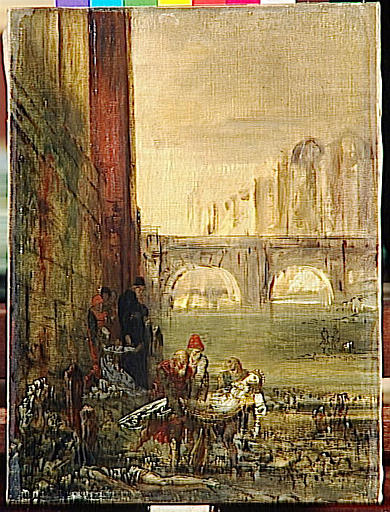
Gustave Moreau’s “La Peste à Florence” isn't merely a depiction of plague; it’s an immersion into the profound anxieties and spiritual yearning that characterized Symbolist art. Painted in 1873, this monumental canvas transcends mere observation, presenting instead a meticulously crafted tableau designed to provoke contemplation and evoke visceral emotion—a testament to Moreau’s unwavering commitment to exploring the subconscious mind through allegorical imagery. The scene unfolds against a backdrop of brooding twilight, dominated by a formidable castle silhouetted against an oppressive sky, immediately establishing a sense of grandeur and impending doom. Below lies Florence itself, rendered with painstaking detail – a bridge spanning a river, its arches echoing the architectural precision favored by Moreau—populated by figures caught in the throes of despair and illuminated by ethereal luminescence.
Style & Technique: The Language of Dreams
Moreau’s stylistic approach firmly rooted him within the Symbolist movement, rejecting the naturalistic conventions championed by Impressionism. Instead, he embraced a deliberately stylized aesthetic, prioritizing mood and psychological resonance over accurate representation. Moreau employed tempera on canvas—a technique known for its luminosity and durability—allowing him to achieve remarkable tonal gradations and create an atmosphere of palpable sorrow. His brushstrokes are deliberate and expressive, layering colors with meticulous care to convey textures and contours that suggest both physicality and spiritual significance. The artist’s masterful use of chiaroscuro – the dramatic interplay between light and shadow – amplifies the emotional impact of the scene, guiding the viewer's gaze toward key figures and emphasizing their vulnerability.
Historical Context: Echoes of Dante & Medieval Anxiety
“La Peste à Florence” draws heavily from Dante Alighieri’s “Inferno,” specifically Canto IX, which recounts the harrowing experience of witnessing the plague in Florence during Dante’s exile. Moreau wasn't attempting to recreate a historical record; rather, he sought to distill the essence of Dante’s poetic vision—the terror of divine judgment and the confrontation with mortality—into visual form. The pervasive gloom reflects the psychological torment experienced by individuals facing existential crisis, mirroring the anxieties prevalent in Europe during the Victorian era. Furthermore, Moreau's preoccupation with biblical symbolism – notably references to Adam and Eve – underscores the painting’s exploration of fundamental human themes: innocence lost, transgression, and redemption.
Symbolism & Emotional Resonance: Faces of Suffering
The figures inhabiting “La Peste à Florence” are rendered with haunting beauty—faces etched with grief and despair—yet imbued with an otherworldly luminescence that suggests a transcendent awareness. Moreau’s meticulous attention to detail extends beyond mere visual accuracy; each gesture, expression, and posture carries symbolic weight. The central figure, positioned prominently on the bridge, embodies both vulnerability and resilience – representing humanity grappling with its fate. Scattered throughout the composition are depictions of saints and angels—symbols of divine compassion—offering solace amidst the devastation. Ultimately, Moreau’s masterpiece compels viewers to confront uncomfortable truths about human existence and invites contemplation on themes of suffering, faith, and spiritual transformation. It remains a profoundly evocative artwork, capturing not just the horrors of plague but also the enduring power of mythic imagination.
A Legacy Enduring Through Reproduction
Today, ArtsDot offers exceptional reproductions of “La Peste à Florence,” allowing art enthusiasts worldwide to experience Moreau’s visionary aesthetic firsthand. These high-quality prints capture the painting's luminous palette and textural richness, faithfully conveying its emotional depth and symbolic complexity—a beautiful way to honor the legacy of Gustave Moreau and his contribution to Symbolist art history.