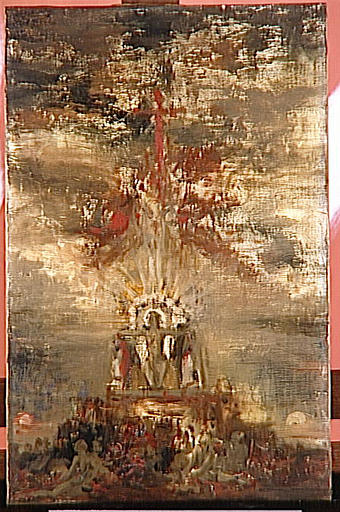
Gustave Moreau’s ‘Le Christ consolateur’ presents a profoundly symbolic and detailed oil painting of Jesus surrounded by angels, embodying the artist's signature Symbolist style from 19th-century Paris. Discover this evocative masterpiece and bring its timeless beauty into your space.
A Vision of Sorrow and Comfort: Exploring Gustave Moreau’s *Le Christ consolateur*
Gustave Moreau's *Le Christ consolateur* (The Consoling Christ) stands as a potent emblem of the Symbolist movement, a period defined by its rejection of literal representation in favor of evocative symbolism and intensely personal emotional expression. Painted during his most productive years, between 1885 and 1890, this large-scale oil on canvas transports the viewer to a realm where religious iconography is filtered through Moreau’s uniquely imaginative lens. The artwork isn't merely a depiction of a biblical scene; it’s an exploration of grief, solace, and the profound mysteries of faith, rendered with a meticulous attention to detail that borders on the obsessive.
- Subject Matter: The painting centers around Jesus Christ, not as a triumphant savior, but in a moment of profound vulnerability. He stands elevated, perhaps upon a fragment of a cross or a symbolic platform, surrounded by a multitude of figures – angels and mourners – engaged in an act of collective mourning.
- Style & Technique: Moreau’s style is immediately recognizable for its opulent textures, rich color palettes, and the deliberate avoidance of naturalistic perspective. He employs a technique reminiscent of Byzantine mosaics and late-Renaissance altarpieces, layering translucent glazes to create an effect of shimmering depth and spiritual luminescence. The brushwork is often obscured by this glazing, contributing to the painting’s dreamlike quality.
Symbolism Woven into the Fabric of Faith
Moreau was deeply influenced by mythology, particularly Greco-Roman legends, and esoteric traditions. *Le Christ consolateur* is saturated with symbolic elements that invite multiple interpretations. The cloudy sky above suggests a turbulent emotional landscape, mirroring the sorrow being experienced. The angels are not depicted as benevolent messengers but rather as figures of profound sadness, their faces etched with empathy. The diverse group of mourners – some identifiable as biblical figures, others representing humanity’s collective suffering – underscores the universality of grief and the need for comfort.
- Color Palette: Moreau's use of deep blues, purples, and golds creates a sense of solemnity and grandeur. The colors are not used to represent reality but rather to evoke specific emotions and spiritual associations.
- Compositional Elements: The crowded composition, with figures overlapping and intertwining, contributes to the painting’s feeling of claustrophobia and emotional intensity. This deliberate density reflects the overwhelming nature of sorrow and the desire for connection in times of distress.
Historical Context & Moreau's Vision
*Le Christ consolateur* was created during a period of significant social and intellectual upheaval in Europe. The rise of industrialization, coupled with advancements in science, challenged traditional religious beliefs. Symbolist artists like Moreau responded by seeking refuge in the realm of myth and spirituality, offering alternative ways to grapple with existential questions. Moreau’s work can be seen as a reaction against the perceived superficiality of academic art and a reaffirmation of the power of subjective experience.
Moreau's artistic trajectory was marked by a relentless pursuit of personal symbolism, often drawing inspiration from esoteric texts and dream imagery. He meticulously constructed his paintings to convey complex emotional states and spiritual truths, inviting viewers to engage in a deeply contemplative dialogue with the artwork. *Le Christ consolateur* exemplifies this approach perfectly – a testament to Moreau’s artistic genius and his profound understanding of the human condition.
Emotional Impact & Artistic Value
The enduring power of *Le Christ consolateur* lies in its ability to evoke a visceral emotional response. The painting's somber mood, combined with its intricate details and symbolic richness, creates a deeply moving experience for the viewer. It’s a work that speaks to our shared humanity – our capacity for both profound sorrow and unwavering hope. As a significant example of Symbolist art, Moreau’s masterpiece offers a rare glimpse into the artistic vision of one of France's most influential painters.