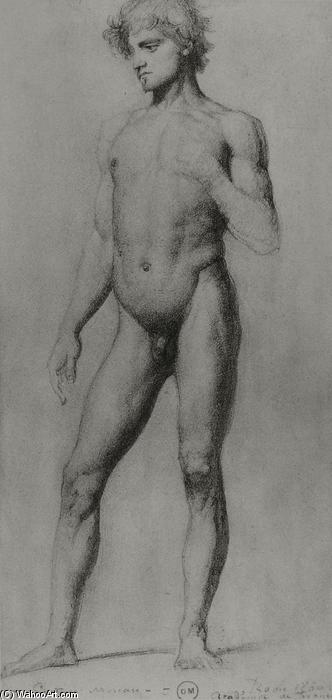
A Study in Nudity and Myth: Gustave Moreau’s ‘Male Nude’
Gustave Moreau's 1860 drawing, “Male Nude,” is more than just a depiction of the human form; it’s a profound meditation on beauty, spirituality, and the enduring power of myth. Executed during a pivotal moment in the development of Symbolism – a movement that sought to express subjective emotions and ideas rather than objective reality – this work exemplifies Moreau's unique artistic vision. The drawing captures a male figure posed with outstretched arms, seemingly reaching towards an unseen sky, immediately evoking a sense of yearning and aspiration. This isn’t a straightforward anatomical study; it’s a carefully constructed tableau designed to resonate with the viewer on a deeper, almost subconscious level.
The Symbolist Aesthetic: Color, Texture, and Narrative
Moreau's style is immediately recognizable within the Symbolist movement. He rejected the bright palettes and fleeting impressions favored by Impressionists, instead opting for a muted, almost melancholic color scheme – predominantly blacks, whites, and subtle grays – that contributes to the drawing’s dreamlike quality. The artist masterfully employs hatching and cross-hatching techniques, layering lines with meticulous precision to build up form and texture. This deliberate approach creates a rich surface that invites close examination, encouraging the viewer to lose themselves in the details of the figure's musculature and the play of light and shadow. Notice the almost sculptural quality achieved through this painstaking rendering.
Historical Context and Influences
Created in 1860, “Male Nude” reflects a fascinating period of artistic transition. The rise of Realism had challenged academic conventions, while new currents like Impressionism were beginning to emerge. Moreau consciously positioned himself outside these trends, drawing inspiration from classical antiquity, medieval religious iconography, and the burgeoning field of psychology. His interest in mythology – particularly themes of sacrifice and redemption – is evident in the figure’s posture and gaze. The presence of two secondary figures in the background further reinforces this symbolic dimension, hinting at a narrative that remains deliberately ambiguous, inviting the viewer to complete the story.
Symbolic Resonance and Emotional Impact
The central male nude embodies a timeless archetype – a representation of human vulnerability, strength, and potential. The upward gaze suggests a spiritual quest, a desire for transcendence. Moreau’s deliberate ambiguity allows for multiple interpretations; is this figure a worshiper, a martyr, or simply an embodiment of idealized beauty? The drawing's emotional impact is profoundly evocative, stirring feelings of awe, contemplation, and perhaps even melancholy. It’s a work that transcends mere representation, offering a glimpse into the artist’s soul and inviting the viewer to engage in their own personal dialogue with its enduring themes. This piece would be an exceptional addition to any collection valuing classical beauty and symbolic depth.