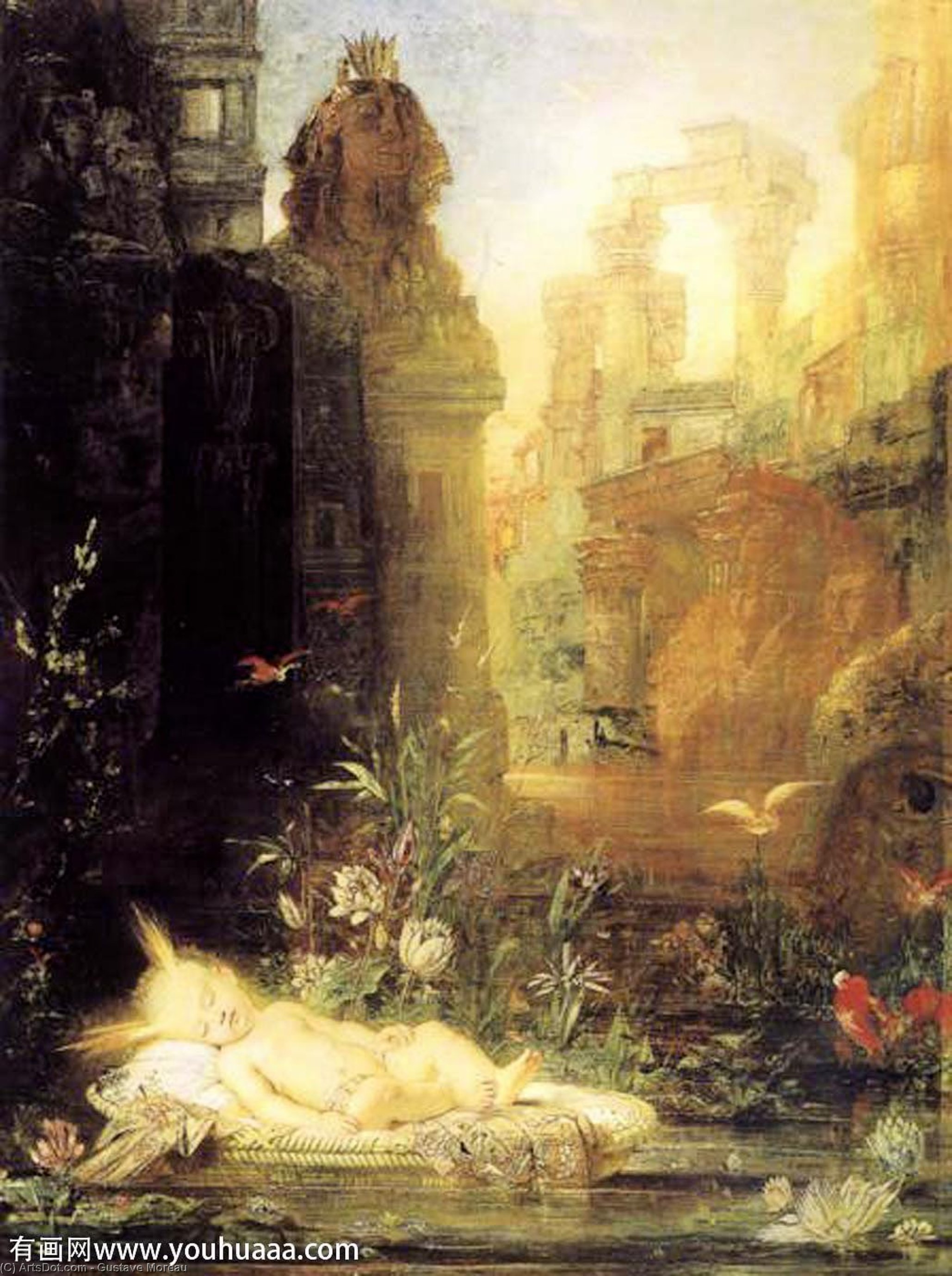
A Visionary Echo of Myth and Faith: Gustave Moreau’s “Moses by the Nile”
Gustave Moreau (1826–1898) stands apart from his contemporaries as a true prophet of Symbolism, an artistic movement that sought to transcend mere representation and delve into the subconscious realm. Unlike Impressionists preoccupied with capturing fleeting moments of light and color, Moreau wrestled with profound spiritual questions—questions rooted in ancient myths and biblical narratives—translating them into a visual language imbued with dreamlike beauty and enigmatic symbolism. His masterpiece, “Moses by the Nile,” exemplifies this distinctive approach, cementing his legacy as one of the foremost artists of his era. Painted around 1878, this monumental canvas transcends simple depiction; it’s an immersive experience designed to provoke contemplation and evoke a visceral response.
- Subject Matter: The painting portrays Moses standing beside a waterfall, bathed in ethereal light as he gazes upon a newborn infant nestled on a bed beneath the cascading water. This juxtaposition of divine figure and vulnerable child immediately establishes a thematic core—the incarnation of God amidst earthly fragility—a motif prevalent throughout Moreau’s oeuvre.
- Style: Moreau's Symbolist style is characterized by its meticulous detail, opulent color palettes, and flattened perspective. Unlike the naturalistic tendencies of Realism, he prioritized conveying mood and emotion over accurate observation. The canvas exudes an otherworldly luminescence achieved through glazing techniques—layers of translucent pigment applied to create depth and luminosity—a technique perfected by Moreau himself.
- Technique: Moreau employed oil paints on canvas with painstaking precision. He utilized a layering process known as alla prima, applying paint directly onto the canvas without underpainting, maximizing vibrancy and capturing subtle tonal variations. The artist’s masterful brushwork contributes to the painting's textural richness, conveying both monumental grandeur and intimate tenderness.
Historical Context: Symbolism and Its Roots in Antiquity
Moreau’s artistic vision emerged during a period of intellectual ferment—the late 1870s—when Symbolist artists rejected the materialism of Victorian society and sought inspiration from sources beyond empirical observation. Influenced by thinkers like Nietzsche and Wagner, Symbolists explored esoteric traditions, mythology, and psychoanalysis to unlock hidden truths about human consciousness. Moreau’s fascination with biblical iconography harkened back to medieval Christian art, which had drawn heavily upon pagan myths—particularly those concerning Osiris and Isis—to convey spiritual concepts. The Nile motif itself symbolizes rebirth and regeneration, aligning perfectly with the central theme of divine incarnation.
Symbolism Beyond Representation: Layers of Meaning
“Moses by the Nile” is replete with symbolic elements that invite multiple interpretations. The waterfall represents purification and renewal—a visual metaphor for Moses’s spiritual transformation from a violent criminal to a devout prophet. The infant symbolizes divine grace and compassion, embodying God's tenderness towards humanity. Moreau’s use of color—particularly blues and golds—creates an atmosphere of serenity and majesty, reinforcing the painting’s spiritual significance. Furthermore, the birds circling overhead symbolize hope and ascension, suggesting that Moses’s gaze is directed upwards toward a transcendent realm.
Emotional Impact: A Dreamlike Reverie
Moreau's intention wasn't merely to depict a biblical scene; he aimed to evoke an emotional response in the viewer—a feeling of awe and wonder akin to experiencing a profound spiritual revelation. The painting’s hazy luminescence, combined with its meticulous detail, transports us into a dreamlike space where rational thought yields to intuition. “Moses by the Nile” remains a testament to Moreau's unparalleled ability to capture the essence of Symbolist art—a captivating exploration of myth, faith, and the human psyche that continues to inspire artists and collectors alike.