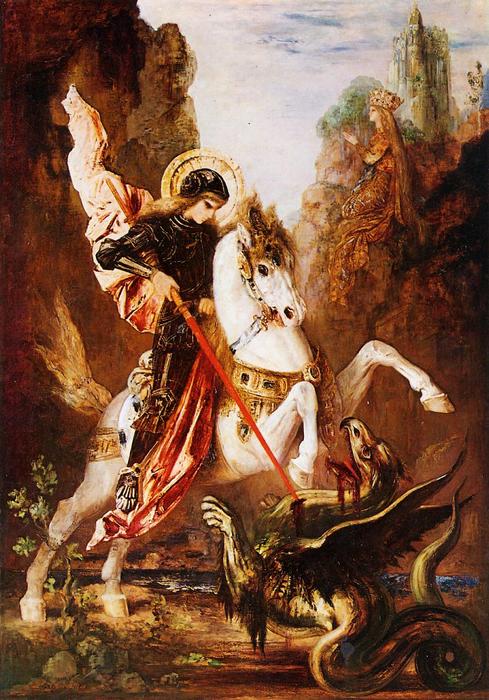
A dramatic Symbolist masterpiece by Gustave Moreau captures the epic battle between Saint George and a colossal dragon amidst a mystical landscape, inviting you to explore this legendary tale of spiritual triumph.
Explore the captivating Symbolist art of Gustave Moreau (1826-1898), famed for mythological & biblical paintings like 'Salome'. Influenced Matisse & Rouault. Discover his dreamlike world!
Explore European art from the 13th-19th centuries at London's National Gallery! Discover masterpieces by Van Gogh, Rembrandt & more – free entry!
A Visionary Encounter: Gustave Moreau’s Saint George
In the twilight of the nineteenth century, as the art world grappled with the fleeting impressions of light and atmosphere, Gustave Moreau emerged from the shadows of Paris to offer something far more profound. His 1869 masterpiece, Saint George, is not merely a painting but a portal into the subconscious. While his contemporaries were preoccupied with the external reality of the natural world, Moreau sought to capture the internal landscape of myth and spirit. This work stands as a cornerstone of the Symbolist movement, a period where art functioned as a conduit for the esoteric, the occult, and the deeply psychological. To gaze upon this canvas is to step away from the mundane and enter a realm where the boundaries between dream and reality dissolve into a symphony of texture and light.
The Drama of Myth and Symbolism
At the heart of the composition lies the legendary confrontation between the Christian martyr Saint George and the serpentine dragon. However, Moreau transcends the traditional heroic narrative to present a complex allegory of spiritual struggle. The landscape itself is a character in this drama; the jagged, mountainous terrain serves as more than a backdrop, symbolizing the arduous ascent of the soul toward moral righteousness. As Saint George descends upon the beast on his white steed, the tension is palpable. The presence of onlookers within the scene adds layers of communal witness to this cosmic battle between good and evil. Every element, from the piercing lance to the menacing scales of the dragon, is imbued with a heavy, symbolic weight, inviting the viewer to contemplate their own internal battles against the shadows of the psyche.
A Masterclass in Texture and Color
Technically, Saint George is a triumph of layered complexity. Eschewing the smooth, photographic finish favored by many academic painters, Moreau employed a rich, impasto technique that gives the work a palpable, sculptural quality. One can almost feel the ruggedness of the rocks and the metallic sheen of the knight's armor through the thick application of oil paint. His palette is a deliberate orchestration of emotion; deep, nocturnal blues clash with vibrant, visceral crimsons, creating a visual friction that heightens the painting's dramatic impact. This manipulation of color and light does not aim for realism but for luminescence, as if the scene were illuminated from within by a divine or supernatural glow.
An Eternal Inspiration for the Modern Space
For the discerning collector or interior designer, a reproduction of this caliber offers more than mere decoration; it provides an intellectual and emotional anchor for a room. The verticality and commanding presence of Saint George make it a magnificent centerpiece for spaces that demand character and depth. Whether placed in a contemporary gallery-style living room or a classic study, the painting’s rich textures and enigmatic subject matter spark conversation and invite contemplation. It is an investment in a piece of art history that continues to resonate with the timeless human desire to find meaning within the beautiful, the terrifying, and the divine.