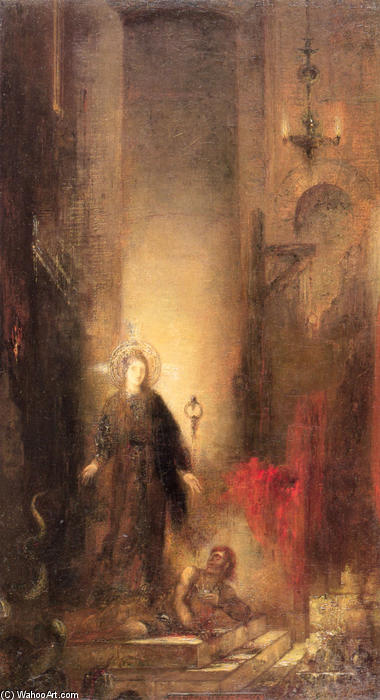
Saint Margaret: A Descent into Mythic Reverie
Gustave Moreau’s “Saint Margaret” (1873) isn't merely a depiction of biblical piety; it’s an immersion into a meticulously crafted dreamscape—a cornerstone of Symbolist painting and a testament to Moreau’s singular artistic vision. Abandoning the objective gaze favored by Realism and Impressionism, Moreau sought to translate inner experience onto canvas, channeling the profound influence of Nietzsche and Wagnerian mythology into a hauntingly beautiful tableau. The artwork immediately captivates with its muted palette—primarily ochres, browns, and dusky blues—creating an atmosphere of solemn contemplation that feels both timeless and deeply personal.
- Subject Matter: The painting portrays Saint Margaret, venerated as the Patron Saint of Mothers and Protection from Poison, cradling a lifeless infant skull. This juxtaposition is deliberately unsettling, representing mortality alongside maternal devotion – a central preoccupation within Symbolist thought.
- Style & Technique: Moreau’s meticulous brushwork—characterized by layered glazes and subtle gradations—imbues the scene with an ethereal luminescence. He employs techniques borrowed from Byzantine iconography, particularly in the depiction of drapery folds and the use of gold leaf, elevating the artwork beyond mere representation to achieve a spiritual grandeur.
- Historical Context: Moreau’s work emerged during a period of intellectual ferment—the Symbolist movement challenged prevailing artistic conventions and embraced esoteric philosophies. Influenced by Nietzsche's concept of Eternal Recurrence and Wagnerian opera cycles, Moreau aimed to evoke emotional resonance rather than factual accuracy, mirroring the anxieties and aspirations of his time.
Symbolic Resonance: Mythological Echoes & Psychological Depth
Moreau’s artistic choices resonate powerfully with mythological narratives—specifically, the tale of Saint Margaret's miraculous conception after she had endured severe poisoning attempts orchestrated by her jealous husband. The infant skull symbolizes not just death but also the regenerative power of sacrifice and divine grace – mirroring motifs found in Greek mythology concerning rebirth and transformation. Furthermore, Moreau’s masterful use of chiaroscuro—the dramatic interplay between light and shadow—amplifies the emotional impact of the scene, drawing viewers into a contemplative state akin to witnessing a sacred rite.
- The Skull: Representing mortality but also hinting at resurrection, it underscores Saint Margaret's unwavering faith amidst suffering – a core theme in Symbolist art exploring existential anxieties.
- Lighting & Composition: Moreau’s careful arrangement of figures and drapery directs the viewer’s gaze upwards towards a celestial realm, symbolizing spiritual aspiration and transcendence. The upward movement reinforces the idea of ascension toward divine grace.
Emotional Impact & Artistic Legacy
“Saint Margaret” transcends mere visual representation; it aspires to evoke profound emotional responses in the viewer—a feeling of melancholy beauty mingled with apprehension about mortality and a yearning for spiritual solace. Moreau’s influence extended far beyond his immediate contemporaries, inspiring artists like Matisse and Rouault who embraced similar expressive techniques and symbolic imagery. Today, reproductions of this masterpiece continue to captivate audiences worldwide, offering a glimpse into the visionary spirit of Symbolist art and its enduring fascination with the mysteries of human consciousness. Its haunting stillness speaks volumes about Moreau’s ability to distill complex philosophical ideas into an unforgettable visual experience—a testament to his place as one of the most significant figures in late nineteenth-century European painting.