A Vision of Suffering: Gustave Moreau’s *Saint Sebastian*
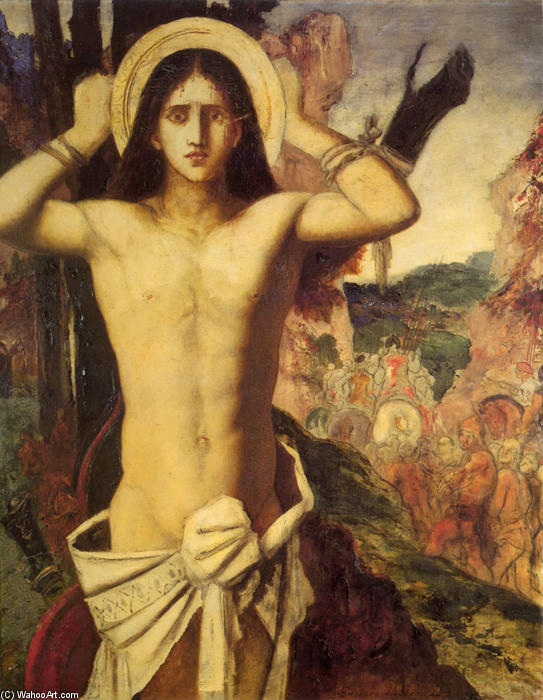
Gustave Moreau's 1875 painting, *Saint Sebastian*, is not merely a depiction of a biblical martyr; it’s an immersion into the profoundly subjective and emotionally charged world of Symbolist art. This arresting work, measuring 90 x 115 cm, immediately draws the viewer in with its unsettling beauty and palpable sense of anguish. The photograph captures a scene dominated by a woman, her head bowed in apparent distress, partially nude save for a draped cloth – a figure instantly recognizable as Saint Sebastian, traditionally depicted after his brutal torture and execution. Moreau’s approach transcends simple representation, opting instead to evoke a powerful emotional response through carefully constructed symbolism and an intensely personal artistic vision.
The Symbolist Aesthetic: Myth, Emotion, and the Unconscious
Moreau was a pivotal figure in the burgeoning Symbolist movement, which arose as a reaction against the perceived materialism and superficiality of Realism and Impressionism. Rejecting objective observation, Symbolists sought to express inner truths—dreams, myths, religious visions—through evocative imagery and suggestive forms. *Saint Sebastian* exemplifies this perfectly. The woman’s posture, her vulnerability, and the surrounding figures are not presented as literal elements but rather as conduits for exploring themes of suffering, faith, and the human condition. Moreau's palette is dominated by rich, jewel-toned colors—deep reds, blues, and golds—further amplifying the painting’s dramatic intensity. The use of muted tones and a dreamlike atmosphere contributes to the overall sense of mystery and psychological depth.
Technique and Composition: A Deliberate Arrangement
Moreau's technique is characterized by meticulous detail and a highly polished surface, achieved through numerous layers of thin glazes. This painstaking process creates an almost jewel-like quality to the pigments, enhancing their luminosity and contributing to the painting’s ethereal effect. The composition itself is deliberately unsettling. The central figure is framed within a shallow space, emphasizing her isolation and vulnerability. The background figures, rendered with a degree of abstraction, appear to observe her plight without offering solace or intervention – adding to the sense of profound loneliness. Moreau's mastery of line and form creates a dynamic tension between stillness and movement, reflecting the internal turmoil of the subject.
Symbolism and Interpretation: A Complex Narrative
*Saint Sebastian* is rich in symbolic meaning, drawing upon both Christian iconography and broader mythological traditions. The figure’s suffering mirrors the saint's martyrdom, but Moreau imbues the scene with a distinctly personal interpretation. The woman could represent not just Sebastian himself, but also humanity’s inherent vulnerability to pain and despair. The surrounding figures may symbolize various aspects of faith, doubt, or even the indifference of the world. The painting invites multiple interpretations, reflecting the Symbolist emphasis on subjective experience and the power of art to unlock hidden meanings. This piece is a testament to Moreau's ability to transform religious narrative into a profoundly moving exploration of the human psyche.