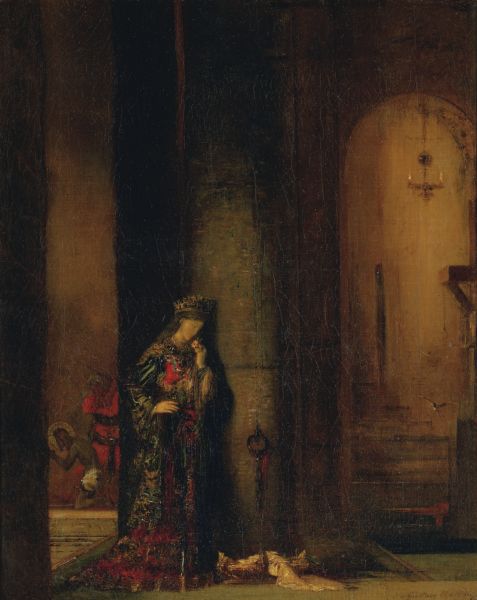
A Descent into Myth and Memory: Exploring Gustave Moreau’s *Salome at the Prison*
Gustave Moreau's *Salome at the Prison*, a haunting tableau of sorrow, power, and veiled desire, is more than just a depiction of a biblical narrative; it’s a profound meditation on memory, loss, and the enduring weight of history. Painted in 1874, this oil-on-canvas work stands as a cornerstone of the Symbolist movement, revealing Moreau's unique ability to translate inner experience into meticulously rendered visual form. The painting immediately draws the viewer into a twilight realm—a space neither wholly light nor entirely dark—where the boundaries between reality and dream blur, mirroring the complex emotional landscape at its core.
Moreau’s approach diverges dramatically from the prevailing artistic trends of his era. He wasn't interested in simply recreating a scene; he sought to evoke an atmosphere, to suggest a story beyond what is immediately visible. This is achieved through a masterful manipulation of color and composition. The palette is dominated by deep blues, purples, and ochres—colors associated with melancholy, antiquity, and the passage of time. These hues are layered with shimmering gold leaf, adding a luxurious yet unsettling quality to the scene, hinting at both opulence and decay.
The Figure of Salome: A Portrait of Grief and Authority
At the heart of the composition stands Salome, rendered not as a seductive temptress but as a figure consumed by grief. She kneels before a formidable structure—a crumbling castle or perhaps a fortress—its weathered stones suggesting centuries of sorrow and confinement. Her posture is one of profound humility, yet her gaze holds an undeniable strength, a quiet assertion of authority born from enduring pain. The crown she wears isn’t a symbol of triumph but rather a heavy burden, a reminder of the power she wields – the power of memory and the weight of past actions.
Moreau's meticulous attention to detail is evident in every element of the painting. Salome’s hands are clasped tightly around the dagger—a potent symbol of both violence and self-sacrifice—while her garments, draped with an ethereal quality, seem to shimmer with a ghostly light. The surrounding figures – the shadowy men observing from afar, the partially visible figure at the bottom left – contribute to the painting's sense of mystery and intrigue, suggesting a narrative that extends beyond the immediate scene.
Symbolism and the Language of Dreams
As a key figure in Symbolist art, Moreau employed a rich tapestry of symbols to convey deeper meanings. The castle itself represents imprisonment—not just physical confinement but also the constraints of memory and the inescapable grip of the past. The stone wall behind Salome acts as a barrier, separating her from the outside world and emphasizing her isolation. The use of gold leaf, frequently associated with divinity and immortality, paradoxically underscores the painting’s themes of decay and mortality.
Moreau's work is deeply rooted in mythology and religious iconography, drawing inspiration from ancient texts and folklore. *Salome at the Prison* echoes elements of the biblical story of Salome and her dance before Herod, but Moreau transforms this narrative into a poignant exploration of human emotion—a meditation on grief, regret, and the enduring power of the subconscious. He wasn’t simply illustrating a story; he was excavating the emotional core beneath it.
Bringing *Salome at the Prison* to Life: A ArtsDot Reproduction
ArtsDot is proud to offer meticulously crafted hand-painted reproductions of Gustave Moreau's *Salome at the Prison*. Our artists, trained in traditional techniques and deeply familiar with Moreau’s distinctive style, painstakingly recreate every detail—from the subtle nuances of color to the intricate textures of the stone and fabric. We use only archival-quality materials to ensure that our reproductions will retain their beauty and vibrancy for generations to come.
- Authentic Detail: Each reproduction captures the richness and complexity of Moreau’s original painting, faithfully reproducing his masterful brushwork and evocative color palette.
- High-Quality Materials: We utilize only museum-grade canvas and archival inks to guarantee long-lasting beauty and preservation.
- Custom Sizes Available: We offer a wide range of sizes to suit your individual needs and décor, from intimate wall pieces to grand statement artworks.
- Hand-Painted Reproduction: Unlike digital prints, our reproductions are created by skilled artists, ensuring an unparalleled level of detail and authenticity.
Whether you’re a seasoned art collector, an interior designer seeking a touch of timeless elegance, or simply someone captivated by the beauty of Symbolist art, a ArtsDot reproduction of *Salome at the Prison* is a stunning addition to any space—a window into the depths of Moreau's artistic vision and a testament to the enduring power of human emotion.