Explore the captivating Symbolist art of Gustave Moreau (1826-1898), famed for mythological & biblical paintings like 'Salome'. Influenced Matisse & Rouault. Discover his dreamlike world!
Explore the Victoria & Albert Museum: A global celebration of human creativity! Discover art & design spanning 5,000 years – from ancient artifacts to contemporary masterpieces.
A Vision of Melancholy Beauty: Exploring Gustave Moreau’s Sappho on the Cliff
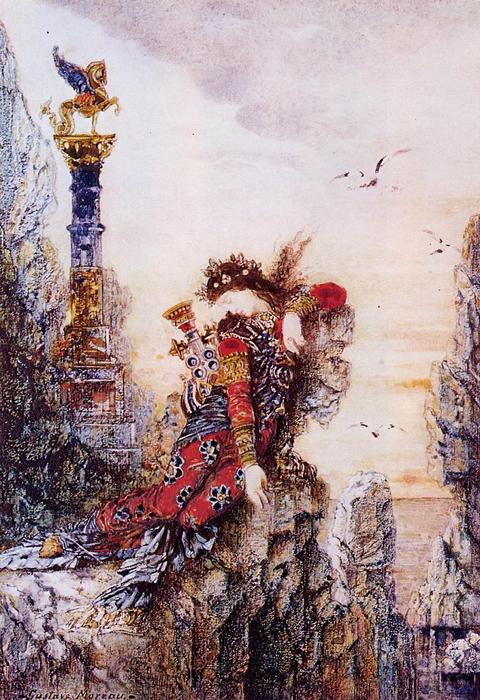
Moreau's "Sappho on the Cliff," painted around 1872, stands as a cornerstone of Symbolist art—a movement that rejected realism in favor of delving into the subconscious and conveying profound emotional resonance. It’s more than just a depiction of a woman; it’s an embodiment of mythic longing and contemplative solitude rendered with meticulous detail and imbued with layers of symbolic meaning. The painting captures Sappho, the legendary Greek poet known for her passionate verses celebrating female love, perched precariously on a rocky outcrop overlooking the turbulent sea—a visual metaphor for vulnerability and yearning amidst overwhelming forces.
Style and Technique: Embracing Symbolism’s Aesthetic Language
Moreau eschewed Impressionistic brushstrokes and opted instead for a technique characterized by dense layering of pigment—a hallmark of Symbolist painting. He employed glazing, applying thin translucent washes over thicker underpaintings to achieve luminous effects that subtly illuminate the scene. This painstaking process allowed him to build up textures and contours with remarkable precision, creating an image that feels both tactile and ethereal simultaneously. The artist’s meticulous attention to detail extends beyond mere representation; it serves to heighten the emotional impact of the artwork by immersing the viewer in a richly textured visual world.
Historical Context: Symbolism's Reaction Against Academic Tradition
The Symbolist movement arose as a reaction against the dominant artistic conventions of its time—particularly the rigid formalism of academic painting. Artists like Moreau sought inspiration from folklore, mythology, and esoteric traditions, rejecting the objective observation championed by Realists and Impressionists. They believed that art should strive to evoke emotion and convey spiritual truths rather than simply mirroring external reality. “Sappho on the Cliff” reflects this ethos, aligning itself with Symbolism’s preoccupation with psychological states and its exploration of themes like loss, desire, and transcendence—a deliberate departure from the narratives of grand historical events favored by earlier generations.
Symbolic Resonance: Birds, Color, and the Landscape as Vessels of Emotion
The painting's symbolism is deliberately understated yet powerfully suggestive. The woman’s scarlet dress draws attention to her figure against the muted tones of the cliffside landscape—a visual contrast that underscores her isolation and vulnerability. Scattered birds throughout the composition represent freedom and aspiration, juxtaposed with the turbulent sea below, symbolizing challenges and uncertainties. Moreau skillfully utilizes color to amplify emotional intensity; the red dominates Sappho’s attire, conveying passion and perhaps hinting at unspoken longing. The artist's masterful rendering of the seascape contributes to the overall atmosphere of melancholy beauty—a feeling that lingers long after viewing the artwork.
Emotional Impact: A Portrait of Inner Reflection
Ultimately, “Sappho on the Cliff” succeeds in capturing a profound sense of contemplative solitude and yearning. Moreau’s depiction invites viewers into Sappho's inner world—her gaze fixed upon the horizon, her posture conveying both resilience and vulnerability. The painting doesn’t offer easy answers or comforting consolations; instead, it presents a portrait of human experience marked by beauty tinged with sadness—a timeless meditation on love, loss, and the pursuit of spiritual understanding. It remains an enduring testament to Moreau's ability to transform visual imagery into emotionally resonant art.