A Study in Shadow and Form: Gustave Moreau’s Precursor to Mythic Portraiture
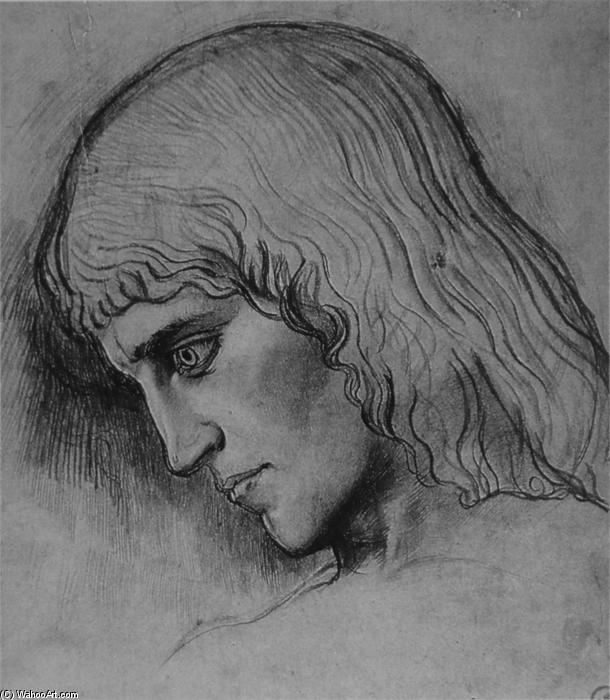
Moreau's "Study for the Head of Oedipus," executed around 1860, stands as a pivotal moment in Symbolist art—a testament to an artist determined to transcend mere representation and delve into the subconscious depths of human experience. Born in Paris amidst the intellectual ferment of his era, Gustave Moreau (1826-1898) rejected the dominant Realism and Impressionism movements, forging instead a path toward exploring spiritual and psychological themes through meticulously crafted imagery. His formative years at the École des Beaux-Arts instilled him with foundational artistic skills, yet it was his unwavering fascination with mythology and folklore that truly defined his creative vision.
- Subject Matter: The drawing depicts a male figure in profile—a deliberate choice reflecting Moreau’s preoccupation with anatomical precision and idealized beauty. It's not merely a portrait; it’s an attempt to capture the essence of humanity itself, filtered through the lens of ancient Greek legend.
- Style: Moreau’s style embodies the core tenets of Symbolism—a rejection of objective observation in favor of subjective emotion and symbolic allusion. He sought to evoke moods and ideas rather than simply depicting a likeness, prioritizing atmosphere and psychological resonance over photographic accuracy.
The artwork's technique is characterized by painstaking detail and masterful execution. Moreau employed graphite pencils on paper with unwavering dedication, utilizing hatching and cross-hatching to build up tonal values and create an illusion of texture that mimics the contours of skin and hair. The artist’s meticulous attention to line density and pressure contributes significantly to the overall impression—a palpable sense of solidity and depth achieved through subtle shading. Observe how Moreau skillfully captures the interplay of light and shadow, guiding the viewer's eye across the composition with deliberate precision.
- Technique: Moreau’s technique is rooted in Renaissance drawing traditions, emphasizing anatomical accuracy alongside expressive rendering. The artist meticulously builds up form through layering graphite strokes—a process that demands patience and unwavering focus.
- Historical Context: Created during the Symbolist movement's ascendance (roughly 1860-1900), “Study for the Head of Oedipus” reflects a broader artistic impulse to grapple with existential questions and explore the darker recesses of human psychology. Moreau’s work anticipates the expressive distortions and dreamlike imagery that would characterize subsequent Symbolist painters like Odilon Redon and Edvard Munch.
Beyond its technical brilliance, “Study for the Head of Oedipus” resonates deeply on an emotional level. The gaze of the figure—downcast yet imbued with quiet contemplation—suggests a profound inner life, hinting at anxieties and aspirations hidden beneath the surface. Moreau’s deliberate simplification of form—the stark contrast between light and shadow—amplifies this psychological impact, inviting viewers to contemplate themes of fate, suffering, and transcendence. It's a piece that speaks not just to the eye but also to the soul—a timeless exploration of human vulnerability and artistic ambition.
- Symbolism: The drawing’s symbolism extends beyond its mythological subject matter. Moreau utilizes chiaroscuro—the dramatic interplay of light and dark—to convey a sense of unease and mystery, mirroring the psychological complexities inherent in Oedipus’s predicament.
A reproduction of “Study for the Head of Oedipus” offers an exceptional opportunity to bring Moreau's visionary aesthetic into your home or studio. ArtsDot.com presents meticulously crafted reproductions that faithfully capture the artwork’s nuanced tonal range and textural subtleties—allowing you to experience the profound beauty and intellectual depth of this seminal Symbolist masterpiece firsthand.