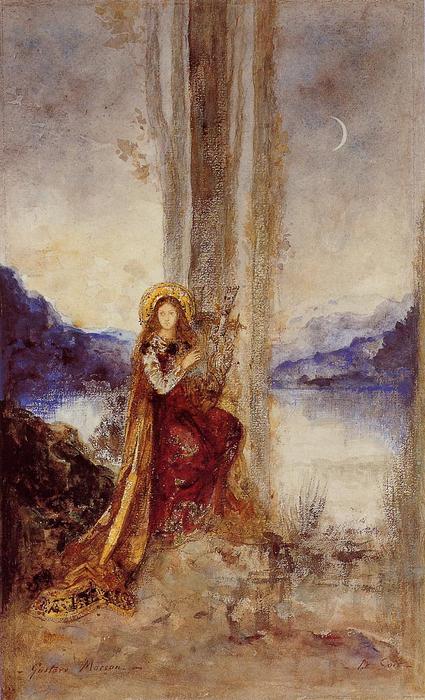
Gustave Moreau's "The Evening" captures a serene Symbolist scene of a solitary woman contemplating the moon amidst mountains, showcasing the artist’s dreamlike style from 1887. Discover this exquisite watercolor reproduction and bring its timeless beauty into your home.
A Vision of Twilight: Exploring Gustave Moreau’s “The Evening”
Gustave Moreau's "The Evening," painted in 1887, is more than just a depiction of a woman and a landscape; it’s a profound meditation on the human condition rendered through the lens of Symbolism. This watercolor, steeped in the atmosphere of late 19th-century Paris, invites viewers into a world where reality subtly blends with dream and myth. Moreau, a pivotal figure in the Symbolist movement, rejected the objective observation favored by Realists and Impressionists, instead seeking to evoke emotional responses and explore profound spiritual themes through carefully constructed imagery.
- Subject Matter: The central focus is a solitary woman standing beside a tree, her gaze directed towards an unseen point in the distance. This deliberate ambiguity – her attention unfixed, lost in contemplation – immediately establishes a sense of mystery and invites the viewer to share in her silent observation.
- Setting: Behind her unfolds a dramatic mountain landscape bathed in the soft hues of twilight. The composition utilizes atmospheric perspective, creating depth and emphasizing the vastness of nature, mirroring perhaps the immensity of human experience.
The Language of Symbolism
Moreau’s artistic approach was deeply rooted in Symbolist principles. He wasn't interested in simply representing what he saw; he aimed to communicate ideas and emotions through symbolic elements. The woman herself can be interpreted as a representation of the soul, searching for meaning amidst the beauty and uncertainty of existence. The tree, often associated with life and wisdom, further reinforces this theme. The inclusion of other figures, rendered smaller and less defined, suggests their relative insignificance in comparison to the central figure’s contemplative journey.
- Color Palette: Moreau masterfully employs a muted color palette dominated by blues, purples, and greens – colors traditionally associated with twilight, melancholy, and spirituality. These hues contribute significantly to the painting's serene yet slightly unsettling atmosphere.
- Technique: The watercolor technique is exquisitely executed, characterized by delicate washes and subtle gradations of tone. This creates a luminous effect, particularly in the sky, enhancing the ethereal quality of the scene.
Historical Context and Moreau’s Vision
"The Evening" was created during a period of significant artistic and intellectual ferment in Paris. The Symbolist movement, emerging as a reaction against materialism and scientific rationalism, sought to explore the realms of imagination, intuition, and spirituality. Moreau's work reflects this broader cultural shift, aligning with the movement’s fascination with mythology, folklore, and the occult. His background – trained at the École des Beaux-Arts but ultimately forging his own path – allowed him to synthesize traditional artistic skills with a radically new vision.
Emotional Impact and Artistic Legacy
Moreau's "The Evening" possesses a haunting beauty that continues to resonate with viewers today. It evokes a sense of quiet contemplation, melancholy, and perhaps even a touch of unease. The painting’s enduring appeal lies in its ability to tap into universal human emotions – our longing for meaning, our fascination with the unknown, and our connection to the natural world. It stands as a testament to Moreau's genius, solidifying his place as one of the most important figures in Symbolist art.