A Portal to the Subconscious: The Ethereal Encounter
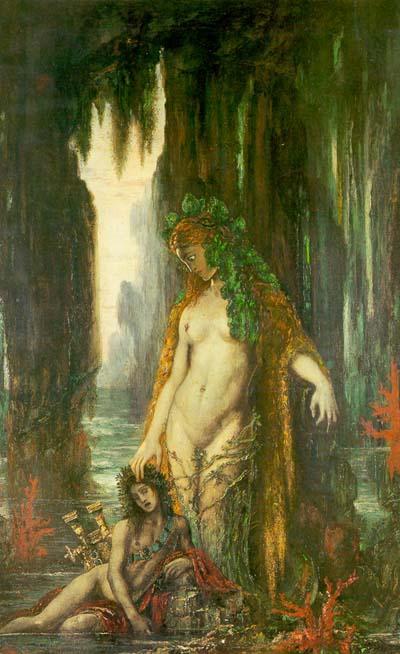
To gaze upon Gustave Moreau’s “The Poet and the Siren” is to step through a shimmering portal, leaving the tangible world behind for a realm where the boundaries between reality and dream dissolve into a golden haze. This masterpiece, painted around 1890, serves as a cornerstone of the Symbolist movement, capturing a moment plucked from the depths of Homer’s Odyssey. Here, we witness the mythic encounter where Odysseus is lured ashore by the enchanting, perilous song of the Siren. Yet, Moreau does not merely recount a legend; he transforms the classical myth into an intensely personal meditation on desire, illusion, and the transformative power of beauty. The painting invites the viewer to move beyond the surface of the canvas and descend into the shadowed corridors of the human psyche.
The composition centers on a profound, almost hypnotic connection between the figures. Amidst a lush, enchanted forest setting, a mermaid rests upon the rocks, her presence both alluring and enigmatic. Beside her stands the poet, caught in the gravitational pull of her melody. The surrounding landscape is not merely a backdrop but a living participant in the drama, filled with intricate botanical details and secondary figures that seem to drift through the scene like memories. For the discerning collector or interior designer, this piece offers more than mere decoration; it provides a focal point of profound mystery, capable of anchoring a room with its deep, narrative weight and atmospheric intensity.
The Dream Weaver’s Technique: Light, Gold, and Layering
Moreau’s technical execution is nothing short of miraculous, eschewing the naturalistic clarity of his Impressionist contemporaries in favor of a deliberately stylized aesthetic. He was a master of dense layering, a hallmark of Symbolist painting that creates an opulent, jewel-like surface. Through the painstaking application of pigments and the integration of shimmering gold leaf, Moreau achieves a visual richness that resembles stained glass more than traditional oil paint. This technique allows light to appear as if it is emanating from within the canvas itself, creating iridescent effects that shift as one moves around the work.
The artist meticulously blended colors to achieve subtle gradations, emphasizing the ethereal and otherworldly quality of his subjects. The interplay of light and shadow—the chiaroscuro of the soul—creates a sense of depth that is both physical and psychological. For those seeking to incorporate this work into a curated space, its ability to manipulate light makes it an extraordinary choice for galleries or sophisticated living areas where the play of illumination can enhance the painting's luminous, breathing quality.
Symbolism and the Rebellion Against Reality
Emerging as a powerful reaction against the perceived limitations of Realism, Moreau’s work embodies the spirit of rebellion that defined the late 19th century. While others sought to capture the fleeting light of a moment or the gritty truth of urban life, Moreau looked inward. Influenced by the philosophical weight of Nietzsche and the Wagnerian operatic tradition, he utilized symbolic imagery to communicate universal truths about the human condition. In “The Poet and the Siren,” every element—from the siren's song to the dense, primordial flora—acts as a metaphor for the struggle between the spiritual and the sensual, the intellect and the instinct.
This painting is an invitation to explore the unseen. It resonates with anyone drawn to the complexities of emotion and the beauty of the unknown. As a high-quality reproduction, this work allows the grandeur of Moreau’s vision to inhabit modern spaces, bringing a sense of historical depth and intellectual curiosity to any collection. It remains a timeless testament to the idea that art should not merely imitate life, but rather transcend it, offering a sanctuary for the imagination in an increasingly literal world.