A Symphony of Symbolism: Gustave Moreau’s “The Tatooed Salome”
Gustave Moreau's
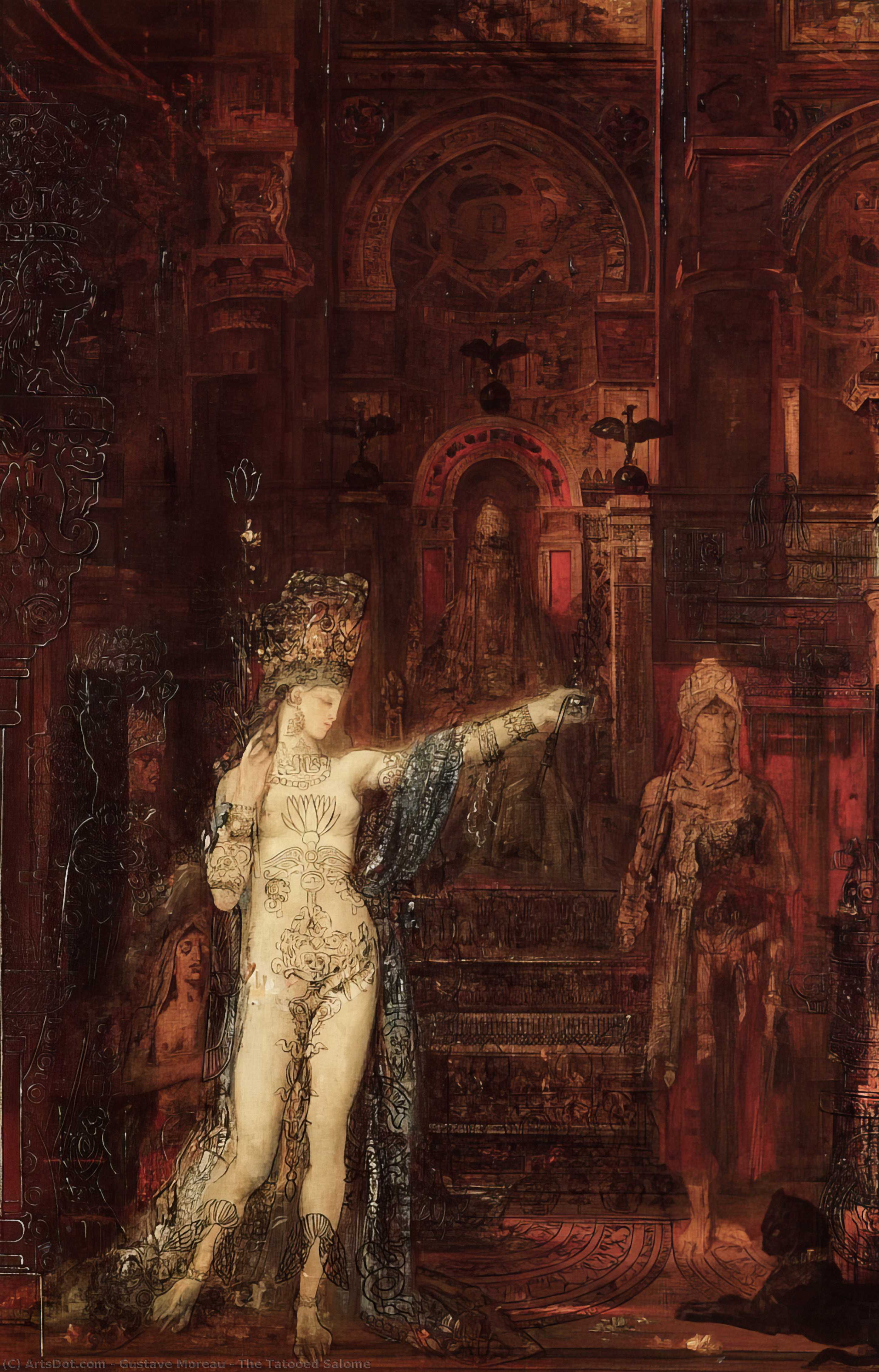
“The Tatooed Salome stands as a cornerstone of Symbolist art—a mesmerizing oil on canvas painting that encapsulates Moreau’s singular vision and masterful technique. Created in 1874, this unfinished masterpiece immediately distinguishes itself through his innovative approach: layering motifs over the original surface to achieve an arresting tattoo-like appearance. This wasn't merely stylistic choice; it was a deliberate exploration of how visual art could convey deeper meanings beyond mere representation.
Historical Context and Artistic Influences
Moreau began sketching “The Tatooed Salome” around 1874, but the painting remained perpetually incomplete—a characteristic trait of Moreau’s oeuvre. Versions were presented at the Salon of 1876, reflecting the prevailing artistic climate of the time. The addition of superimposed patterns in 1890, following Moreau's death, allowed for a radical freedom in color application and expansive compositional development before covering these areas with an intricate ornamental net. This technique owes considerable debt to Eugène Delacroix’s dramatic use of color and expressive brushstrokes—a stylistic kinship that profoundly shaped Moreau’s artistic sensibilities. Furthermore, the painting echoes themes found in biblical narratives and mythological tales, aligning it squarely within the Symbolist movement's preoccupation with spiritual contemplation.
Composition and Narrative Depth
Unlike his monumental “The Apparition,” John the Baptist is absent from “The Tatooed Salome,” placing Salome at the very heart of the composition. She stands facing forward, subtly swayed—a posture conveying both vulnerability and regal composure—with her face turned in profile and her left arm raised as if reaching for something beyond the frame. Herod occupies a commanding position on his throne, accompanied by the executioner of Saint John the Baptist, creating a dynamic interplay between power and impending doom. The entire decorative scheme is deliberately overlaid onto the canvas, generating an effect akin to ancient tattoos—a visual metaphor for hidden meanings and enduring symbols.
Symbolism Embodied: Layers of Meaning
Moreau’s technique transcends mere imitation; it actively seeks to communicate emotion and spiritual insight. The superimposed patterns themselves represent a departure from academic conventions, prioritizing color application across large expanses before concealing them with the ornamental net—a process that mirrors the artist's fascination with layering textures and hues to evoke profound psychological states. These motifs originate from diverse sources: chapiteaux from Brive, Angoulême, Moissac, and La Charité-sur-Loire—each contributing to a rich tapestry of references that enrich the painting’s symbolic significance. The image speaks volumes about Moreau's belief in art as a conduit for accessing realms beyond the visible world.
Legacy and Enduring Appeal
“The Tatooed Salome” remains a pivotal work in Moreau’s artistic legacy—a testament to his unwavering dedication to detail and complexity. Now housed in the Musée Gustave-Moreau in Paris, it continues to captivate viewers with its haunting beauty and intellectual depth. More than just a depiction of biblical legend, it embodies the Symbolist movement's core ethos: prioritizing subjective experience over objective representation. Its enduring appeal lies in Moreau’s ability to transform familiar narratives into evocative symbols—a feat that cements his place as one of the most influential artists of the late nineteenth century.