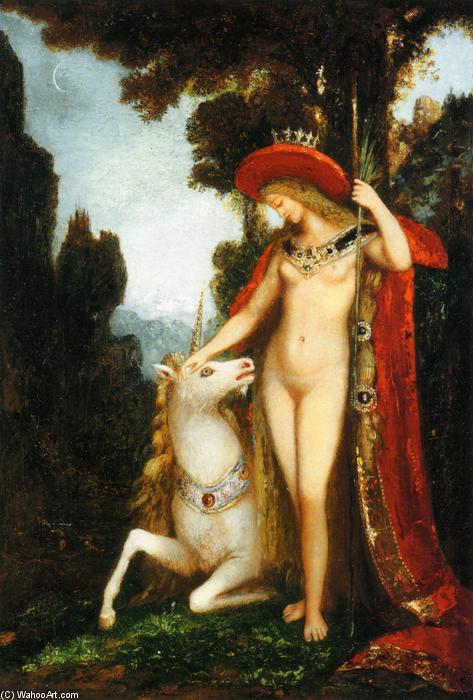
Experience Gustave Moreau’s ‘The Unicorne,’ a mesmerizing Symbolist painting of myth and beauty. Explore its dreamlike quality, vibrant colors & profound symbolism at ArtsDot.com.
Explore the captivating Symbolist art of Gustave Moreau (1826-1898), famed for mythological & biblical paintings like 'Salome'. Influenced Matisse & Rouault. Discover his dreamlike world!
A Vision of Mythic Beauty: Gustave Moreau’s The Unicorne
Gustave Moreau's *The Unicorne* stands as a cornerstone of Symbolist art, transporting viewers into a realm where dreams intertwine with mythology and spirituality. Painted in 1885, this mesmerizing oil on canvas—measuring 50 x 34 cm—isn’t merely an image; it’s an experience crafted by Moreau's singular artistic vision. Located within the Musée National Gustave-Moreau in Paris, France, this artwork offers a profound glimpse into the artist’s preoccupation with timeless themes and his masterful manipulation of color and form.
Decoding Symbolism: Layers of Meaning
Moreau’s approach to painting defied the conventions of Realism, rejecting objective representation for an exploration of inner psychological states. He sought to evoke emotion and contemplation by employing symbolic imagery drawn from Greco-Roman mythology and biblical narratives—a deliberate departure from the dominant artistic trends of his era. *The Unicorne* exemplifies this ethos perfectly. The central figure – a nude woman – embodies feminine grace and vulnerability, positioned before a unicorn, a creature steeped in pagan lore representing purity, innocence, and divine magic. This juxtaposition immediately establishes a dialogue between earthly desire and spiritual aspiration.
Technique and Artistic Style: Moreau’s Delicate Hand
Moreau's technique was characterized by meticulous detail and painstaking layering of glazes—a hallmark of Symbolist painting. He achieved an ethereal luminescence through subtle gradations of color, creating an atmosphere that feels both opulent and melancholic. Observe the intricate patterns adorning the woman’s crown and the unicorn’s horn; these aren't mere decorative embellishments but deliberate symbols reinforcing the artwork’s overarching message. The artist’s use of vibrant hues—particularly blues and golds—contributes to the painting’s dramatic impact, guiding the viewer’s gaze across the canvas.
Historical Context: Embracing the Spirit of Antiquity
Created during a period marked by intellectual ferment and artistic experimentation, *The Unicorne* reflects Moreau's engagement with the philosophical currents of his time—particularly Nietzschean ideas about the death of God and the importance of individual subjectivity. Like many Symbolist artists, Moreau rejected materialism and embraced mysticism, believing that art could access realms beyond empirical observation. He drew inspiration from ancient myths and biblical stories, reimagining them through a lens of psychological depth and emotional resonance.
Emotional Resonance: A Dreamlike Landscape
Ultimately, *The Unicorne* succeeds in capturing the elusive beauty of the imagination. The painting’s serene stillness invites contemplation, prompting viewers to consider questions of faith, desire, and transcendence. Moreau's masterful composition—coupled with his evocative use of color and texture—creates a dreamlike landscape that lingers in the memory long after viewing. It is precisely this ability to evoke emotion and inspire wonder that secures *The Unicorne*'s place as an enduring masterpiece of Symbolist art.