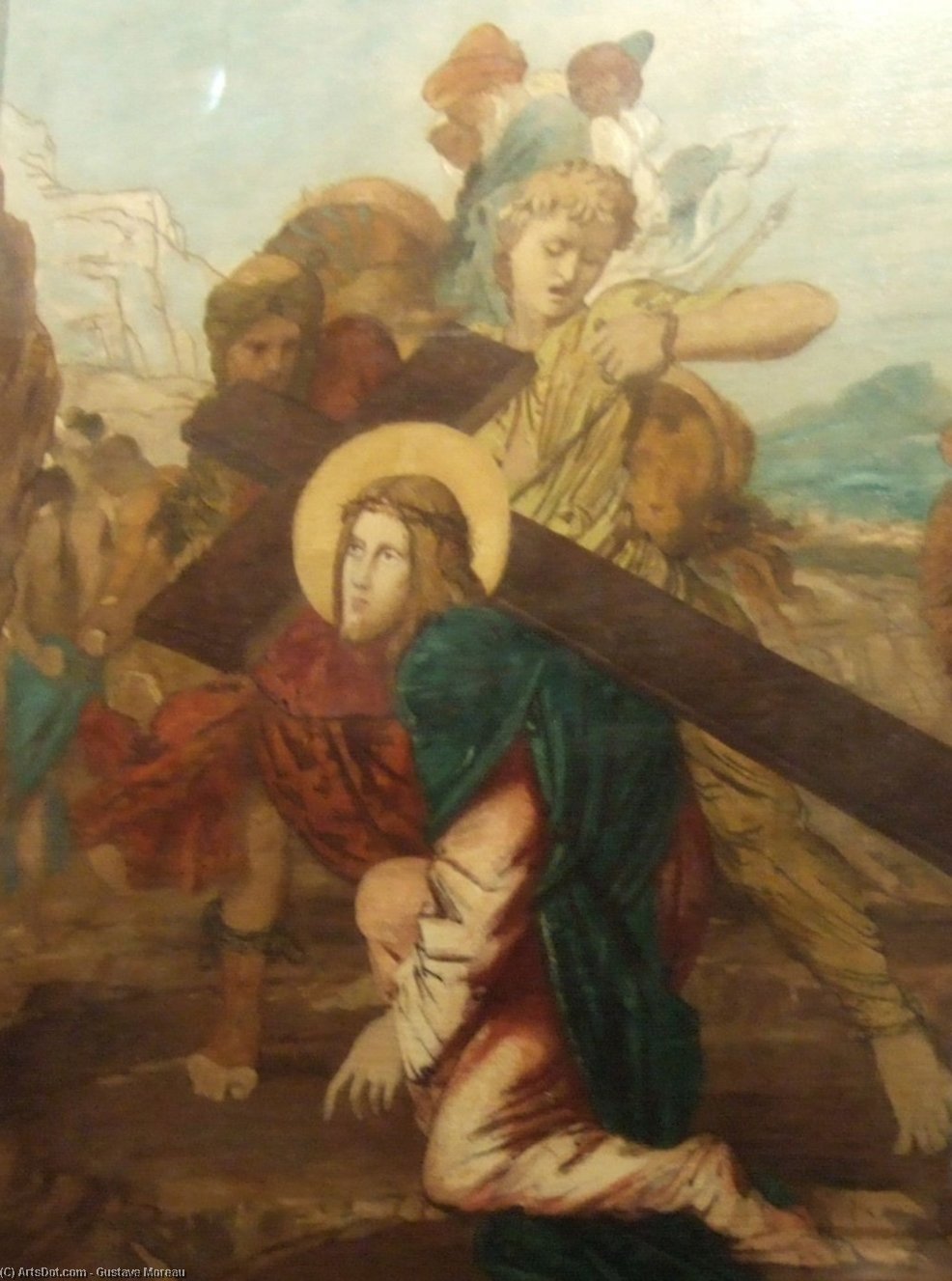
A Visionary Descent: The Ethereal World of Gustave Moreau
To gaze upon Gustave Moreau’s “Third Station of the Cross” is to step through a portal where the boundaries between the tangible world and the subconscious dissolve. Completed in 1897, this masterpiece serves as a profound cornerstone of the Symbolist movement, a period that sought to move beyond the mere imitation of nature to capture the spiritual and psychological truths hidden beneath the surface of reality. Unlike his contemporaries in the Impressionist circle who chased the fleeting dance of light upon water, Moreau turned his gaze inward. He meticulously constructed a narrative that feels less like a historical record and more like a sacred dream, inviting the viewer into a realm of mythic resonance and quiet, heavy mystery.
The scene captures a moment of profound vulnerability and transition: Jesus being lowered from the cross by two figures. Moreau envelops this central drama in a swirling vortex of drapery and foliage, a compositional masterstroke that creates a sense of rhythmic, almost hypnotic movement. The way the fabric folds and flows around the main figures does more than demonstrate anatomical precision; it serves to isolate the sacred event within a celestial, otherworldly atmosphere. For the collector or designer, this painting offers an unparalleled depth, providing a focal point that commands attention through its sheer emotional gravity and intricate, layered complexity.
The Alchemy of Technique and Symbolism
Moreau’s technical prowess is nothing short of alchemical. Utilizing tempera on canvas, he achieved a remarkable luminosity and textural detail that allows the painting to shimmer with an internal light. He employed a method of meticulous layering, building up pigments to create intricate patterns that catch the eye and reward prolonged contemplation. This technique lends a jewel-toned richness to the work, where every fold of cloth and every shadow in the background feels imbued with a weight of significance. The texture is not merely decorative; it is essential to the painting's ability to convey the "polyvalence" for which Moreau was celebrated—the idea that a single image can hold multiple layers of spiritual meaning.
Symbolism permeates every inch of the composition. The surrounding figures, some pressing close to the viewer and others receding into the shadows, create a sense of communal grief and layered observation. The presence of objects, such as the subtle inclusion of a book or the heavy textures of the landscape, adds layers of context that suggest a larger, unfolding cosmic drama. This is art that does not merely depict a story; it conjures an atmosphere of melancholy, reverence, and awe. For those seeking to infuse a space with intellectual depth and spiritual elegance, this work provides a sophisticated narrative anchor that transcends simple decoration.
An Eternal Legacy for the Discerning Collector
In the context of art history, “Third Station of the Cross” stands as a testament to Moreau’s role as the "painter par excellence" of Symbolism. His ability to blend academic rigor—honed at the École des Beaux-Arts—with an unbridled imaginative spirit allows the painting to remain eternally modern. It possesses a psychological complexity that resonates with the contemporary soul, speaking to our shared experiences of suffering, transition, and the search for meaning in the face of the unknown.
For interior designers and art enthusiasts, a high-quality reproduction of this work offers more than just visual beauty; it offers an invitation to introspection. Whether placed in a grand gallery setting or a quiet, contemplative study, Moreau’s vision brings a sense of historical prestige and an aura of mystery. It is a piece designed for those who appreciate the fine line between the seen and the unseen, making it a timeless acquisition for any collection dedicated to the profound beauty of the human spirit.