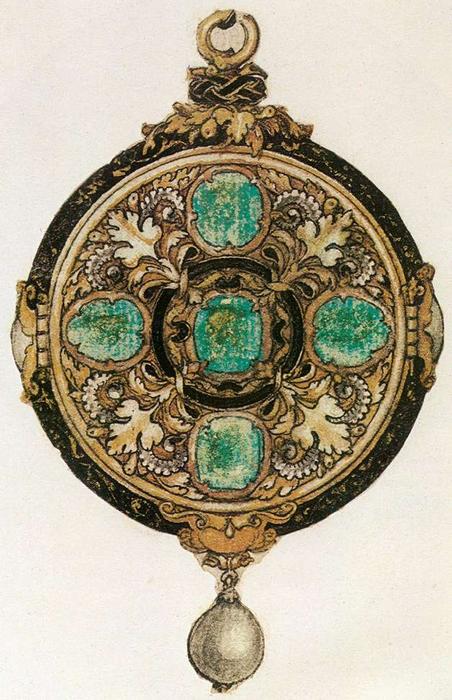
Design for a Pendant – A Glimpse into Renaissance Ornamentation
Hans Holbein the Younger’s “Design for a Pendant,” created in 1535, isn't merely a study of jewelry; it’s a meticulously crafted window into the aesthetic sensibilities of the Northern Renaissance. This exquisite drawing, now housed within the British Museum’s collection, offers a captivating glimpse into the world of courtly decoration and the burgeoning interest in geometric abstraction that characterized this pivotal era. More than just a technical exercise, it reveals Holbein's profound understanding of color, proportion, and the interplay between natural forms and stylized design – elements he would later masterfully employ in his renowned portraits.
The piece immediately draws the eye with its elegant simplicity and sophisticated balance. A circular form dominates, acting as the framework for a complex arrangement of interlocking circles and delicate lines. Within this central motif resides a captivating array of green jewels—a vibrant counterpoint to the predominantly neutral tones of the parchment. These aren’t simply decorative embellishments; they are carefully positioned to create a dynamic visual rhythm, suggesting movement and depth. The use of varying shades of green – from deep emeralds to lighter, almost translucent hues – adds richness and complexity to the composition, hinting at the luxurious materials that would have been employed in the actual pendant.
The Artist’s Hand: Holbein's Northern Renaissance Style
Hans Holbein the Younger was a pivotal figure in the transition from late Gothic to Renaissance art. Trained by his father, Hans Holbein the Elder, a master painter and printmaker, he inherited a strong foundation in observation and technique but quickly developed his own distinctive style. Unlike the heavily ornamented and often emotionally charged works of his father, Holbein’s art is characterized by its clarity, precision, and a remarkable ability to capture likeness with astonishing accuracy. “Design for a Pendant” exemplifies this approach – it's not about dramatic expression, but rather about meticulous detail and harmonious composition. The drawing showcases Holbein’s mastery of linear perspective and his understanding of how geometric shapes could be used to create illusions of depth and volume.
The influence of the Northern Renaissance is palpable in this piece. Holbein's work reflects a shift away from the purely religious focus that dominated much of European art at the time, embracing humanist ideals and a greater interest in secular subjects. The geometric patterns—a hallmark of the period—were inspired by classical antiquity but adapted to suit the tastes of the wealthy elite. This drawing demonstrates Holbein’s ability to synthesize these diverse influences into a cohesive and visually compelling whole.
Symbolism and Context: Courtly Decoration in Tudor England
“Design for a Pendant” was created during a period of significant political and cultural change in England. Henry VIII's rise to power brought with it a renewed interest in luxury, ornamentation, and courtly display. Jewelry played a crucial role in this culture of extravagance, serving as symbols of status, wealth, and royal authority. The fleur-de-lis motif, prominently featured within the design, was a potent symbol of French royalty – a subtle nod to the political landscape of the time. The pendant itself would have been a prized possession, likely commissioned by Anne Boleyn, Henry VIII’s second wife, known for her lavish tastes and patronage of the arts.
The drawing's focus on geometric patterns and symmetrical arrangements reflects the prevailing aesthetic trends in Tudor England. These designs were often incorporated into furniture, textiles, and other decorative objects, creating a cohesive and opulent environment within the royal court. Holbein’s “Design for a Pendant” provides valuable insight into this world of luxury and refinement, offering a tangible connection to the artistic tastes of one of England's most influential monarchs.
Reproducing a Masterpiece: ArtsDot.com’s Commitment to Authenticity
At ArtsDot.com, we understand the profound appreciation for original artwork and strive to capture its essence in our meticulously crafted reproductions. Our team of skilled artists utilizes 100% cotton canvas and archival-quality inks to faithfully recreate “Design for a Pendant” by Hans Holbein the Younger. We painstakingly replicate every detail – from the delicate lines of the geometric patterns to the subtle variations in color—ensuring that your reproduction is as close as possible to the original drawing. With ArtsDot.com, you’re not just acquiring a beautiful piece of art; you're investing in a legacy of artistic excellence.
Explore our collection of Hans Holbein reproductions and discover how we can bring this captivating masterpiece into your home or office. Browse other works by Hans Holbein the Younger on our website today.