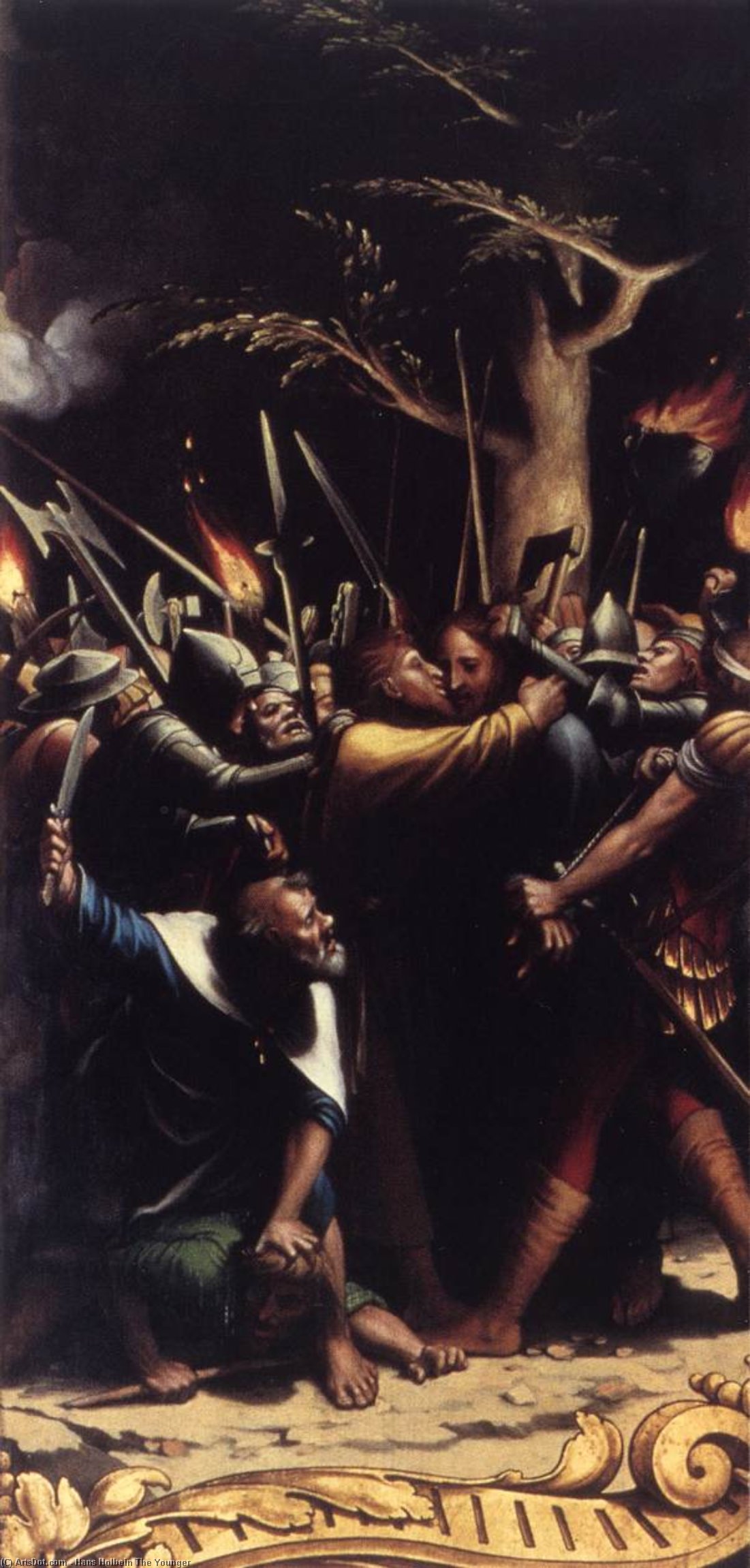
A Moment Frozen in Time: "Passion - the passion (detail)" by Hans Holbein the Younger
This arresting detail from Hans Holbein the Younger’s “Passion” is more than just a depiction of a biblical scene; it's a visceral plunge into the heart of human emotion and religious drama. Painted around 1525, during a period of intense spiritual questioning and artistic innovation within the Northern Renaissance, this work embodies Holbein’s unparalleled ability to capture not merely physical appearance but the very soul of his subjects. The image focuses on a pivotal moment – a gathering of onlookers surrounding what is unmistakably the crucifixion of Christ – rendered with an almost brutal realism that compels the viewer to confront the profound suffering and sacrifice at its core.
The Master’s Technique: Precision and Psychological Depth
- Oil on Panel: Holbein's masterful use of oil paint allowed for a level of detail previously unseen in Northern European art. The smooth gradations of tone, the subtle modeling of flesh, and the meticulous rendering of textures – from the rough bark of the tree to the worn garments of the figures – demonstrate his extraordinary technical skill.
- Chiaroscuro: Employing dramatic contrasts between light and shadow (chiaroscuro), Holbein intensifies the emotional impact of the scene. The focused illumination on Christ’s body, juxtaposed with the darker forms surrounding him, heightens the sense of pathos and vulnerability.
- Anatomical Accuracy: Holbein's rigorous study of human anatomy is evident in the precise depiction of musculature and bone structure, reflecting his commitment to portraying figures with believable physicality.
Symbolism Within the Scene – A Tableau of Faith and Humanity
The composition itself is laden with symbolic weight. The central tree, a recurring motif in Christian art representing the Tree of Knowledge and Sacrifice, dominates the scene, anchoring the narrative. The diverse group of onlookers—some in mourning, others in contemplation, and some seemingly lost in disbelief – represents the multifaceted human response to witnessing such an extraordinary event. The inclusion of the horse on the right side is particularly intriguing; its presence may allude to Roman military power and the imperial context within which Christ’s crucifixion took place, adding another layer of complexity to the scene.
Historical Context: Reformation and Artistic Innovation
Painted in the tumultuous years surrounding the early 16th century, “Passion” reflects the anxieties and spiritual fervor of the era. The rise of Protestantism challenged traditional religious dogma, prompting artists like Holbein to explore themes of faith, doubt, and redemption with unprecedented honesty. Holbein’s work was commissioned during a period of significant artistic innovation, moving away from the stylized conventions of earlier Gothic art towards a more naturalistic and emotionally resonant style – a hallmark of the Northern Renaissance.
Emotional Impact & Reproduction Possibilities
"Passion - the passion (detail)" possesses an enduring power to move viewers. Holbein’s ability to convey profound emotion through his figures is remarkable, inviting contemplation on themes of sacrifice, suffering, and redemption. ArtsDot offers meticulously crafted hand-painted reproductions of this iconic artwork, allowing you to bring its beauty and emotional depth into your home or office. Our skilled artisans employ the same techniques as Holbein himself, ensuring an authentic representation that captures the essence of this masterpiece. Choose from a range of sizes and canvas materials to perfectly suit your space and aesthetic.