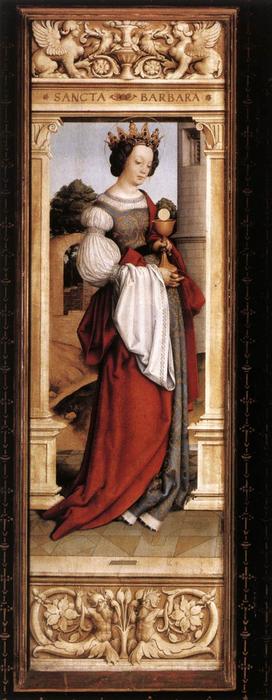
Discover Hans Holbein’s ‘St. Barbara’! A stunning Northern Renaissance oil painting of a captivating saint. Admire its realism & symbolism. Own a piece of art history via ArtsDot.com!
Hans Holbein the Younger (1497-1543): Northern Renaissance master of realistic portraiture, famed for painting Tudor royalty like Henry VIII & intricate detail.
Discover European art history at the Alte Pinakothek in Munich! Explore Renaissance & Baroque masterpieces by Dürer, Rembrandt & Rubens within a stunning neoclassical setting.
A Saintly Vision: Unveiling Hans Holbein the Younger’s St. Barbara
Hans Holbein the Younger's *St. Barbara*, painted in 1516, is a captivating example of Northern Renaissance artistry. This oil on panel (150 x 47 cm) currently resides at the Alte Pinakothek in Munich and offers a compelling glimpse into both religious devotion and the masterful technique that defined Holbein’s career.
Subject & Narrative
The painting portrays St. Barbara, a figure deeply revered for her unwavering faith and tragic martyrdom. She is depicted as a young woman of noble bearing, adorned in rich red garments – a color often associated with courage and sacrifice. A delicate crown rests upon her head, signifying not earthly power but perhaps divine grace or the triumph over suffering. Most strikingly, she holds a small cage containing a dove, a potent symbol representing both captivity *and* the promise of spiritual freedom. The architectural backdrop, featuring classical columns, suggests an interior space – possibly a chamber within a castle or church – lending a sense of contained dignity to the scene.
Artistic Style & Technique
Holbein’s meticulous attention to detail is immediately apparent. He was renowned for his realism and ability to capture the textures and nuances of fabrics, skin tones, and materials. The painting exemplifies characteristics of the Early Netherlandish style – also known as the Flemish Primitives – a movement that prioritized precise observation and symbolic representation. Notice how Holbein uses light and shadow to model Barbara’s face and drapery, creating a sense of volume and depth. His brushwork is remarkably refined, contributing to the overall impression of polished elegance.
Historical Context & Symbolism
St. Barbara's story originates in the 3rd century AD. Legend recounts her imprisonment by her pagan father who sought to protect her from converting to Christianity. She became a symbol of protection for miners, artillerymen, and others facing dangerous professions – likely due to her association with being imprisoned within towers. The dove she holds is not merely decorative; it represents the Holy Spirit and Barbara’s unwavering faith even in confinement. The architectural setting subtly alludes to the structures associated with her legend—the tower where she was held captive. Holbein, working during a period of religious upheaval leading up to the Reformation, likely intended this depiction to resonate with contemporary audiences grappling with questions of faith and persecution.
Emotional Impact & Interpretation
*St. Barbara* is not simply a portrait; it’s an evocation of inner strength and spiritual resilience. The saint's gaze, though directed slightly away from the viewer, conveys a sense of quiet dignity and unwavering resolve. The painting invites contemplation on themes of faith, sacrifice, and the enduring power of the human spirit in the face of adversity. It is a work that speaks to both the beauty of artistic skill *and* the depth of religious belief.
Holbein’s Legacy
Hans Holbein the Younger (1497-1543) was a German-Swiss artist who became celebrated for his portraiture, particularly during his time as court painter to King Henry VIII in England. His ability to capture not only physical likeness but also psychological depth set him apart from his contemporaries. Beyond portraits, Holbein produced religious works, satirical prints, and designs that reflect the complex political and religious landscape of his era.
Considerations for Collectors & Designers
A reproduction of *St. Barbara* would be a stunning addition to any collection or interior space. The rich color palette – particularly the vibrant red – lends itself well to both traditional and contemporary settings. The painting’s vertical format makes it ideal for hallways, dining rooms, or as a focal point in a study. Its historical significance and artistic merit ensure that it will continue to inspire admiration for generations to come.