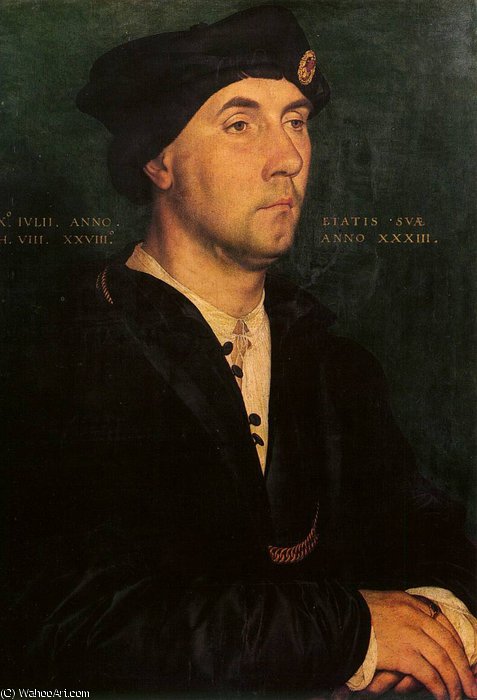
Captured in exquisite detail by Hans Holbein the Younger during the Northern Renaissance, this portrait exudes solemn seriousness and psychological insight—a masterful depiction of a man adorned with a black hat and gold trim, gazing intently at the viewer.
A Portrait of Dignified Resolve: Exploring Hans Holbein the Younger’s Untitled (4186)
The painting, tentatively titled “Untitled (4186),” presents a striking portrait of a man—a figure rendered with an unparalleled level of detail and imbued with palpable psychological complexity. Captured by Hans Holbein the Younger during his prolific period in England, this artwork transcends mere representation; it embodies the spirit of the Northern Renaissance’s fascination with human anatomy and emotion. The photograph reveals a gentleman adorned in a black hat embellished with gold trim, gazing directly at the viewer with an expression that speaks volumes about seriousness and authority. His meticulously groomed mustache and goatee contribute to his aristocratic demeanor, reflecting the stylistic conventions prevalent during Tudor England—a time marked by political intrigue and artistic innovation.
- Style: Holbein’s masterful technique exemplifies the High Renaissance style, prioritizing realism and anatomical accuracy. However, unlike many of his contemporaries who adhered strictly to idealized forms, Holbein skillfully captured the subtle nuances of human expression, elevating portraiture beyond mere likeness.
- Technique: Employing oil paint on panel—a favored medium for portrait painters of the era—Holbein utilized layering and glazing techniques to achieve luminous skin tones and a remarkable sense of depth. The meticulous application of pigment allowed him to capture textures with astonishing precision, from the sheen of the hat’s gold trim to the subtle folds of the man's clothing.
Historical Context: Tudor England and Artistic Patronage
This portrait emerged during Henry VIII’s reign—a period characterized by dramatic religious upheaval and ambitious royal ambition. Holbein was commissioned by Henry VIII to depict prominent figures within the court, demonstrating the importance of artistic patronage in shaping cultural trends. The painting reflects the humanist ideals that permeated Tudor society, emphasizing human intellect and moral virtue – qualities Holbein sought to convey through his subject’s gaze and posture.
Symbolism: Beyond Appearance—The Language of Gesture
Beyond its visual splendor, “Untitled (4186)” is rich in symbolic significance. The man's unwavering stare conveys confidence and determination—attributes considered desirable in a ruler navigating turbulent political waters. Furthermore, the positioning of his hands—one resting on his thigh, the other outstretched slightly—suggests contemplation and deliberation. These gestures subtly communicate inner thoughts and emotions, inviting viewers to engage in a dialogue with the portrait’s subject.
Emotional Impact: Capturing the Essence of Dignified Presence
Ultimately, Holbein's achievement lies in his ability to evoke a profound emotional response. The painting transcends its formal constraints—a testament to Holbein’s genius—to convey an aura of dignified resolve and intellectual contemplation. It serves as a powerful reminder that art can illuminate not only what we see but also what we feel, capturing the intangible qualities that define human character.