A Vision of Renaissance Grace
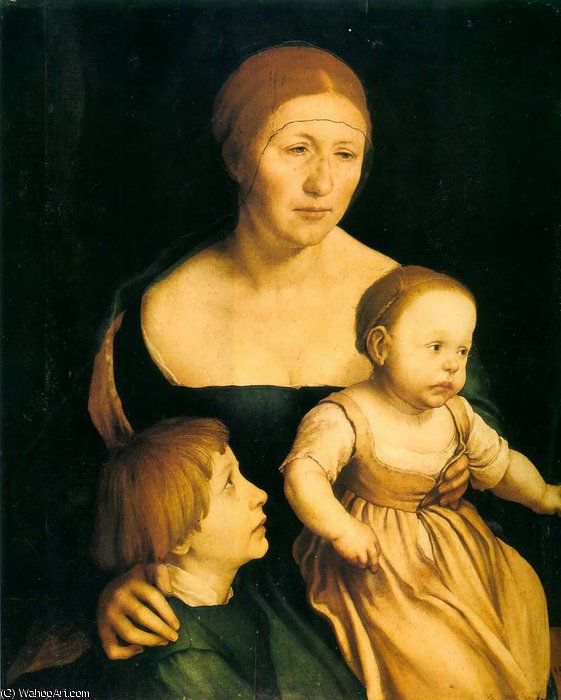
In the quiet presence of Hans Holbein the Younger’s untitled (4805), one does not merely encounter a portrait, but enters a profound dialogue with the past. This exquisite work, emerging from the golden era of the Northern Renaissance around 1533, serves as a breathtaking window into the Tudor court. At its heart, the painting captures a moment of tender intimacy: a noblewoman, believed by many to be Anne Holland, Countess of Nottingham, cradling her two children. There is an undeniable gravity to the scene, a sense of weight not just in the heavy, textured fabrics of their attire, but in the very atmosphere of devotion and lineage that Holbein so masterfully orchestrates.
The composition is a masterclass in emotional storytelling. The mother’s gaze, characterized by a quiet dignity and a subtle, soulful depth, anchors the piece, while the children—standing with hands clasped in a gesture of pious innocence—symbolize the continuity of family and the sacredness of the next generation. For the discerning collector or interior designer, this painting offers more than mere decoration; it provides a focal point of historical substance, bringing an air of intellectual sophistication and timeless warmth to any curated space.
The Mastery of Light and Anatomical Truth
To study this work is to witness the pinnacle of Holbein’s technical virtuosity. Renowned for his scientific approach to art, Holbein applied a level of anatomical precision that was revolutionary for his time. Every fold of the woman's ruffled collar and every delicate feature of the children's faces is rendered with an almost tactile realism. He achieved this through the painstaking application of thin oil glazes, a technique that allows light to penetrate the layers of paint and reflect back, creating a soft, ethereal luminescence that seems to emanate from within the subjects themselves.
This luminous quality mimics the gentle flicker of candlelight, imbuing the portrait with a sense of living breath. The interplay between shadow and light—the chiaroscuro of the Northern tradition—does not merely define form; it sculpts emotion. The subtle shading around the eyes and the soft contours of the children's hands invite the viewer to linger, discovering new details with every glance. It is this marriage of scientific observation and poetic expression that makes a high-quality reproduction of this piece such a captivating addition to a refined collection.
A Legacy of Devotion and History
Beyond its aesthetic brilliance, untitled (4805) is steeped in the turbulent history of 16th-century England. Created during the reign of Henry VIII, a period defined by religious reformation and political upheaval, the painting carries an underlying current of stability and faith. The clothing, the poised gestures, and the very arrangement of the figures speak to a world where status was inextricably linked to piety and family duty. Holbein, serving as a trusted chronicler of the English court, captured not just the likenesses of the elite, but the values they sought to project to posterity.
For those seeking to infuse their surroundings with a sense of heritage and narrative depth, this portrait stands as an incomparable inspiration. It is a piece that transcends time, offering a bridge to the Renaissance spirit. Whether placed in a grand library or a contemporary living space, the painting’s ability to evoke both historical awe and intimate connection ensures it remains a timeless treasure for any lover of fine art.