A Portrait of Scholarly Intensity: Hans Holbein’s ‘Untitled (5146)’
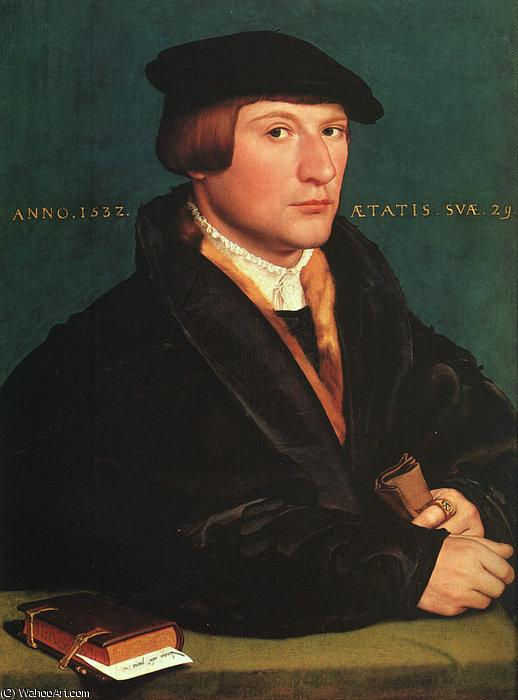
Hans Holbein the Younger's “Untitled (5146)” is not merely a depiction of a man in robes; it’s a meticulously crafted window into the intellectual and spiritual climate of the Northern Renaissance. This arresting portrait, likely executed around 1530-1535, captures the essence of a learned individual – perhaps a clergyman or scholar – with an intensity rarely seen in portraiture of this era. The subject, identified by his distinctive beard and mustache, gazes directly at the viewer with unwavering eyes, creating an immediate and profoundly intimate connection. Holbein’s mastery is immediately apparent: the rendering of texture—the heavy folds of the black robe, the delicate white collar, the worn leather of the book – speaks to a dedication to realism that was revolutionary for its time.
The Precision of Detail: Holbein's Technique
- Oil on Panel: Executed in oil paint on a wooden panel, a technique favored by Holbein, allowed for the layering of colors and subtle gradations that contribute to the portrait’s remarkable depth and luminosity. The slow-drying nature of oil paint enabled Holbein to build up complex forms with incredible precision.
- Chiaroscuro: Holbein's masterful use of *chiaroscuro* – the dramatic contrast between light and shadow – sculpts the subject’s face, emphasizing his features and creating a sense of three-dimensionality. The subtle play of light across the robe enhances its texture and adds to the overall visual impact.
- Detailed Observation: Holbein's meticulous attention to detail is evident in every aspect of the portrait, from the individual strands of hair to the wrinkles around the subject’s eyes. This reflects his father’s teachings – a dedication to observing and capturing not just likeness but the very soul of his subjects.
Symbolism and Context: A Window into Tudor England
The painting's symbolism is layered, reflecting the intellectual currents of the time. The book held in the subject’s hand represents knowledge, learning, and perhaps religious devotion – a common theme in portraits commissioned for the English court during this period. The clock in the upper left corner subtly alludes to the passage of time and the importance of spiritual reckoning. Holbein's work flourished during a pivotal moment in English history—the reign of Henry VIII—a time marked by religious upheaval and intellectual ferment. His portraits were frequently commissioned by prominent figures within the court, offering a valuable glimpse into the lives and aspirations of this era.
Emotional Impact: A Portrait of Contemplation
"Untitled (5146)" transcends a simple likeness; it evokes a powerful sense of contemplation and introspection. The subject’s direct gaze compels the viewer to confront their own thoughts and beliefs. Holbein's ability to capture such profound psychological depth is what elevates this portrait beyond mere representation, transforming it into a timeless meditation on human nature. This reproduction offers an unparalleled opportunity to experience the enduring power of Holbein’s artistic vision – a testament to his genius and a captivating addition to any discerning collection.