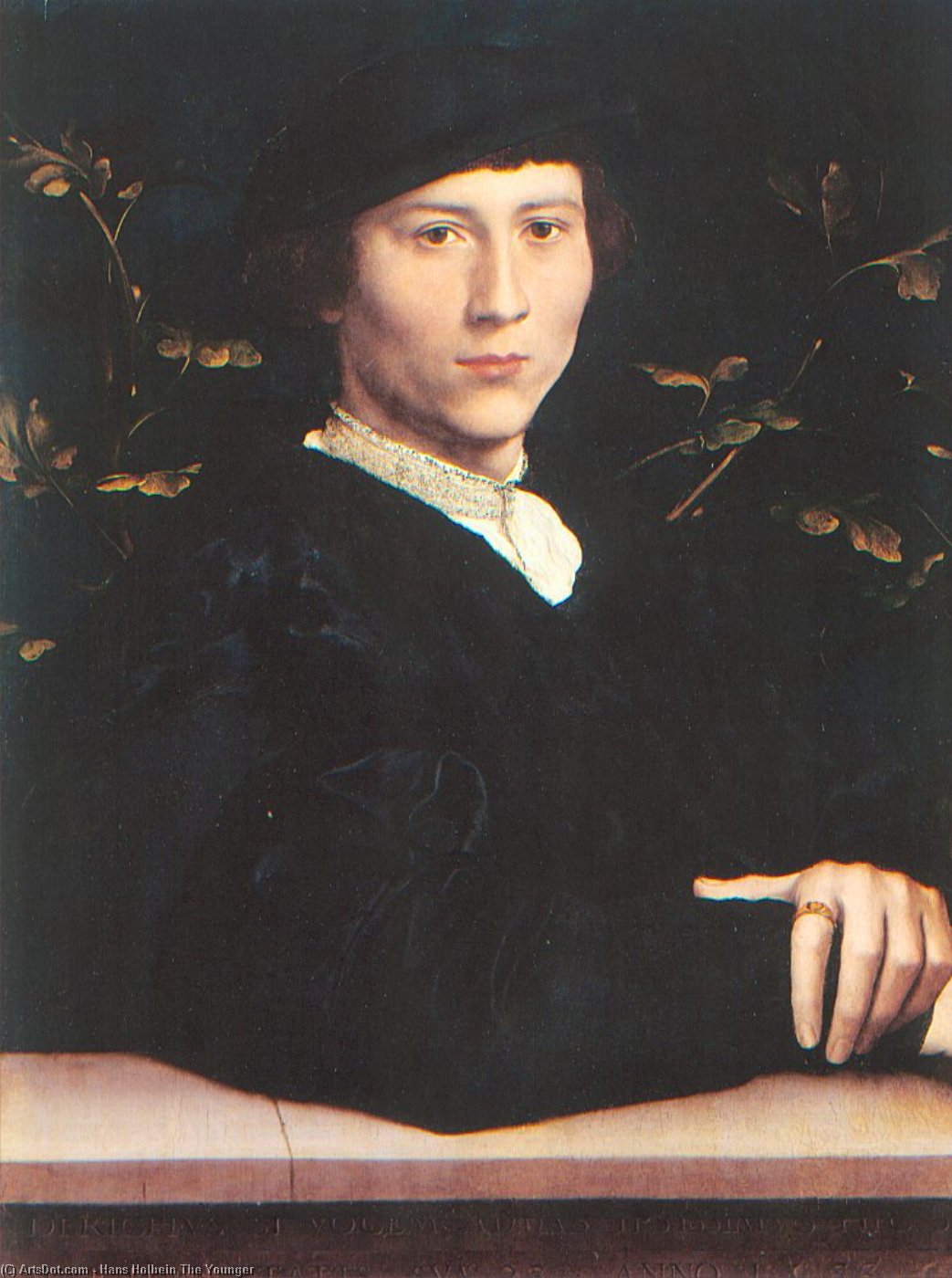
Admire Hans Holbein’s "Untitled (725)", a haunting Renaissance portrait of a young man in dark tones & rich detail. Explore its realism, symbolism & masterful technique.
Hans Holbein the Younger (1497-1543): Northern Renaissance master of realistic portraiture, famed for painting Tudor royalty like Henry VIII & intricate detail.
A Portrait of Quiet Dignity: Exploring Hans Holbein the Younger’s “Untitled (725)”
“Untitled (725)” by Hans Holbein the Younger stands as a testament to the Northern Renaissance's obsession with meticulous observation and psychological realism. Executed sometime around 1535, this portrait captures a young man in contemplative repose against a backdrop of dark foliage—a composition that speaks volumes about the artist’s skill and his era’s aesthetic sensibilities. The image immediately draws the eye to the subject’s face, rendered with astonishing detail; Holbein's masterful use of chiaroscuro – dramatic contrasts between light and shadow – sculpts the figure’s features, conveying a palpable sense of solemnity and inner stillness.
Technical Brilliance: Layers of Glaze and Texture
Holbein’s technique exemplifies the advancements in oil painting during his time. Rather than applying paint in broad strokes, he employed thin glazes—transparent layers of pigment applied over previous coats—to build up color and texture with remarkable subtlety. This painstaking process allowed him to achieve luminous skin tones and capture the intricate patterns of fabric, particularly evident in the shirt worn by the sitter. The artist’s meticulous brushwork is palpable throughout the canvas; one can almost feel the velvety surface of the foliage and the subtle folds of clothing. Materials used were primarily oil paints applied to a primed canvas—a standard practice for portraiture during the Renaissance.
Historical Context: Tudor England and Artistic Patronage
Painted during Henry VIII’s reign, “Untitled (725)” reflects the artistic fervor of Elizabethan England. Holbein had already established himself as a celebrated portraitist in Basel and Zurich before accepting commissions from the English court, where he served as royal painter for several years. This patronage fostered an environment conducive to innovation and experimentation—artists like Holbein were tasked with elevating the status of their subjects through visual representation. The painting’s solemn demeanor aligns perfectly with the prevailing mood of Tudor England, a period marked by religious upheaval and political ambition.
Symbolism: Youthful Promise Amidst Dark Foliage
Beyond its technical prowess and historical significance, “Untitled (725)” is rich in symbolic meaning. The dark foliage surrounding the figure serves as an evocative counterpoint to his pale complexion—a visual metaphor for youthfulness, vitality, and perhaps even vulnerability. It suggests a connection to the natural world, reflecting humanist ideals that emphasized the importance of human experience within the broader context of existence. Furthermore, the ring adorning the man’s finger symbolizes status and wealth, reinforcing the portrait's narrative about an individual of considerable influence.
Emotional Resonance: A Moment Frozen in Time
Ultimately, “Untitled (725)” transcends mere likeness; it captures a profound psychological state—a quiet contemplation that invites viewers to contemplate themes of dignity, introspection, and perhaps melancholy. Holbein’s masterful manipulation of light and shadow creates an atmosphere of intimacy and solemnity, drawing us into the subject's gaze and prompting reflection on the complexities of human emotion. This enduring image continues to fascinate art historians and collectors alike—a timeless masterpiece that exemplifies the pinnacle of Renaissance portraiture.