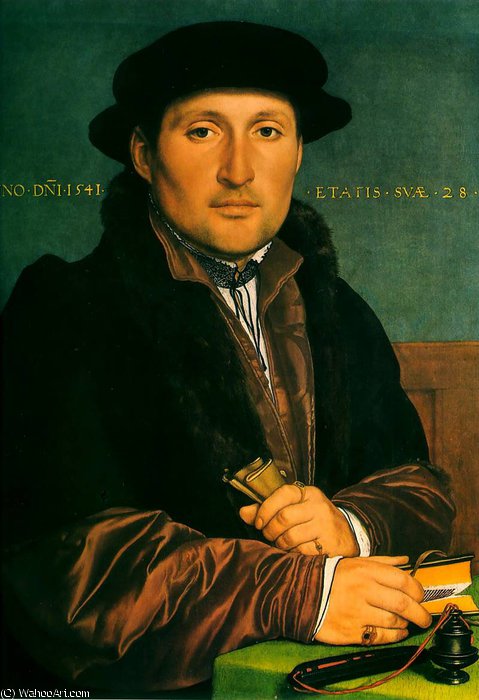
Explore Hans Holbein’s "untitled (8191)", a stunning Renaissance portrait brimming with realism & symbolism. Admire its dramatic lighting, rich detail & Tudor elegance.
Hans Holbein the Younger (1497-1543): Northern Renaissance master of realistic portraiture, famed for painting Tudor royalty like Henry VIII & intricate detail.
A Renaissance Portrait of Dignity and Intellect
This striking portrait, executed in the style of a master like Hans Holbein the Younger, presents a compelling study of a man defined by his intellect and social standing. The composition immediately draws the eye to the subject’s face, framed by a traditional pyramidal structure that lends stability and gravitas to the image. His direct gaze engages the viewer, conveying confidence and perhaps a hint of authority.
Style & Technique: Echoes of the Northern Renaissance
The artwork is deeply rooted in the traditions of the Early Netherlandish painting – a style characterized by meticulous detail and an almost photographic realism. Oil on panel was likely the medium employed, allowing for the smooth blending of colors and subtle gradations of light and shadow that define the subject’s features and clothing. The artist demonstrates exceptional skill in rendering textures; one can almost feel the weight and richness of the fabrics. Linear perspective is expertly utilized to create a convincing sense of depth, with receding planes formed by the table, books, and background wall.
Historical Context: Holbein’s World
Hans Holbein the Younger (1497-1543) was a pivotal figure in the Northern Renaissance, renowned for his portraits of prominent figures – most notably within the English court of Henry VIII. While this work is currently untitled and its provenance unknown, it embodies the hallmarks of Holbein’s style: exceptional realism, precise detail, and an ability to capture not just likeness but also character. His father, Hans Holbein the Elder, was also a celebrated artist, though their styles are distinct. The period saw a flourishing of artistic innovation alongside growing humanist thought, influencing portraiture to emphasize individual personality and intellectual pursuits.
Symbolism & Meaning
The inclusion of books and instruments on the table is particularly significant. These objects suggest that the subject is a man of learning – perhaps a scholar, cleric, or someone involved in scientific study. Such symbolic elements were common in Renaissance portraiture, adding layers of meaning beyond mere representation. The warm color palette—dominated by ochres, reds, and browns—creates an atmosphere of warmth and sophistication, while touches of blue and green provide subtle contrast.
Emotional Impact & Interior Design
The overall emotional tone is one of dignity and contemplation. The subject appears thoughtful and reserved, inviting the viewer to ponder his story and inner life. This artwork would be a stunning addition to any interior space, particularly those seeking a touch of Renaissance elegance. Its rich colors and detailed composition make it a focal point for living rooms, libraries, or studies. A high-quality reproduction would bring a sense of historical depth and intellectual refinement to any collection. The portrait’s classic style ensures its timeless appeal, making it a versatile piece that complements both traditional and contemporary décor.