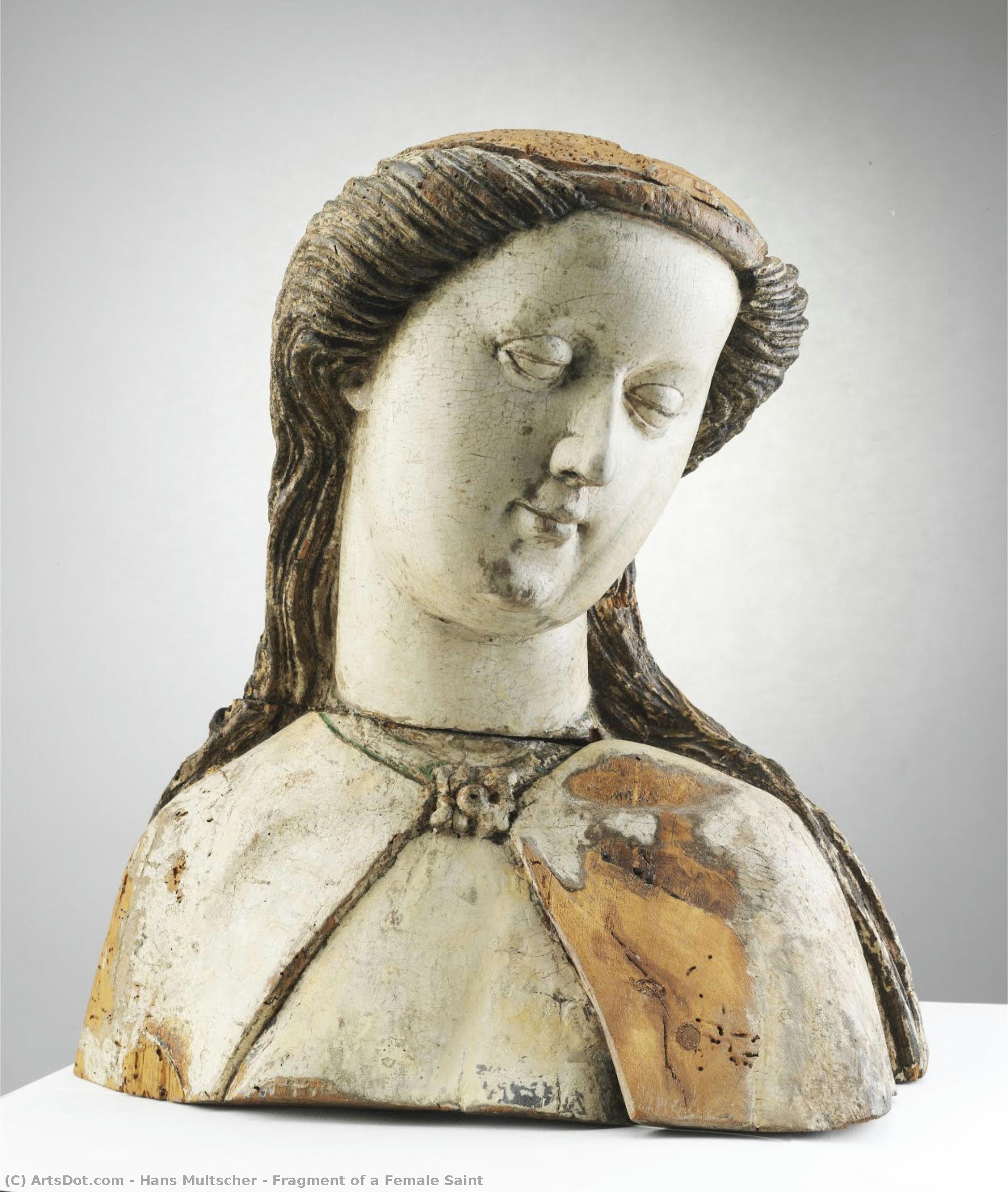
This captivating sculpture showcases a female saint’s head adorned with a crown, reflecting the artistic spirit of Hans Multscher (c.1400-1467). Created around 1440–1450 in Reichenbach im Baumes, Germany, it exemplifies German Realism and draws inspiration from Northern European painting techniques.
A Pioneer Bridging Gothic Legacy and Renaissance Dawn
Hans Multscher’s “Fragment of a Female Saint,” created around 1450, stands as a remarkable testament to the artistic ferment occurring in Germany during this pivotal transitional period. Emerging from the shadows of late Gothic formalism—characterized by stylized drapery and flattened perspectives—Multscher boldly embraced the burgeoning realism championed by Early Netherlandish painters, marking him as one of the foremost sculptors of his time.
The sculpture depicts a portion of a woman’s head adorned with a crown, capturing an expression of serene dignity. Multscher's meticulous attention to detail—evident in the delicately rendered hair and facial features—reflects the influence of Flemish artistic principles. Unlike the rigid conventions of preceding generations, Multscher sought to imbue his work with palpable emotion, striving for a level of naturalism previously unattainable.
- Style: Early Renaissance – Demonstrates a shift away from Gothic abstraction towards greater anatomical accuracy and expressive realism.
- Technique: Multscher skillfully employed alabaster—a favored material for sculptural works—to achieve a luminous surface finish that enhances the sculpture’s visual impact. The sculptor utilized carving tools with precision, capturing subtle nuances of form and texture.
The artwork's historical context is inextricably linked to the broader intellectual currents sweeping across Europe during this era. Humanist ideals—emphasizing human reason and observation—were gaining traction alongside a renewed interest in classical art and philosophy. Multscher’s embrace of realism mirrored these developments, reflecting a desire to portray humanity with greater fidelity and sensitivity.
Symbolically, the crown signifies royalty and divine grace, underscoring the saint's spiritual stature. The serene expression conveys compassion and contemplation—themes central to Christian iconography. Multscher’s masterful execution elevates the sculpture beyond mere representation; it communicates profound emotional resonance, inviting viewers to contemplate themes of faith and humility.
Currently housed in the Museum of Fine Arts, Budapest (Hungary), “Fragment of a Female Saint” exemplifies Multscher's enduring legacy as a sculptor who successfully navigated the complexities of artistic change. Its inclusion in the museum’s collection underscores its significance within Hungarian art history and serves as an inspiration for contemporary artists seeking to honor tradition while embracing innovation.
- Dimensions: 41 x 39 x 20 cm
- Material: Alabaster
Further research into Multscher’s oeuvre reveals a prolific workshop that produced numerous religious sculptures, demonstrating his commitment to disseminating Christian teachings through visual art. His influence extended beyond Budapest, shaping artistic practices throughout Central Europe.