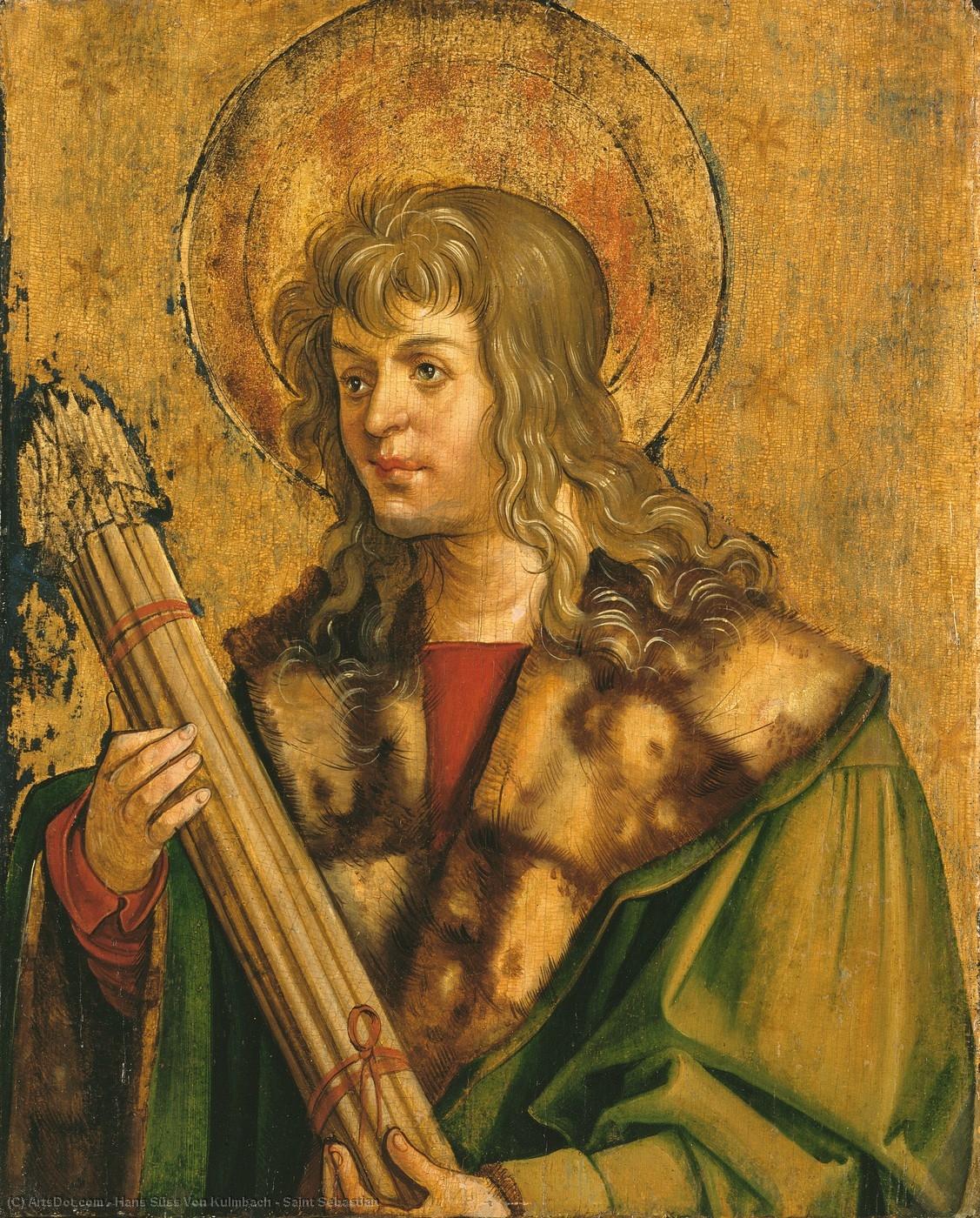
A Vision of Devotion: The Sacred Presence of Saint Sebastian
In the quiet intensity of Hans Süss von Kulmbach’s Saint Sebastian, we are invited into a moment of profound spiritual contemplation. Painted around 1510, this masterpiece captures the saint not merely as a figure of martyrdom, but as a vessel of divine grace. The composition centers on a man of striking presence, his blonde hair catching a soft, ethereal light that seems to emanate from within the scene itself. Clad in a rich green robe and draped in a luxurious fur coat, the figure possesses a tactile materiality that speaks to the burgeoning realism of the German Renaissance. As he holds the cross, his gaze and posture suggest a deep, internal dialogue with the divine, transforming a moment of potential suffering into one of serene endurance.
The artistry of Kulmbach, heavily influenced by his legendary mentor Albrecht Dürer, is evident in the meticulous attention to texture and depth. Every fold of the heavy fabric and every strand of fur is rendered with a precision that invites the viewer to reach out and touch the canvas. This technical mastery extends beyond the central figure; the landscape behind him unfolds with a delicate complexity. A sunlit hillside provides a naturalistic stage, while the subtle inclusion of distant figures adds a layer of narrative depth, suggesting a world that continues to move around this singular moment of sanctity. The interplay of light and shadow creates a sense of atmospheric perspective, pulling the eye from the intimate details of the saint's attire toward the vast, breathing horizon.
Symbolism and the Renaissance Spirit
Beyond its visual splendor, the painting serves as a profound symbolic tapestry. The cross held by Saint Sebastian is more than an attribute of his faith; it is the anchor of the composition, representing the intersection of human mortality and eternal life. The choice of green for his robe carries deep connotations of rebirth, hope, and the enduring nature of the soul, contrasting beautifully with the earthy tones of the landscape. Kulmbach utilizes the natural world to mirror the spiritual state of his subject, where the stability of the hills reflects the steadfastness of the saint's conviction.
For the discerning collector or interior designer, this work offers much more than mere decoration. It is a piece of history that brings an air of intellectual and spiritual sophistication to any space. Whether placed in a grand library, a formal study, or a curated gallery wall, the painting acts as a focal point of quiet strength. Its ability to evoke emotion—ranging from awe at its technical execution to a sense of peace through its subject matter—makes it a timeless addition to a collection. Owning a high-quality reproduction of this work allows one to preserve the legacy of the German Renaissance, bringing the luminous beauty of 16th-century devotion into the modern home.