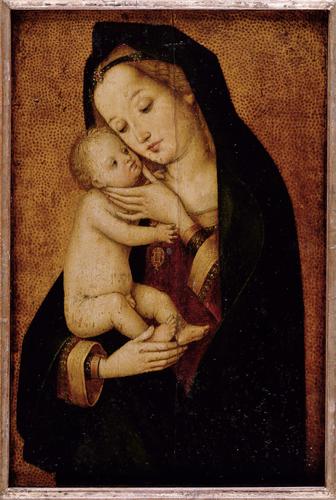
A Tender Embrace: Hans Holbein the Elder’s Maria, das Kind liebkosend
Hans Holbein the Elder's "Maria, das Kind liebkosend," painted in 1499, transcends mere depiction; it embodies the very essence of Renaissance piety and maternal devotion. Housed within the Kunsthistorisches Museum in Vienna, this oil on panel masterpiece—measuring just 24 x 16 cm—commands attention not solely for its diminutive size but for the profound depth of emotion conveyed through masterful technique and symbolic resonance. Holbein’s unwavering commitment to realism distinguishes him from many contemporaries, establishing him as a cornerstone of Northern Renaissance art and securing his place amongst the titans of European painting history.
The Artist's Vision: Contextualizing Holbein’s Genius
Born around 1497 in Augsburg, Germany—a correction to earlier attributions placing his origins in Italy—Hans Holbein the Elder emerged as a pivotal figure bridging the late Gothic tradition with the burgeoning innovations of the Northern Renaissance. His life unfolded during a period of immense religious and political upheaval, a context that subtly yet profoundly informed his artistic vision. Unlike many artists who gravitated towards the Italian peninsula for their training, Holbein honed his skills within the German artistic landscape, absorbing influences from masters like Albrecht Dürer while simultaneously developing a uniquely personal style. His early career blossomed in Basel, Switzerland, where he quickly established himself as a sought-after creator of religious imagery, intricate murals adorning public and private spaces, and beautifully detailed book illustrations. This formative experience instilled within him an unparalleled understanding of conveying spiritual narratives with breathtaking precision—a characteristic that would define his oeuvre throughout his prolific artistic life.
Technical Mastery: Oil Paint on Panel – A Revelation of Detail
The painting’s remarkable fidelity to reality stems from Holbein's pioneering use of oil paint on panel, a technique that revolutionized art production at the time. Prior to this innovation, tempera—pigments bound in egg yolk—dominated artistic practice, resulting in images characterized by flattened colors and reduced textural nuance. Oil paint, however, allowed for unparalleled luminosity and depth, permitting Holbein to achieve astonishing levels of detail—particularly evident in the rendering of Mary’s drapery and the infant Jesus's face. Careful layering of glazes created a shimmering surface that captured subtle variations in light and shadow, elevating the artwork beyond mere representation into an immersive experience for the viewer. This meticulous approach reflects Holbein’s dedication to capturing not just what was seen but also what was felt—a testament to his artistic genius.
Symbolism Woven Into Sacred Narrative
Beyond its technical brilliance lies a rich tapestry of symbolism that speaks volumes about Renaissance beliefs concerning motherhood and divine grace. The crown adorning Mary's head is a deliberate allusion to her role as Queen of Heaven, signifying her exalted status within Christian theology. Furthermore, the intimate gesture—Mary gently embracing Jesus—represents the profound bond between mother and child, embodying compassion, tenderness, and unwavering faith. The inclusion of additional figures in the background—likely representing members of Mary’s family or entourage—adds to the painting's narrative complexity, reinforcing its depiction as a cornerstone of Christian iconography. Each element contributes to an overarching message of maternal love and spiritual contemplation.
Emotional Resonance: A Window Into Renaissance Spirituality
“Maria, das Kind liebkosend” continues to captivate audiences centuries after its creation because it succeeds in conveying a palpable sense of serenity and devotion. The warm golden hue permeates the entire composition, fostering an atmosphere of tranquility and illuminating Mary’s serene countenance. Holbein's masterful portrayal captures not only the visual splendor of the scene but also the emotional core of Christian faith—a belief in divine providence and unwavering trust in God’s mercy. It stands as a poignant reminder of the enduring power of art to inspire contemplation and evoke profound feelings of compassion and reverence.
- Artist: Hans Holbein the Elder
- Born Year: 1497
- Death Year: 1543
- Birth City: Augsburg
- Birth Country: Italy