A Portrait of Contemplation: Hendrick Terbrugghen’s Heraclitus
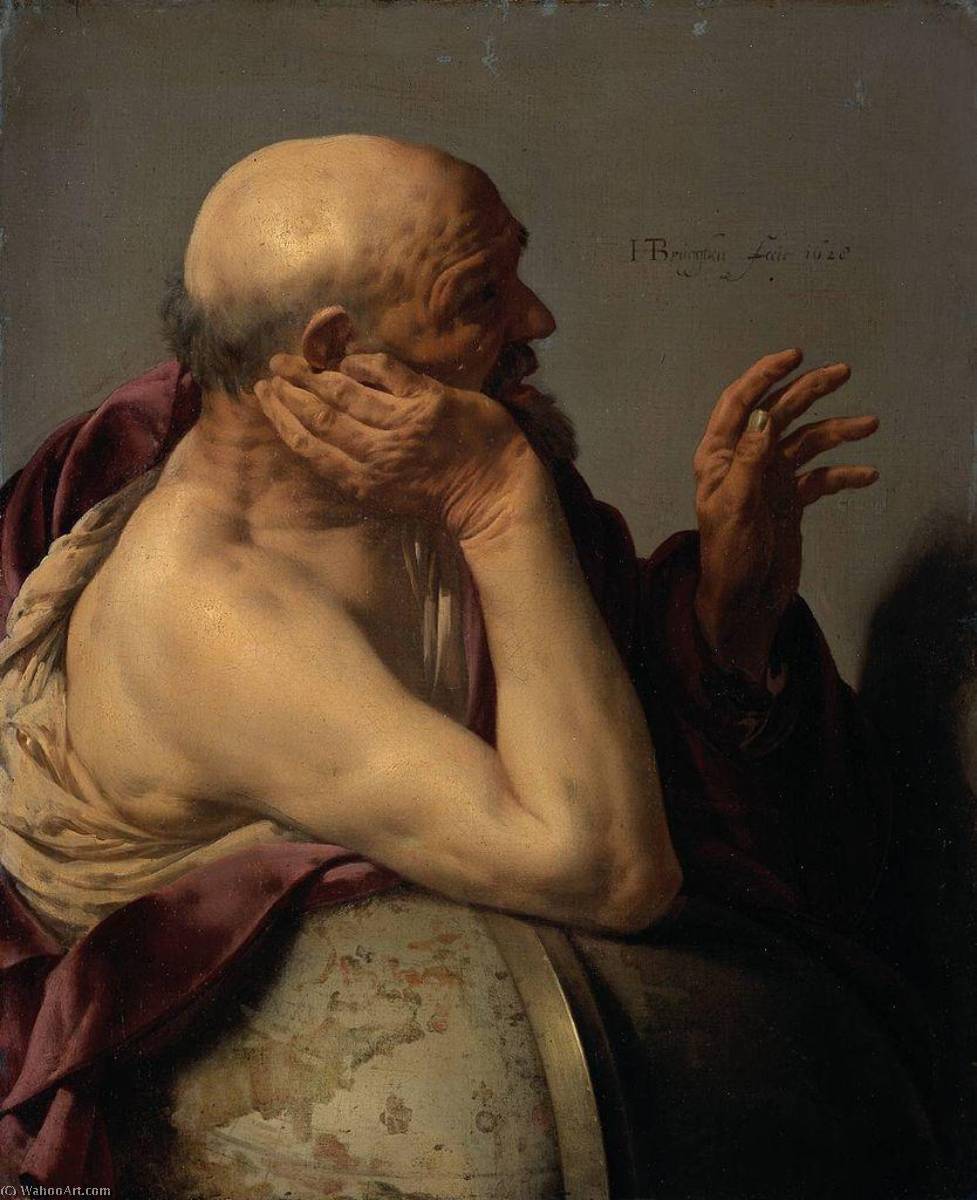
Hendrick Terbrugghen's "Heraclitus," painted in 1628, is more than a mere likeness; it’s a profound meditation on wisdom, melancholy, and the ceaseless flux of existence. This oil-on-canvas masterpiece, currently residing within the hallowed halls of the Rijksmuseum in Amsterdam, offers a glimpse into the mind of one of antiquity's most enigmatic philosophers while simultaneously embodying the artistic sensibilities of the Dutch Golden Age. The painting immediately draws the viewer in with its muted palette – earthy browns, deep reds, and subtle blues – creating an atmosphere of quiet introspection and timelessness. It’s a scene steeped in symbolism, inviting us to ponder the nature of truth, change, and the human condition.
At the heart of the composition stands Heraclitus himself, depicted as an aged figure leaning upon a terrestrial globe. His posture is one of deliberate repose, yet his gaze is intensely focused, suggesting a mind perpetually wrestling with complex ideas. The gesture of his hand resting on his chin – a pose frequently associated with philosophical inquiry – reinforces this impression. Notice the subtle downturn of his mouth and the furrowed brow; these are not signs of anger or frustration, but rather of deep contemplation, perhaps even sorrow at the perceived folly of humankind. He is, as Terbrugghen’s notes suggest, “the crying philosopher,” burdened by a profound understanding of the world's impermanence.
The Caravaggisti Influence and Dramatic Lighting
Terbrugghen was a key figure within the Utrecht Caravaggisti group, a collective of Dutch painters deeply influenced by the dramatic style of Italian painter Michelangelo Merisi da Caravaggio. This influence is readily apparent in “Heraclitus” through its masterful use of chiaroscuro – the stark contrast between light and shadow. Just as Caravaggio employed strong directional lighting to heighten emotional impact, Terbrugghen uses it to sculpt Heraclitus’s form, emphasizing his age and wisdom while simultaneously creating a sense of mystery and depth. The light source appears to originate from an unseen point above and slightly to the left, casting dramatic shadows that pool around the philosopher's figure and accentuate the folds of his robe.
The composition itself is carefully constructed to reinforce this sense of drama. The globe beneath Heraclitus’s hand serves as a visual anchor, representing the totality of existence – past, present, and future – all contained within a single point. The red robe, a rich and symbolic hue often associated with royalty and wisdom, further elevates the figure's status. The inclusion of a ring on his finger adds a subtle layer of personal significance, hinting at a life lived in pursuit of knowledge and understanding.
A Window into 17th-Century Thought
“Heraclitus” was painted during a period of intense intellectual ferment in the Netherlands. The Dutch Republic was experiencing a golden age of trade, exploration, and scientific inquiry, alongside a flourishing of artistic and philosophical thought. The painting reflects this spirit of questioning and introspection, aligning with the broader trends of the era. Terbrugghen’s depiction of Heraclitus resonates with the prevailing anxieties about change, mortality, and the search for meaning in a rapidly evolving world.
Interestingly, the painting was created just a few years before Ter Brugghen's untimely death at the age of 42. This adds another layer of poignancy to the work, suggesting that it may be a reflection on his own mortality and the fleeting nature of human existence. The melancholic expression on Heraclitus’s face could also be interpreted as a subtle self-portrait, capturing the artist's own contemplative disposition.
Collecting a Masterpiece: Reproductions and Legacy
While admiring “Heraclitus” in person at the Rijksmuseum is an unparalleled experience, high-quality reproductions offer a remarkable opportunity to bring this iconic artwork into your home or office. ArtsDot offers meticulously crafted oil painting reproductions of Terbrugghen’s masterpiece, ensuring that you can appreciate the artist's skill and vision for years to come. These reproductions faithfully capture the original’s rich colors, dramatic lighting, and nuanced details, providing a stunning tribute to this enduring work of art.
Beyond its aesthetic appeal, “Heraclitus” serves as a powerful reminder of the importance of philosophical inquiry and the ongoing quest for understanding. It is a painting that invites contemplation, prompting us to reflect on our own place in the universe and the nature of truth itself. Consider acquiring a reproduction – not just as a beautiful object, but as a window into the mind of one of history’s greatest thinkers.