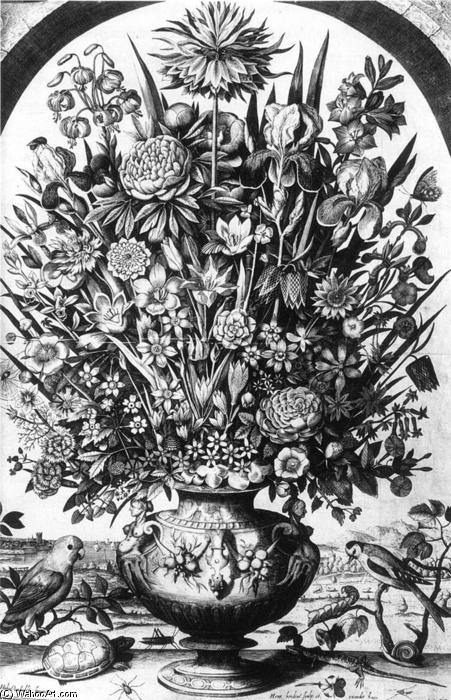
Hendrik Hondius’ ‘Flower Piece with Birds’ (1599) is a stunning Baroque engraving showcasing opulent floral still life. Explore this detailed, 620x450cm masterpiece!
Discover Hendrik Hondius I (1573-1650), a Dutch Golden Age engraver & cartographer! Explore his detailed portraits, maps, and the influential 'Pictorum...' artist series.
Explore six centuries of art & innovation at the Graphische Sammlung Albertina! Discover Dürer, Klimt & more within Vienna's historic Hofburg Palace – a visual communication masterpiece.
A Baroque Still Life of Abundance: Hendrik Hondius’ “Flower Piece with Birds”
Hendrik Hondius I's "Flower Piece with Birds," created in 1599, is more than just a meticulously rendered engraving; it’s a window into the opulent world of 17th-century Dutch art and a testament to the artist’s extraordinary technical skill. This captivating work, now housed within the Graphische Sammlung Albertina in Vienna, immediately draws the eye with its dense composition – a veritable explosion of blossoms, verdant foliage, and two diminutive birds perched amongst the floral profusion. The scene unfolds within an elaborate, arched vase, reminiscent of the grand still life paintings favored by artists like Jan van Eyck and later embraced by the Dutch Masters. Hondius masterfully captures the textures of velvet petals, delicate leaves, and the smooth curves of porcelain, demonstrating a remarkable ability to translate three-dimensional forms onto a two-dimensional plate. The level of detail is astonishing; each individual flower appears to possess its own unique character, rendered with an almost photographic precision achieved through the painstaking process of engraving.
The Techniques of Dutch Baroque Engraving
The creation of “Flower Piece with Birds” exemplifies the hallmarks of Dutch Baroque engraving. Hondius employed a copper plate, meticulously incised with a needle and burin – a tool used to shave away small portions of the metal surface. This created lines that would then be inked and pressed onto paper, transferring the image in reverse. The resulting monochrome effect is profoundly evocative, relying entirely on variations in line weight and shading to convey depth, volume, and texture. Notice how the artist uses heavier lines to define the outlines of the vase and larger flowers, while lighter, more delicate strokes are reserved for the intricate details of petals and leaves. This subtle manipulation of linework creates a dynamic interplay between light and shadow, lending the scene an incredible sense of realism and immediacy. The engraving’s flatness is characteristic of the medium; Hondius skillfully utilizes perspective to suggest space without resorting to traditional aerial or linear techniques.
Symbolism and Context within Dutch Society
Beyond its technical brilliance, “Flower Piece with Birds” offers a fascinating glimpse into the cultural values of 16th-century Holland. Still life paintings were immensely popular during this period, often serving as allegorical representations of broader themes – mortality, wealth, and the transience of beauty. The abundance of flowers in this piece speaks to the prosperity and flourishing trade that characterized the Dutch Republic at the time. Flowers were not merely decorative; they held symbolic significance, representing virtues like purity, love, and fertility. The inclusion of two small birds adds another layer of meaning, perhaps alluding to the fleeting nature of beauty or the ephemeral joy found in simple pleasures. Furthermore, the arrangement echoes the *memento mori* tradition – a reminder of mortality – subtly woven into the celebration of earthly delights.
Hendrik Hondius: A Master Engraver and Publisher
Hendrik Hondius I (1573-1650) was a pivotal figure in the development of engraving during the Dutch Golden Age. Initially trained as a goldsmith, he quickly developed his skills as an engraver under Jan Wierix, mastering the techniques required to produce intricate and detailed images. He later transitioned into publishing, securing a crucial print privilege that protected his work from unauthorized reproduction – a landmark achievement in the burgeoning printing industry. Hondius’s prolific output included portraits of prominent figures, maps, architectural designs, and numerous reproductions of works by other artists. “Flower Piece with Birds” stands as one of his most celebrated achievements, showcasing his exceptional artistic talent and his profound understanding of both engraving technique and the cultural context in which he worked. It remains a captivating example of Baroque artistry, offering viewers a rich and rewarding experience for generations to come.