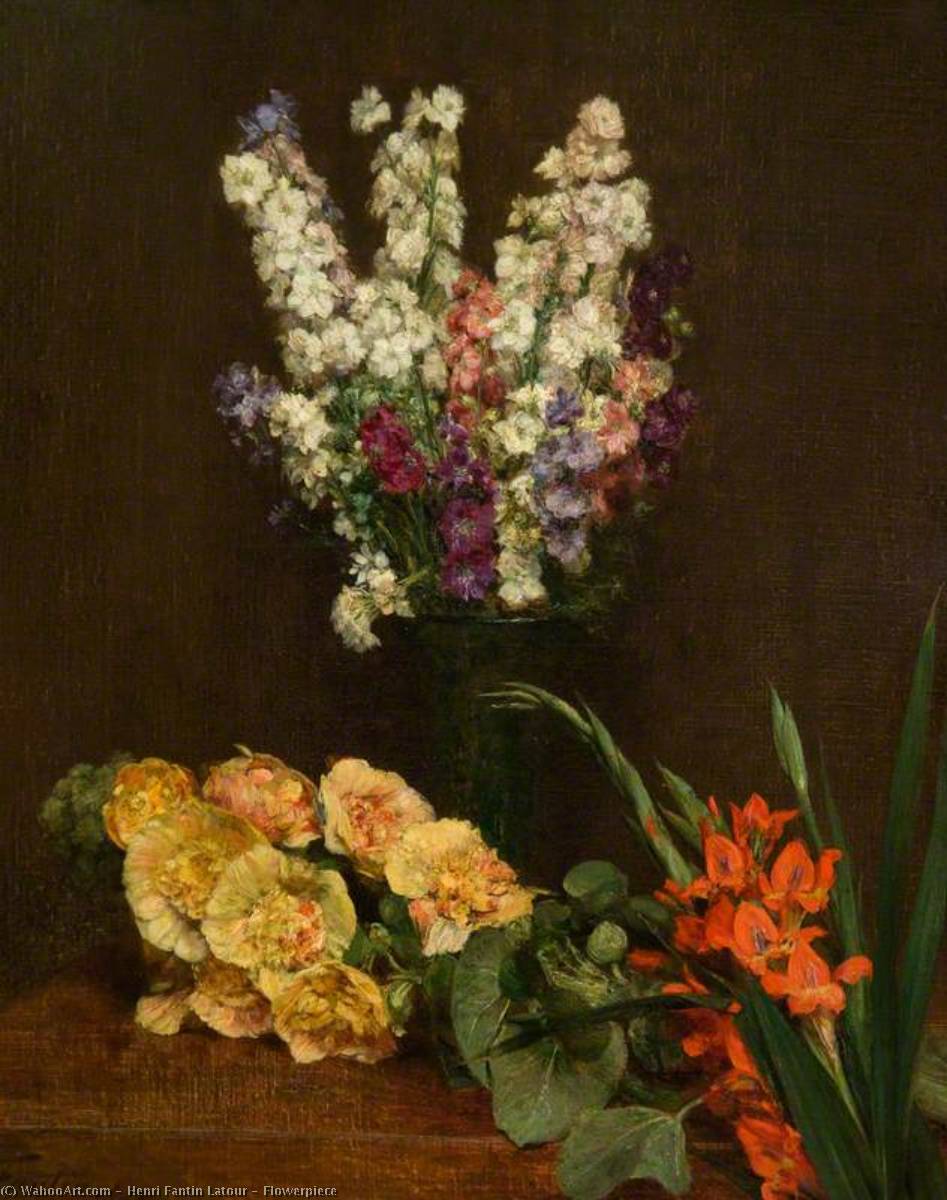
Admire Henri Fantin-Latour’s ‘Flowerpiece’ (1869), a stunning realist still life showcasing exquisite floral detail & muted tones. Explore Impressionistic nuances in this captivating 19th-century artwork.
Discover Henri Fantin-Latour (1836-1904), French painter of exquisite still lifes, flower paintings & intimate portraits of Parisian artists & writers. Explore his blend of Realism & Symbolism.
Explore Hill of Tarvit Mansion & Garden – a stunning Arts & Crafts estate near Cupar featuring exquisite interiors, historic hickory golf and captivating landscapes managed by the National Trust for Scotland.
A Delicate Dance Between Observation and Emotion: Henri Fantin-Latour’s ‘Flowerpiece’
‘Flowerpiece,’ painted in 1869 by Henri Fantin-Latour, stands as a testament to the burgeoning Impressionist movement's embrace of nuanced observation alongside profound emotional resonance. More than just a depiction of blossoms—a bouquet of lilies and roses arranged thoughtfully within a simple vase—the artwork embodies a carefully considered aesthetic that reflects Fantin-Latour’s artistic philosophy and captures the spirit of Belle Époque Paris.
The Painter’s Vision: Horace Lecoq de Boisbaudran's Influence
Fantin-Latour’s formative years were shaped by his studies under Horace Lecoq de Boisbaudran at the École des Beaux-Arts, a revolutionary figure who championed drawing from memory as paramount to artistic skill. Unlike traditional academic training focused on meticulous copying of masterworks, Boisbaudran encouraged students to cultivate their own perceptual awareness—a practice that profoundly impacted Fantin-Latour’s approach to capturing the ephemeral beauty of nature. This emphasis on inner vision is palpable in ‘Flowerpiece,’ where the artist strives not merely to reproduce what he sees but to convey its essence.
Style and Technique: Layered Glazes and Impressionistic Light
Fantin-Latour skillfully employed a technique characterized by layering thin glazes of oil paint—a hallmark of Impressionism—to build up color and texture. This meticulous process allowed him to achieve subtle tonal variations that mimic the diffused light characteristic of Parisian interiors during his time, creating an atmosphere of serene contemplation. The brushstrokes are soft and flowing, imparting a velvety quality to the petals and subtly hinting at the textures of the wooden tabletop. Careful attention is paid to capturing the interplay between light and shadow, enhancing the three-dimensional appearance of the floral arrangement.
Historical Context: Symbolism in Victorian Art
‘Flowerpiece’ emerged during a period marked by significant social and artistic transformations—the Victorian era—where decorative arts sought to express sentiments of beauty and refinement. Flowers held considerable symbolic significance within Victorian culture, representing themes of love, purity, remembrance, and gratitude. Fantin-Latour's choice of lilies and roses – traditionally associated with innocence and devotion – underscores this broader cultural context, inviting viewers to contemplate the profound emotions conveyed by the artwork.
Emotional Resonance: A Moment Frozen in Time
Ultimately, ‘Flowerpiece’ transcends its formal elements to evoke a palpable sense of tranquility and aesthetic pleasure. The muted brown background serves as an anchor for the vibrant hues of the flowers, directing the eye towards their delicate beauty. Fantin-Latour's masterful rendering captures not just the visual appearance of the blossoms but also their inherent emotional power—a testament to his ability to transform observation into artful expression and solidify his place among the luminaries of Impressionist painting.
Further Exploration
To delve deeper into Henri Fantin-Latour’s artistic legacy, explore similar works at WikiArt: https://www.wikiart.org/en/henri-fantin-latour/spring-flowers
Discover more about Fantin-Latour's life and career on Art Renewal Center: https://uat1978.artrenewal.org/artwork/index/58186