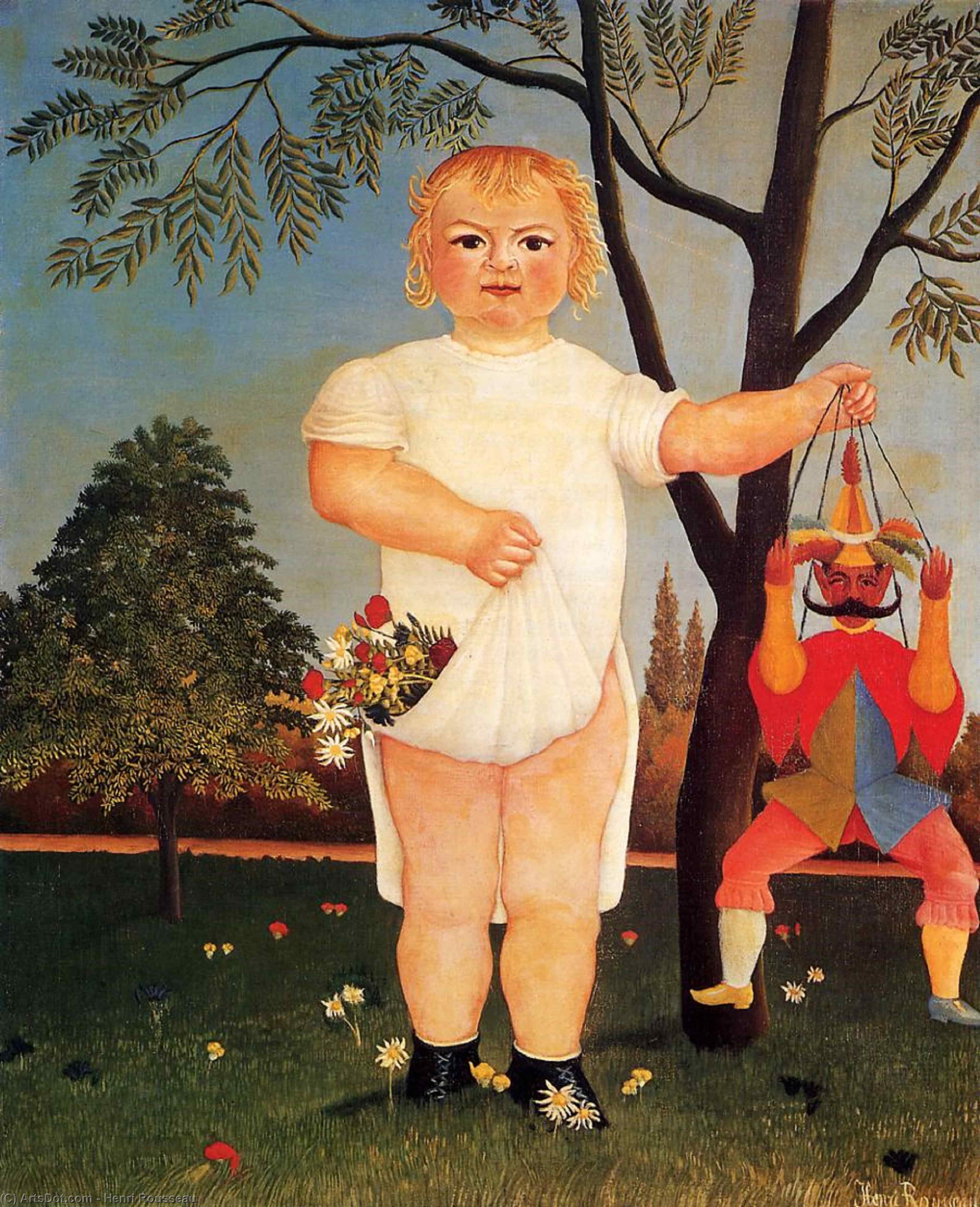
A Whimsical Encounter: The Enchanting World of Child with Puppet
In the quiet, dreamlike realm of Henri Julien Félix Rousseau, known affectionately to history as Le Douanier, reality bends into a soft, nostalgic tapestry of innocence. His 1903 masterpiece, "Child with Puppet" (also titled To Celebrate the Baby), serves as a profound window into the artist's unique ability to capture the pure, unadulterated wonder of childhood. The painting presents us with a tender moment: a young child, draped in a pristine white dress, stands nestled beside the sturdy trunk of a tree. In their small hands, they cradle a puppet, an object that bridges the gap between the tangible world and the boundless reaches of imagination. This intimate portrait is not merely a depiction of a subject, but an invitation to revisit the magic of our own earliest memories.
The composition of the work is a masterclass in Naïve art storytelling, where every element contributes to a larger sense of playfulness and domestic peace. As the viewer's eye wanders from the central figure, they discover a branch arching overhead like a protective canopy, while in the distant background, the silhouette of another soul playing with a kite dances against the sky. Rousseau masterfully populates the scene with unexpected details—a chair resting to one side, a clock marking the steady passage of time, and a delicate vase placed near the center. These objects, though rendered with his signature simplified forms, add layers of depth and domestic complexity, suggesting a world that is both structured and infinitely whimsical.
Symbolism and the Naïve Aesthetic
To understand this painting is to understand the Symbolist movement's influence on Rousseau’s self-taught hand. While his technique lacks the traditional academic pursuit of anatomical perfection or complex perspective, it compensates with a powerful emotional resonance. The puppet itself acts as a potent symbol of agency and play, representing the beginning of human storytelling and the projection of identity. The contrast between the stillness of the child and the movement of the kite in the distance creates a rhythmic balance between peace and energy. Through his use of vibrant yet often flattened colors, Rousseau strips away the distractions of the modern world, leaving behind an essence of purity that feels both timeless and otherworldly.
For the discerning collector or interior designer, "Child with Puppet" offers more than just visual beauty; it provides a focal point of emotional warmth. The painting’s ability to evoke a sense of calm and nostalgia makes it an exquisite addition to any curated space, particularly those seeking to introduce a touch of French Post-Impressionist charm. Whether placed in a sunlit nursery or as a sophisticated accent in a contemporary living room, this work invites conversation and contemplation. Owning a high-quality oil reproduction of this piece allows one to bring the legendary, dreamlike landscapes of Le Douanier into the home, preserving the enduring magic of a world where every child is a protagonist in their own unfolding legend.