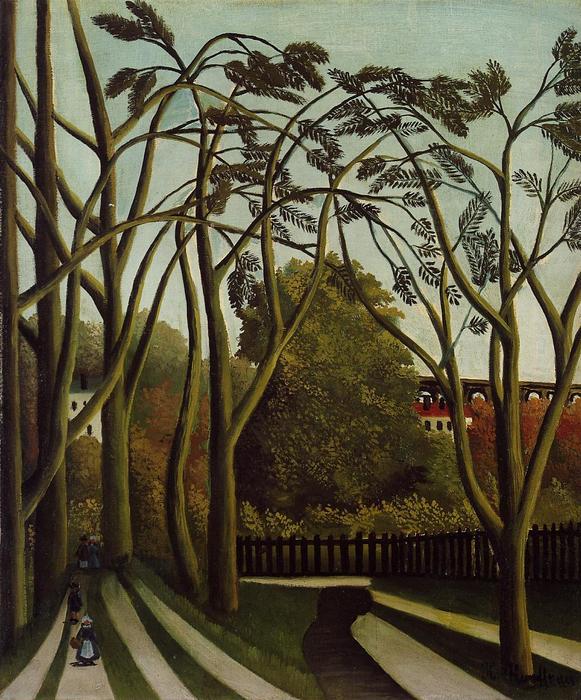
Landscape on the Banks of the Bievre at Bicetre, Spring – A Vision of Rousseau’s Symbolism
Henri Julien Félix Rousseau's "Landscape on the Banks of the Bievre at Bicetre, Spring," painted in 1908, stands as a cornerstone of Symbolist art and a testament to the artist’s singular vision. More than just a depiction of a Parisian park scene, it embodies Rousseau’s profound engagement with primal forces and his belief that nature could communicate truths beyond rational comprehension—a conviction deeply rooted in his own experiences as a toll collector and his fascination with indigenous cultures.
The Canvas Speaks: Style and Technique
Rousseau eschewed academic conventions entirely, opting for a style that deliberately rejected realism. Instead of meticulously rendering detail, he employed bold colors – predominantly earthy greens and browns punctuated by splashes of cool blues – applied with thick, visible brushstrokes. This technique wasn’t merely stylistic; it served as a conduit for emotion. The artist sought to capture not what the eye sees but what the soul feels—a characteristic that aligns perfectly with Symbolism's core principle: conveying ideas and emotions through symbolic imagery rather than literal representation. The textured surface of the canvas itself contributes to this immersive experience, inviting viewers to contemplate the painting’s atmosphere as much as its visual elements.
A Journey Through Time: Historical Context
Painted during the Belle Époque—Paris's golden age—the artwork reflects the broader artistic currents of the period. Symbolism emerged in reaction to Impressionism’s focus on fleeting sensory impressions, arguing that art should delve into psychological and spiritual realms. Rousseau’s work aligns with this movement’s exploration of mythic landscapes and primal emotions, drawing inspiration from folklore and anthropological studies—particularly his observations during expeditions to Tahiti. The painting's placement within the Metropolitan Museum of Art underscores its significance as a pivotal piece in European artistic history.
Decoding the Symbols: Meaning Beyond Appearance
The composition itself is laden with symbolic resonance. A narrow pathway winds through a dense grove of trees, creating an enclosed space that suggests both solitude and contemplation. The towering trunks and branches dominate the scene, symbolizing obstacles and challenges—a visual metaphor for life’s journey. Five figures are scattered along the path, representing humanity's presence within nature but also highlighting its vulnerability. Rousseau skillfully employs perspective to draw the viewer into this immersive landscape, fostering a feeling of movement and inviting reflection on themes of spirituality and transcendence. The muted lighting casts long shadows, enhancing the painting’s mystery and reinforcing its connection to primal darkness—a deliberate contrast against the vibrant greens of the foliage.
An Echo of Emotion: Artistic Impact
Ultimately, “Landscape on the Banks of the Bievre at Bicetre, Spring” transcends mere visual beauty; it communicates a powerful emotional response. Rousseau's masterful technique and symbolic vision capture the essence of Symbolist art—a desire to access deeper truths about human experience through evocative imagery and emotionally charged color palettes. It continues to inspire artists and collectors alike, reminding us that art can illuminate aspects of our inner lives inaccessible to logic or reason.
- ArtsDot.com offers handmade oil painting reproductions of this masterpiece.
Visit: /art/list/?Filter=8XXKFC-Henri-Julien-Felix-Rousseau-(Le-Douanier)-Landscape-on-the-Banks-of-the-Bie..
Learn more about the Metropolitan Museum of Art: /art/list/?Filter=A@D3BEXZ-El-Museo-Setagaya-Art-Museum-(Tokio-Japon)
Exploring Rousseau’s Other Masterpieces
Beyond “Landscape on the Banks of the Bievre at Bicetre, Spring,” Henri Julien Félix Rousseau produced several other notable works that exemplify his distinctive artistic style. Consider "Negro Attacked by a Jaguar," showcasing his fascination with indigenous subjects and his bold use of color to convey primal emotion—available for reproduction at ArtsDot.com:
/art/list/?Filter=8XXKFC-Henri-Julien-Felix-Rousseau-(Le-Douanier)-Negro-Attacked-by-a-Jaguar. Also, “Child with Puppet” exemplifies his ability to capture childlike innocence and wonder—another stunning reproduction obtainable at ArtsDot.com:
/art/list/?Filter=8XXKFC-Henri-Julien-Felix-Rousseau-(Le-Douanier)-Child-with-Puppet
The Metropolitan Museum of Art: A Legacy of Artistic Innovation
Discover more about Rousseau’s influence and the museum's impressive collection: /art/list/?Filter=A@D3BEXZ-El-Museo-Setagaya-Art-Museum-(Tokio-Japon)