A Moment Frozen in Time: The Enigmatic Presence of Pierre Loti
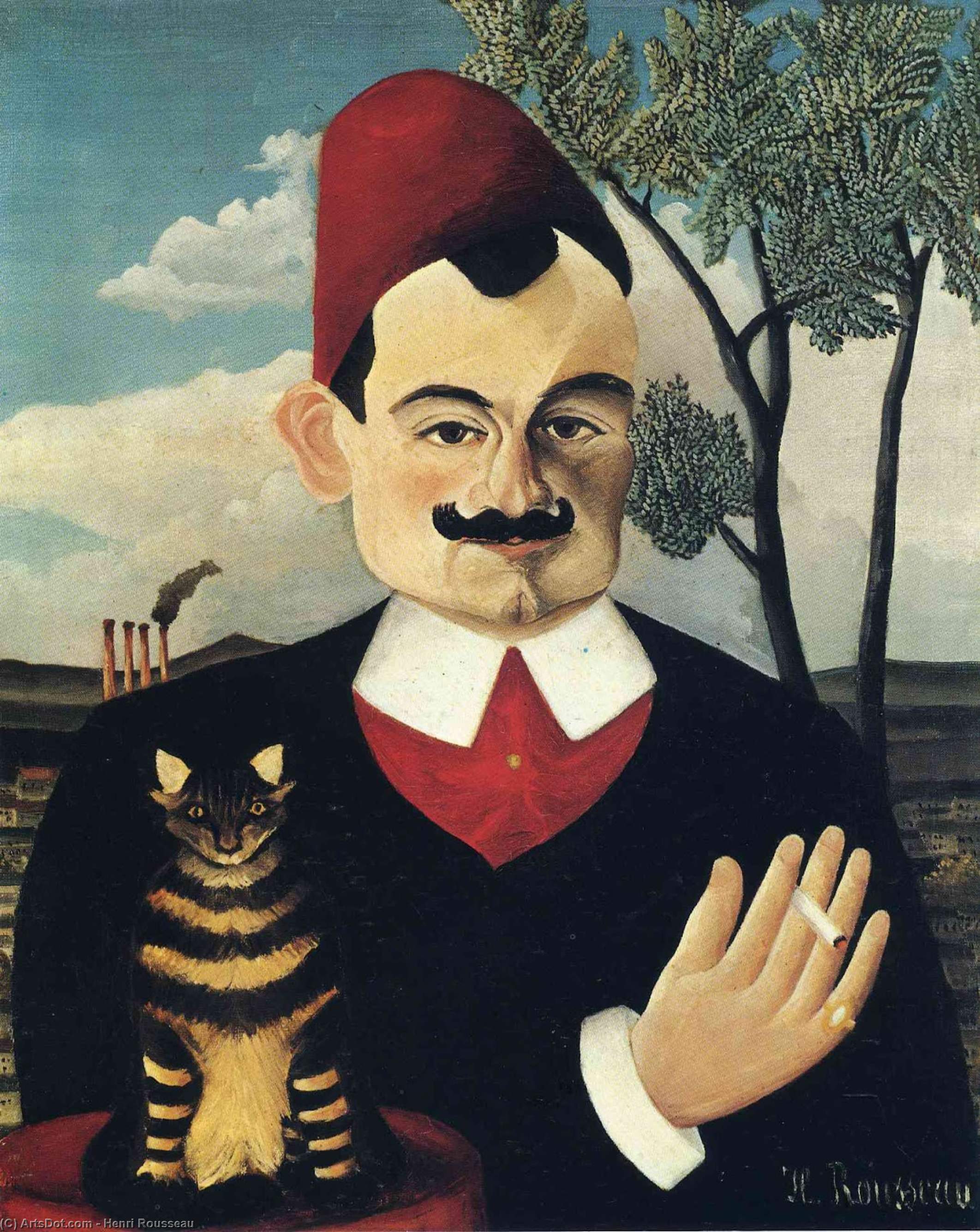
In the quiet intimacy of Portrait of Pierre Loti, we are invited into a world that feels both profoundly personal and strangely timeless. Painted in 1891 by the legendary self-taught master Henri Julien Félix Rousseau, this work captures more than just a likeness; it captures an atmosphere. The subject, the celebrated French novelist Pierre Loti, sits with a composed, contemplative air, his presence anchored by the iconic red fez that adds a splash of exoticism to the composition. Beside him, the inclusion of a cat introduces a touch of domestic whimsy, softening the formal gravity of the man’s black suit and mustache. As he holds his pipe, one can almost smell the faint, lingering scent of tobacco and feel the stillness of the room, where a clock on the wall keeps watch over a moment that refuses to fade.
The painting serves as a masterful example of Rousseau’s unique approach to portraiture, blending the boundaries between reality and a dreamlike, primitive charm. While many of his contemporaries were obsessed with the complex light play of Impressionism, Rousseau leaned into a style characterized by simplified forms and a captivating, flat perspective. In this piece, the background—a glimpse of verdant trees—suggests an outdoor connection that contrasts beautifully with the indoor setting, creating a layered sense of depth that is characteristic of his "naïve" technique. The colors are vibrant yet controlled, pulling the viewer’s eye toward the textures of the fabric and the soft fur of the feline companion, making the scene feel tactile and alive.
A Legacy of Unconventional Genius
To understand the emotional weight of this portrait, one must consider the hands that held the brush. Rousseau, famously known as Le Douanier due to his career as a customs officer, brought a perspective to art that was entirely unburdened by academic tradition. His lack of formal training allowed him to bypass the rigid rules of anatomy and shadow, instead focusing on the raw, emotional essence of his subjects. This freedom is palpable in Portrait of Pierre Loti; there is an honesty in the way the figures are rendered, a lack of pretension that makes the subject feel accessible to any viewer. For the collector or the lover of fine art, this painting represents a bridge between the structured world of late 19th-century France and the burgeoning avant-garde movements that would soon redefine modernism.
For interior designers and connoisseurs of fine decor, this artwork offers a sophisticated focal point that commands attention through character rather than sheer scale. The piece possesses a narrative depth that invites conversation, making it an ideal addition to a library, a study, or a curated gallery wall. Whether displayed as a high-quality reproduction in a contemporary setting or paired with classical furnishings, the Portrait of Pierre Loti brings a sense of historical weight and whimsical charm. It is a piece that does not merely decorate a space; it inhabits it, offering a window into a bygone era of literary elegance and artistic innocence.