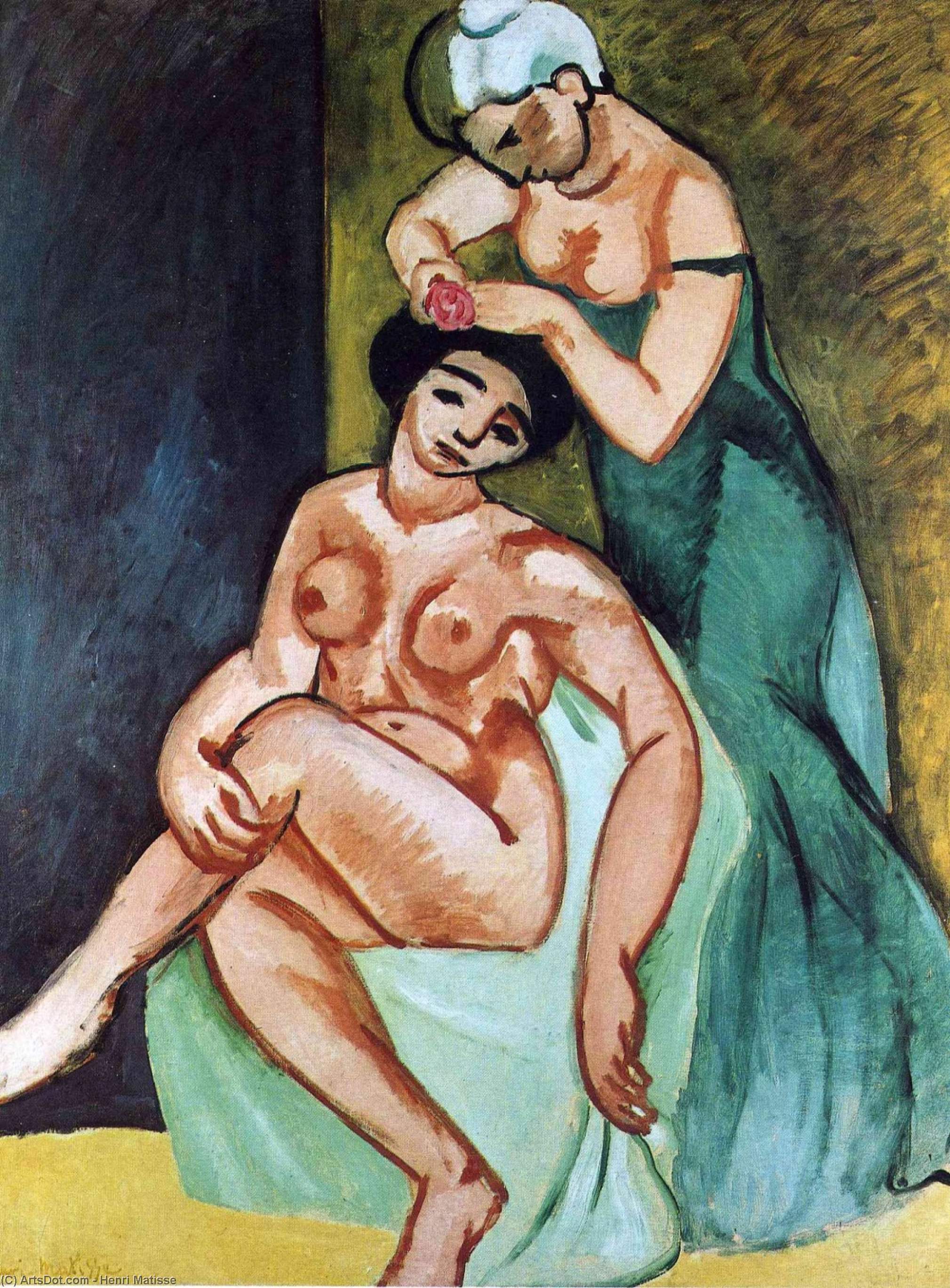
Discover Henri Matisse's 'Female Toilets' (1907) – a vibrant Fauvist masterpiece exploring intimacy and human connection. Explore the bold colors & dynamic composition of this iconic work.
Explore Henri Matisse (1869-1954): Fauvism's master of color! Discover iconic paintings, cut-paper collages & his influence on modern art. A leading French painter.
A Moment of Intimacy: Unpacking Henri Matisse’s “Female Toilets”
Henri Matisse’s "Female Toilets," painted in 1907, isn't merely a depiction of two women; it’s a vibrant distillation of the Fauvist movement and a profound exploration of human connection. Emerging from a pivotal year for Matisse as he fully embraced the bold experimentation of Fauvism – a style prioritizing emotive expression over realistic representation – this painting offers an intimate glimpse into a private, almost sacred moment. Measuring 116 x 89 cm and executed in oil on canvas, “Female Toilets” immediately captivates with its audacious color palette and dynamic brushwork, hallmarks of Matisse’s revolutionary approach to art. The scene unfolds within a modestly furnished room: a chair provides a grounding element, while a bottle and a bowl subtly suggest domesticity, yet the true focus lies in the interaction between the two women. One reclines on the floor, legs crossed in an act of relaxed repose, while the other stands over her, gently attending to her hair – a gesture laden with care and perhaps even affection. This seemingly simple tableau becomes a powerful meditation on vulnerability, trust, and the quiet beauty of everyday intimacy.
The painting’s composition is deliberately loose and unconfined, mirroring the spirit of Fauvism. Matisse eschews traditional perspective and anatomical precision in favor of expressive lines and flattened forms. The colors are not used to mimic reality but rather to convey feeling – a rich tapestry of reds, blues, greens, and yellows pulsates across the canvas, creating an atmosphere of warmth and vitality. Notice how the vibrant hues seem to spill outwards from the figures themselves, enveloping the entire scene in a wash of emotional intensity. This deliberate departure from academic realism was revolutionary at the time, challenging established artistic conventions and paving the way for future generations of artists. The brushstrokes are loose and visible, adding a sense of immediacy and spontaneity to the work – as if Matisse were capturing a fleeting moment with unrestrained passion.
Beyond its purely aesthetic qualities, “Female Toilets” is deeply rooted in the broader context of early 20th-century art. Matisse’s exploration of color and form directly influenced the development of Cubism, spearheaded by artists like Pablo Picasso. While Matisse's work retains a sense of figurative representation, he similarly fragmented forms and presented multiple viewpoints – albeit with a far more lyrical and emotionally charged approach than Picasso’s analytical Cubism. The influence of other masters, such as Chardin and Poussin, is also evident in the painting’s composition and use of light, demonstrating Matisse's ongoing engagement with artistic tradition while simultaneously forging his own unique style. The inclusion of elements like the chair and bottle subtly anchors the scene within a domestic setting, reminding us that even the most intimate moments are often rooted in the familiar rhythms of daily life.
Furthermore, it’s important to consider the historical context surrounding the painting's creation. 1907 was a period of immense social and artistic change, marked by rapid industrialization, urbanization, and a growing sense of disillusionment with traditional values. Matisse’s work reflects this atmosphere of uncertainty and transformation, offering a counterpoint to the prevailing pessimism through its celebration of beauty, color, and human connection. The painting's focus on female intimacy can also be interpreted as a subtle challenge to societal norms and expectations, suggesting that moments of vulnerability and tenderness are just as valuable as those of power and authority. “Female Toilets” is not simply a portrait; it’s an invitation to contemplate the complexities of human relationships and the enduring power of art to capture the essence of our shared experience.
The Artist: Henri Matisse – A Revolutionary Vision
Henri Émile Benoît Matisse (1869-1954), born in Le Cateau-Cambrésis, France, was a pivotal figure in the development of modern art. Initially studying law, he abandoned his legal aspirations after an appendicitis attack in 1889, discovering his true calling in painting. His early works were characterized by a classical style influenced by masters like Chardin and Poussin, but it was his embrace of Fauvism that cemented his place in art history. Matisse’s relentless pursuit of color and expressive brushwork transformed the landscape of 20th-century art, inspiring countless artists to break free from traditional constraints and explore new ways of representing the world. His later years saw him experimenting with paper collage, further demonstrating his innovative spirit and commitment to pushing artistic boundaries.
Bringing “Female Toilets” Home: ArtsDot’s Hand-Painted Reproductions
At ArtsDot, we are passionate about preserving and celebrating the masterpieces of art history. Our hand-painted reproductions of "Female Toilets" capture the vibrant colors, dynamic brushwork, and emotional intensity of Matisse's original painting with unparalleled fidelity. Unlike digital prints, our reproductions are created by skilled artists who meticulously recreate each detail, ensuring that you receive a truly authentic work of art for your home or office. We offer various sizes to suit your space and budget, all printed on archival-quality canvas using museum-grade pigments. Each reproduction is accompanied by a certificate of authenticity guaranteeing its provenance and quality.
Explore More Masterpieces – Discover the ArtDot Collection
To deepen your appreciation for Matisse’s artistic vision, we invite you to explore our extensive collection of art reproductions on ArtsDot.com. You can also delve into the works of other influential artists like Pablo Picasso and discover a wealth of information about modern art movements such as Fauvism and Cubism. For further insights, consider visiting the Musée National d'Art Moderne in Paris, where you can experience Matisse’s paintings firsthand alongside those of other masters.